8 Essential Customer Success Metrics and KPIs to Track in 2025
You can track data in any business: sales, marketing, customer success, or anything else. Most companies rely heavily on simply and openly visualizing their key performance indicators. This may be accomplished by employing a dashboard which can be critical to a company's performance, as long as they know which KPIs to monitor!
According to Gartner, 80% of businesses prioritize customer experience over price and product, while PwC reveals that 86% of buyers are willing to spend more for a better experience. To thrive in this competitive landscape, tracking the right KPIs is crucial. You can turn satisfied users into loyal advocates by monitoring metrics like churn rate, customer lifetime value, and NPS.
Dive into these seven must-track KPIs that enhance retention and fuel growth and profitability. Let's uncover how these key metrics can redefine success for your SaaS business!
What Are Customer Success KPIs?
Customer success KPIs are quantifiable measures of a customer's progress in adopting, utilizing, and promoting a product to other potential users. Customer metrics reflect the customer success team's performance and the effectiveness of your customer interaction and support channels.
They can give valuable insights into crucial areas such as the customer journey, support quality, satisfaction, etc. They are organized into two primary groups, both equally important:
- KPIs for measuring customer success, support, and engagement
- KPIs for measuring business health and revenue
Why Are Customer Success KPIs Critical for SaaS Businesses?
Focusing on Customer Success KPIs is no longer an option; it is necessary for long-term growth and sustainability. These indicators provide critical insights into how well a company meets consumers' demands and retains essential clients. According to a TSIA report, 30% of companies adjust their health scores based on changing business conditions.
1. The Cost of Churn
When your success is measured by monthly recurring revenue (MRR), every failed client is a lost customer, which equals lost income.
Example: A SaaS company with $100,000 MRR loses 10% of its clients due to churn. That's $10,000 lost in recurring revenue each month.
2. The expense of winning new business
Every time you lose a customer, you must spend more money to attract new ones. Lost consumers indicate the loss of all you paid to get them in the first place.
Example: If it costs $1,000 in marketing and sales efforts to acquire a new customer, losing one customer means spending $1,000 to replace them.
3. The Value of Champions
Happy early adopters frequently become loud advocates for the platforms they adore. External product champions are equivalent to having salespeople on your team but not on your payroll.
Example: A customer who consistently praises your SaaS product online can attract more leads, essentially becoming a free promoter. These "champions" can significantly reduce marketing costs.
4. The importance of reputation
People check your reviews. If your reviews are bad, your sales will suffer as well. Successful clients might be encouraged to submit wonderful evaluations, resulting in more business. The same goes for word of mouth. Having positive ratings and word-of-mouth reputation is similar to hiring a marketing staff, but without the expense.
Example: A SaaS company with a high rating on G2 receives 50% more inbound leads than a competitor with mediocre reviews.
5. The potential to sell more
Most established SaaS firms do not intend to sell their whole product to every customer immediately. You sell a piece appropriate for the buyer and sell them more as they develop and learn. And the more successful they are on your platform, the more likely they will grow.
Example: Offering a basic plan at first, then upselling additional features and advanced services as the customer gains more value from your product, increases overall revenue.
8 Essential Customer Success KPIs
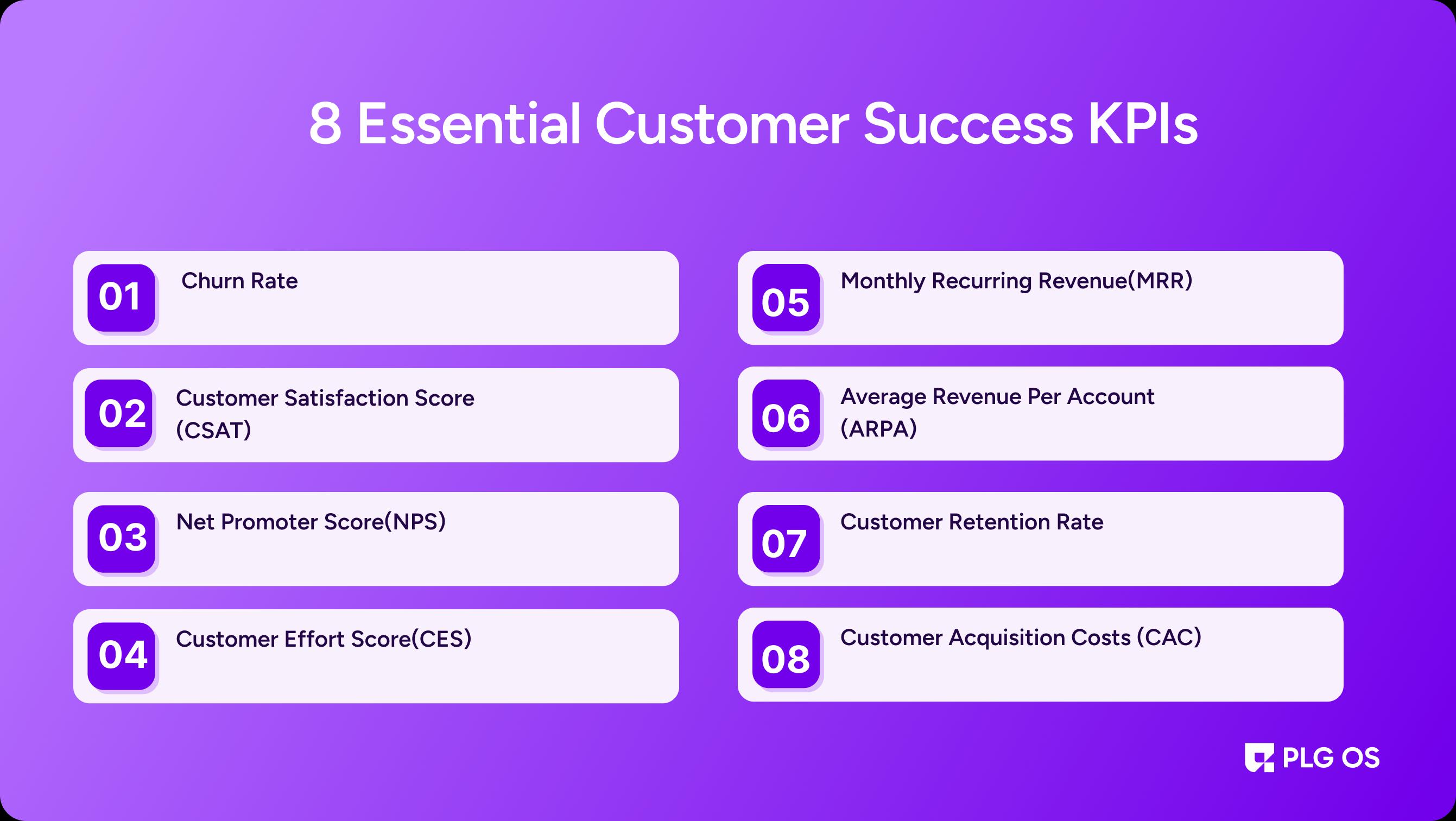
1. Churn Rate
What It Is: The churn rate indicates how often consumers quit their subscriptions during a specific period. It is one of the most important metrics for SaaS organisations since it directly affects customer success and revenue.
Why This Matters: A high customer churn rate indicates that users do not perceive enough value in your product to justify the expense. It is an indicator of client unhappiness or unfulfilled wants. Reducing client turnover can boost monthly recurring revenue and customer retention rates.
How To Measure It: The churn rate is computed by dividing the number of customers lost over a given period by the total number of customers at the start, multiplying by 100.
Actionable Insights: Create and distribute in-app notifications like banners or modals to inform the user in the appropriate situation. Customer success teams may boost adoption rates with training and targeted communication.
2. Customer Satisfaction Score (CSAT)
What It is: The Customer Satisfaction Score, or CSAT, measures how satisfied customers are with their experience using your product or interacting with your customer service.
Why This Matters: High CSAT scores directly relate to customer loyalty and retention, suggesting that users are satisfied with the services offered. A low CSAT score indicates that people are unhappy with your product, putting them at risk of churn.
How To Measure It: The CSAT score is calculated by asking consumers to rate their satisfaction on a scale (e.g., 1-5 or 1-10). You take the good responses, which you define from the start (for example, 4-5 out of 5), divide them by the entire number of responses, multiply by 100, and you have your CSAT.
Actionable insights: Analyse trends of poor CSAT scores to identify common friction areas. Improving these areas increases customer happiness, reduces customer churn, and improves client retention.
3. Net Promoter Score(NPS)
What It is: The Net Promoter Score (NPS) measures how likely users are to suggest your product to others. It is a crucial indicator for determining customer success.
Why This Matters: The Net Promoter Score is extremely useful for understanding customer loyalty and engagement. A high net promoter score indicates that your customers find actual value in your product and are willing to urge others to use it. Low NPS indicates that they not only do not think your product is good enough to suggest to others, but they also have low customer loyalty and may be leaving soon.
How to Measure It: First, identify a 'promoter' versus a 'detractor.' Here is a simple scale commonly used for NPS calculation:
- Promoters (9-10): Loyal clients who are very inclined to recommend your goods.
- Passives (7-8): Satisfied but unenthusiastic consumers who are reluctant to suggest.
- Detractors (0-6): Dissatisfied consumers who may dissuade others from using your product.
Take the number of promoters, divide by the total number of responses, and multiply by 100. Do the same with detractors. Subtract the percentage of detractors from the percentage of promoters. Then you get your net promoter score.
Actionable Insights: Follow up with detractors to determine why they are unhappy. Use the information to improve customer support, address product faults, and offer a better user experience, lowering customer turnover rates.
5. Monthly Recurring Revenue(MRR)
What It is: Monthly recurring revenue is the predictable monthly money generated by subscriptions, and it provides a clear picture of a SaaS company's financial performance.
Why This Matters: MRR growth indicates improved adoption and customer success, demonstrating your product's capacity to retain consumers and generate recurring revenue. If your MRR is suffering, it is indicative of significant churn.
How To Measure It: This is simple. It is your total recurring revenue for a particular month, minus one-time payments received.
Actionable insights: Increase MRR via lowering churn and upselling. Retaining clients with strong onboarding processes, robust customer support, and specialised services maintains MRR consistency or increase.
6. Average Revenue Per Account (ARPA)
What it is: ARPA, also known as ARPU (Average Revenue Per User), is a metric that calculates the average revenue generated per account over a given time period, typically monthly or annually. This success statistic is similar to your expansion revenue rate, but it takes a broader perspective.
Why this matters: ARPA assists SaaS organisations in understanding each account's value, identifying which client categories are the most profitable. It also provides information on revenue trends and forecasts future growth. Higher ARPA may imply successful upsells or premium service acceptance.
How to Measure It: Take the monthly recurring revenue value from above and divide it by the number of accounts. That's your monthly ARPA.
Actionable insights: By tracking ARPA trends, product and customer success teams may determine which features or services customers value the most. If your ARPA is low, consider measures to enhance it, such as adding premium features or bundled pricing, or enhancing your product to increase user value and customer happiness.
7. Customer Retention Rate
What it is: The percentage of customers that continue to use your product over a specific period.
Why This Matters: Your customer retention rate has a direct impact on growth because maintaining existing customers costs less than gaining new ones. A high retention rate suggests that your product is satisfying client expectations.
How To Measure It: Subtract the number of new customers acquired over a certain period from the total number of customers at the conclusion of that period. Divide the result by the number of consumers at the start, then multiply by 100.
Actionable insights: Success teams can use feedback from customer retention analytics to identify and reinforce key engagement elements. Higher retention rates indicate a good product-market fit.
8. Customer Acquisition Costs (CAC)
What It is: CAC represents the average cost of gaining a new customer, which includes marketing, sales, and onboarding charges.
Why This Matters: Balancing CAC with CLTV (client lifetime value) is critical to profitability. High CAC combined with low retention might have an impact on revenue stability for SaaS organisations.
How To Measure It: Divide the total acquisition costs (including sales and marketing expenses) by the number of new clients obtained.
Actionable insights: Reducing CAC through targeted marketing and successful onboarding can boost profits. Aligning CAC with retention metrics promotes long-term growth.
Best Practices for Maximizing Customer Success KPIs
Customer Success KPIs allow businesses to see how well they are performing in terms of client connections while also helping them grow their business. The topic of "Customer Success KPIs" is currently quite popular.
Maximizing Customer Success KPIs in SaaS drives growth, reduces churn, and enhances customer satisfaction. Here are some key best practices to follow:
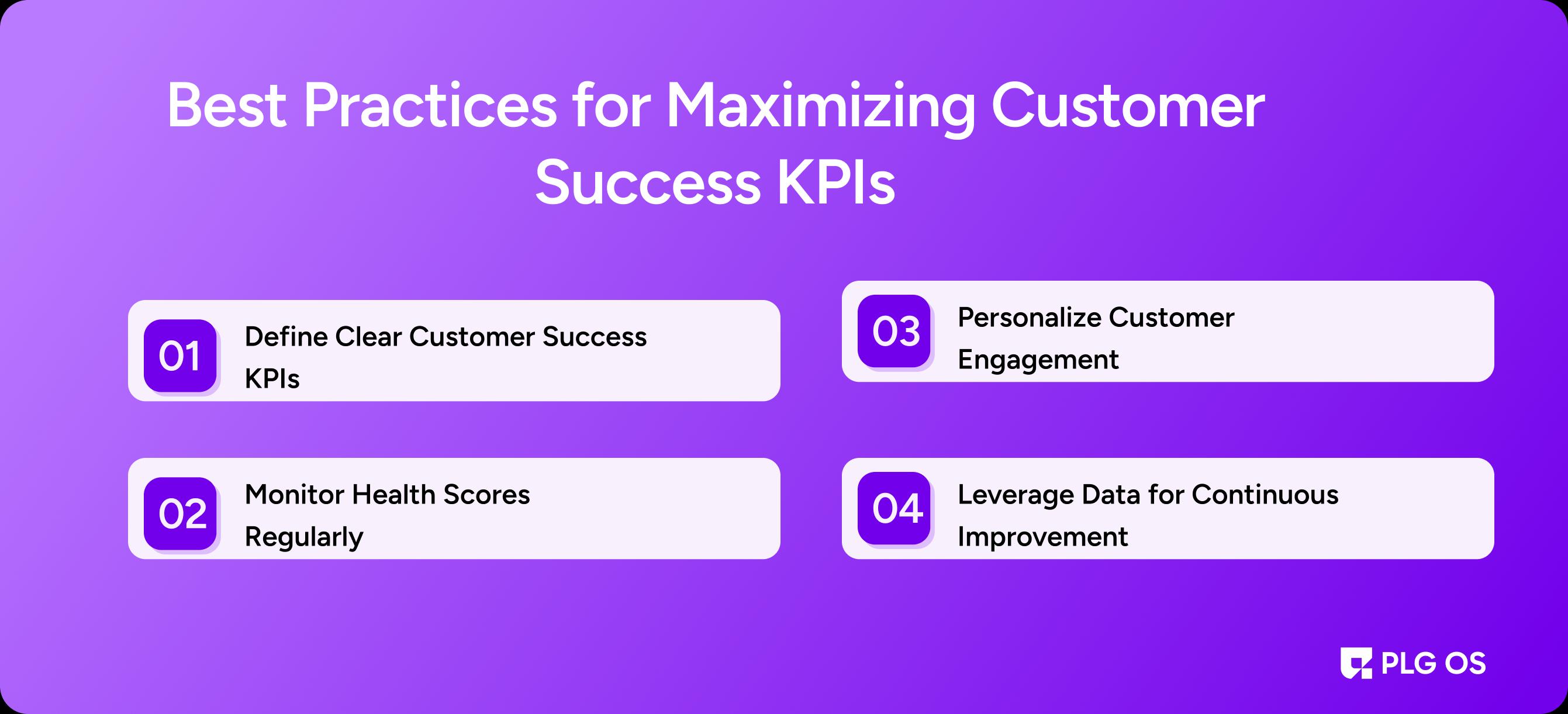
1. Define Clear Customer Success KPIs
Setting precise customer success KPIs to track in SaaS products is essential. Metrics like Customer Satisfaction Score (CSAT), Net Promoter Score (NPS), and Customer Lifetime Value (CLV) should align with business goals. According to a report from Gartner, 84% of companies that successfully track customer success KPIs outperform their competitors in customer retention.
Example: A SaaS company that measures Customer Lifetime Value (CLV) might focus on improving its support and customer engagement practices to increase the average value a customer brings throughout their relationship. For instance, a company like HubSpot tracks both CLV and NPS to align its marketing efforts with customer satisfaction, directly enhancing its customer retention and driving long-term revenue growth.
2. Monitor Health Scores Regularly
Use customer success metrics like product usage frequency, support ticket volume, and onboarding completion rates. These metrics help evaluate customer health and identify potential issues early. A study by Totango shows that companies with automated health score tracking experience a 25% lower churn rate.
Example: Consider a company like Zendesk, which uses a health score based on customer engagement and ticket resolution time. If the health score drops, the company immediately alerts customer success teams to take action—reaching out to the customer with personalized support, offering additional resources, or even upselling a feature to improve their experience.
3. Personalize Customer Engagement
Tailor engagement strategies based on customer behavior. For instance, proactively reaching out to high-risk customers can prevent churn. Data from HubSpot shows that personalized email campaigns increase customer retention by 15%.
Example: A company like Salesforce uses a personalized engagement model based on the customer's usage patterns. If a user hasn't logged into their account in a week, they may receive a personalized email offering a tutorial on a new feature. This helps customers become re-engaged and reduces churn by making them feel valued.
4. Leverage Data for Continuous Improvement
Regularly analyze customer success metrics and KPIs to identify trends and areas for improvement. This helps refine strategies and provides actionable insights to enhance customer experience.
Example: A company like Intercom regularly reviews data from its customer success platform to identify customers who are getting the most value from the product. They analyze engagement data such as message response rates and active session times. Based on this data, Intercom can proactively improve customer education, adjust onboarding programs, and develop targeted product updates.
Conclusion
Maximising Customer Success KPIs in SaaS is more than just recording numbers; it's about using them to create meaningful, personalised experiences that reduce churn and increase loyalty. To achieve long-term success, prioritise the proper indicators, monitor consumer health, and adjust your plans accordingly.
Start driving customer success with PLG OS Saas KPIs tracking—your growth journey starts here.
Frequently Asked Questions
What is Customer Success KPI?:
A Customer Success KPI (Key Performance Indicator) is a measurable value that demonstrates how effectively a SaaS business is managing customer relationships, ensuring customer satisfaction, retention, and growth. Examples include metrics like Customer Lifetime Value (CLV), Net Promoter Score (NPS), and churn rate.
What are the 5 Key Performance Indicators for Customer Service?:
Customer Satisfaction Score (CSAT) – Measures customer happiness after an interaction. First Response Time – Time taken to respond to customer inquiries. First Contact Resolution (FCR) – Percentage of issues resolved in the first interaction. Net Promoter Score (NPS) – Measures customer loyalty and likelihood of recommending the company. Churn Rate – Percentage of customers who stop using the service during a given period.
What KPIs Do You Consider Essential for Measuring Customer Success?:
Essential KPIs include Customer Satisfaction (CSAT), Customer Lifetime Value (CLV), Churn Rate, Net Promoter Score (NPS), and Customer Health Score.
What are KPI Success Indicators?:
KPI success indicators are metrics that define whether a business or team is meeting its goals. For customer success, these indicators show the effectiveness of strategies in improving customer retention, satisfaction, and overall business growth.
What Are the 5 SMART Criteria to Be Met by KPIs?:
Specific – Clearly defined with a particular focus. Measurable – Quantifiable so progress can be tracked. Achievable – Realistic and attainable. Relevant – Aligns with the business's goals and objectives. Time-bound – Has a defined time frame for achievement.