8 Essential SaaS Activation Metrics and Proven Strategies to Boost Growth

One of the most typical challenges for SaaS organizations is converting trial users to paying customers.
More trial users converted to paying customers equals more money in the bank. Here is where the activation of the user is crucial. In addition to being a crucial part of the user experience, it is also one of the most essential KPIs for SaaS that can impact the performance of your company in the long run.
Despite the impact this measure might have on their SaaS business, many organizations fail to take it into consideration. Activation monitoring was actually only being used by 25% of organizations at the beginning of 2019.
Having someone click a confirmation button on your email is just one small part of activation. Making sure your product delivers on its value to people is what matters most.
In the fast-paced world of SaaS, activation isn’t just a milestone, it’s the moment your users decide if they’ll stick around or walk away. Studies show that improving activation rates by just 20% can lead to a 60% increase in revenue over time.
What is User Activation?
When a consumer gets a good feel for your product and can articulate how it will benefit them, you've achieved user activation. Steps like making an invoice in an invoicing tool or establishing an automated email sequence in a marketing automation platform are examples of important actions that are directly related to your value proposition. Growing your user retention rate by just 5% can increase your profits by 25% – 95% (Bain & Company)
Even while activation occurs at several points in the customer lifecycle, there is typically a single major event that indicates a user "gets" your product. People who engage with your content and reach a critical milestone are more inclined to upgrade from free to premium.
Nevertheless, it should be mentioned that the user activation process and milestones change for each SaaS company according to their commercial objectives.
Why is User Activation Important for SaaS Companies?
The SaaS market places a premium on activation for a number of reasons. The probability of upselling existing users ranges between 60% – 70%, compared to 5% – 20% for new prospects (Forbes). Among the most important ones, these are included:
Building your customer base:
Converting trial users into paying customers is the first step in expanding your customer base, and activation is the doorway to that. A small consumer base is what you can expect if you fail to execute it successfully.
Reaching Financial Success
Activation is crucial to the SaaS market for a number of reasons, one of which is inherent to the way the business operates. You will receive a monthly payment for each user who has been activated in this business. Therefore, a low churn rate and a high user activation rate are essential for becoming profitable.
Facilitating an Enjoyable Experience for the User
You should never make a poor first impression on users while designing for their experience. A late "Aha!" moment, inadequate onboarding, or a difficult buying process can all lead to a bad activation phase, which in turn impacts the customer lifecycle and reduces customer success rates over time.
Early Problem Detection
Always be wary of signs of low activation rates. It may indicate that the consumer has encountered some kind of difficulty and is now less likely to continue utilizing your product. A bad onboarding procedure or user experience design error is usually to blame for these obstacles. You should reassess your product and fix these issues before they escalate if you observe low activation rates, which is good news.
8 Essential SaaS Activation Metrics
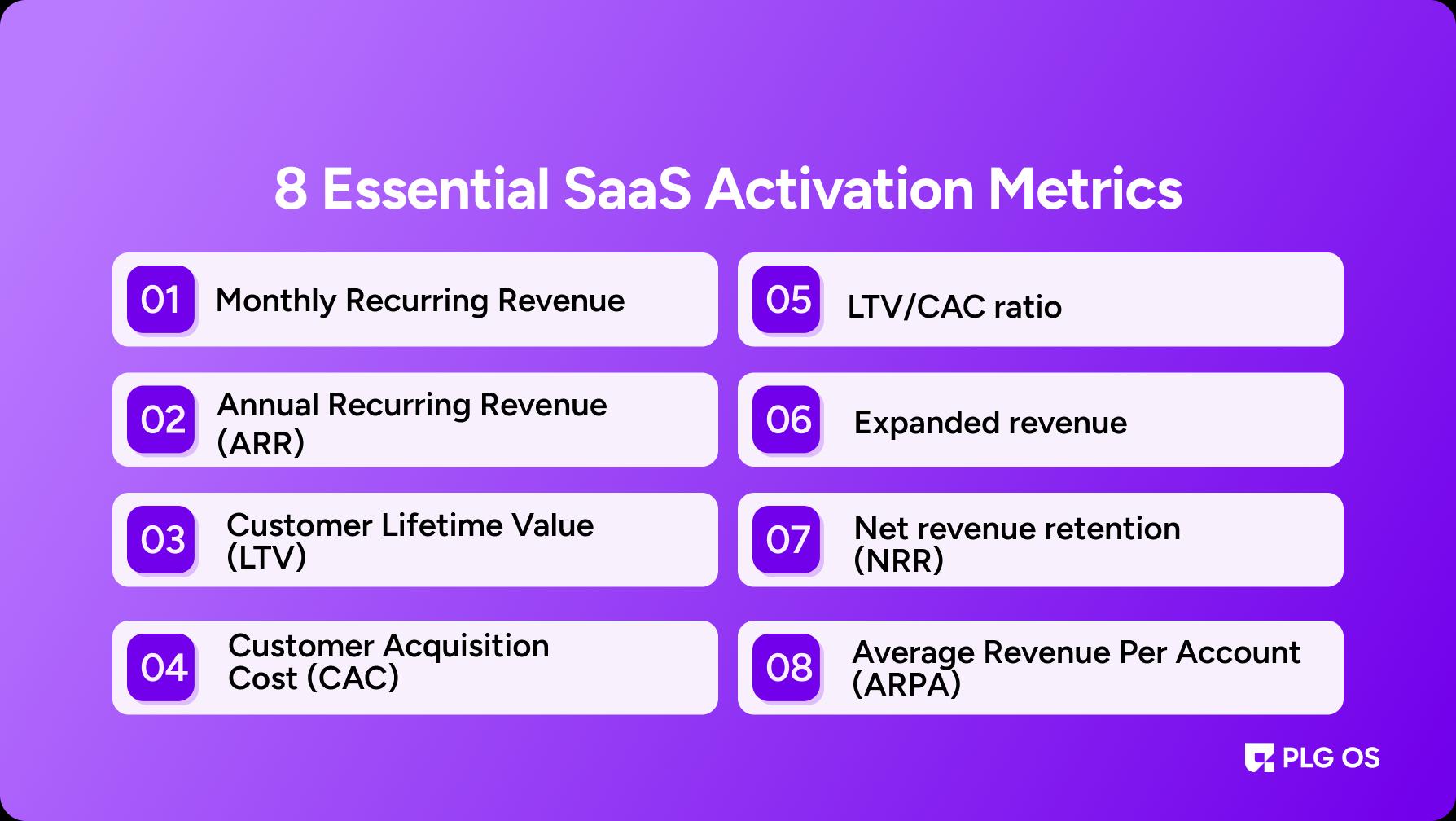
Metric 1: Monthly Recurring Revenue
The monthly revenue you anticipate is calculated using your current number of paying clients and long-term subscribers. It is one of the most essential SaaS KPIs since it provides you and your investors with information about your company's profitability and scalability.
Metric 2: Annual Recurring Revenue (ARR)
ARR, like monthly recurring revenue, is the expected revenue you'll earn from all of your year memberships. Recurring revenue is extremely beneficial since it simplifies small business financial planning.
Metric 3: Customer Lifetime Value (LTV)
Let us break down this term a little. The first element, known as the LT, represents a customer's lifetime. It is not about their real longevity, but rather how long they remain your paying customer. You track it from the day they join up for your services until they opt out. The end result is an average lifetime for all of your clients. This is a useful prediction since it provides an estimate of the revenue generated by the average client over their association with your SaaS firm.
ARPU, or average revenue per user, is the average amount you earn from each of your paying clients. You may determine it by dividing your monthly revenue by the number of subscribers.
Metric 4: Customer Acquisition Cost (CAC)
This statistic is as straightforward as it sounds: the cost of acquiring a new customer. The total comprises the amount spent on marketing efforts, lead generation, software costs, sales outreach, wages, and so on.
Metric 5: LTV/CAC Ratio
This ratio is sometimes known as the "magic number". You calculate it by dividing the client lifetime value by the customer acquisition costs. This statistic indicates how many times the entire revenue from a single client pays the expense of recruiting them.
The goal is to achieve at least a 3:1 ratio, which means that the average revenue per client is three times more than the cost of acquisition. If it's less than 3:1, you should focus on lowering the cost and time it takes to attract clients.
Metric 6: Expanded Revenue
Expansion revenue is the additional money you receive from current clients through upselling, cross-selling, increasing consumption, or renewals with price increases. You can calculate this on a monthly or annual basis.
When you have enough upgrades and cross-sells, your churn rate can even fall below zero, implying that your expanded revenue exceeds your churned revenue. A high expansion revenue demonstrates that you are providing value to your clients while boosting their faith in your firm and reliance on your items.
Metric 7: Net Revenue Retention (NRR)
Net revenue retention, commonly known as the net retention rate, is the percentage of revenue a company keeps from existing clients over a given time period. You're aiming for a score higher than 100%.
Metric 8: Average Revenue Per Account (ARPA)
ARPA measures how much money a single account generates. It should be noted that a single client may have multiple accounts, thus it is not the same as the ARPU (average revenue per user), which we discussed in the LTV section.
Tracking ARPA over time and segmenting the acquired data can help you identify valuable trends in consumer behavior and develop more accurate growth estimates.
Remember that the timescale for this equation should match your subscription model. You may need to switch the recurring revenue to an annual or quarterly basis.
Best practices to improve activation metrics
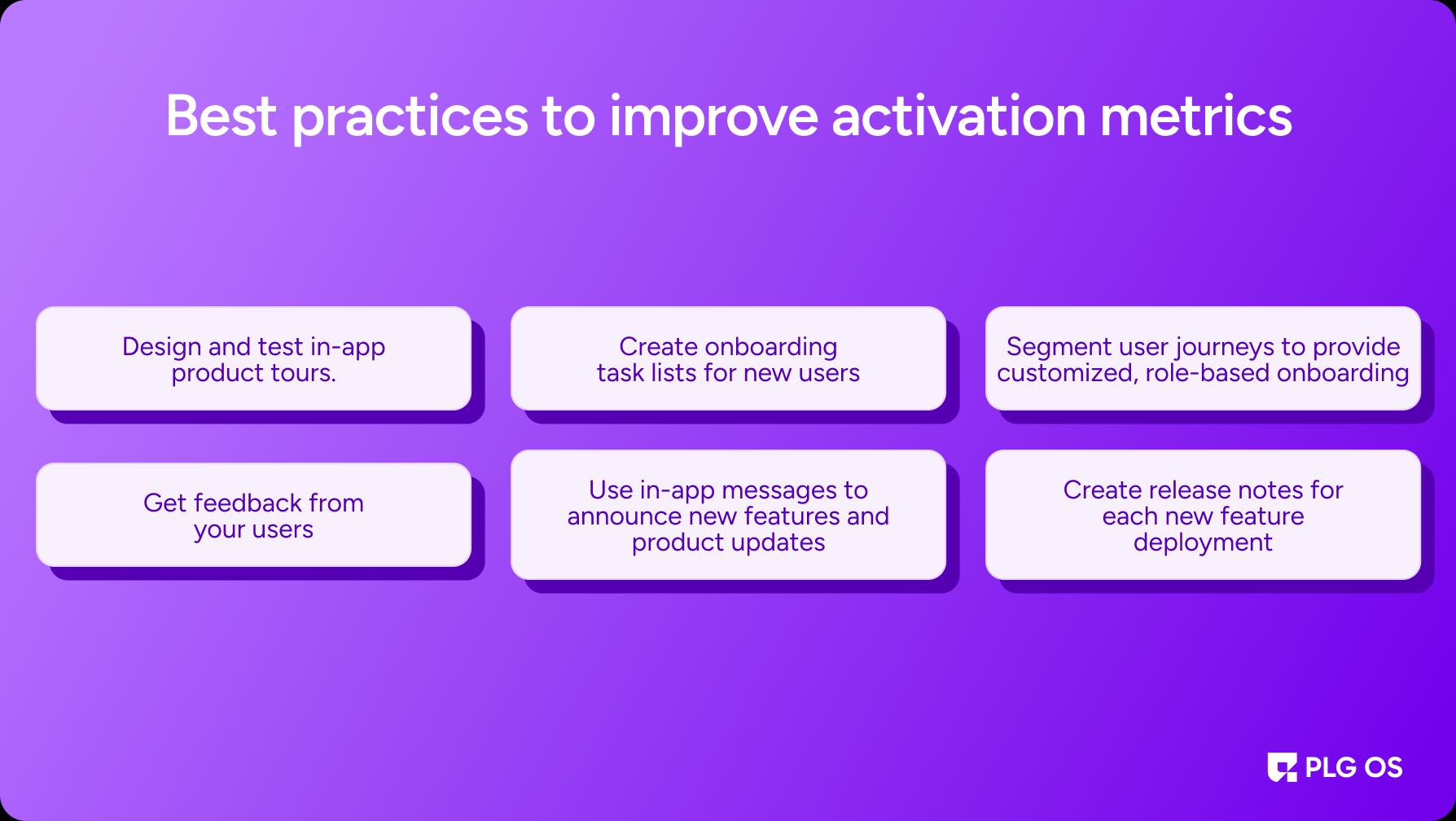
1. Design and Test In-App Product Tours
A product tour is a step-by-step guide that demonstrates how your product's various features work.
A product tour teaches new users how to navigate your product's interface and complete basic tasks such as importing data, inviting team members, setting up their workspace, and connecting the rest of their tools. You want them to learn how to use your product by demonstrating it and asking them to follow along and try out features for themselves.
2. Create Onboarding Task Lists for New Users
Onboarding checklists are lists of steps that new users should take to understand how your product operates and how to navigate the user interface.
3. Segment User Journeys to Provide Customized, Role-Based Onboarding
Onboarding experiences should always be structured to present users with personalized content based on their profile, account data, and preferences.
Notion is an example of a SaaS application that provides an excellent onboarding experience. When you create a new account, you can specify how you wish to utilize Notion, such as product management, marketing, or sales.
Notion then populates your dashboard with appropriate templates based on your selection.
Role-based onboarding is incredibly beneficial, especially if your product is a multifunctional SaaS with numerous use cases (such as Notion or ClickUp). Customized onboarding experiences make it easier for new customers to navigate your product, as opposed to forcing them to learn everything from a one-size-fits-all product document or whitepaper.
4. Get Feedback from Your Users
Product analytics provides you with the data you need to determine how to keep your users interested and coming back. With this data, teams can understand common user flows and journeys, discover friction and pain points in a product, track important product adoption metrics such as MAUs and DAUs, and develop an actionable, data-driven adoption strategy.
You can ask them directly, and NPS surveys are one of the most effective ways to obtain user feedback.
An NPS survey asks users, "How likely are you, on a scale of 1 to 10, to recommend our product to a friend?" You can incorporate extra questions and allow visitors to elaborate on their replies in free text sections.
5. Use In-App Messages to Announce New Features and Product Updates
In-app messages are tailored notifications that appear within an application while the user is actively using the product. These messages are automatic and can be generated when certain conditions are met, such as a user performing a specific activity, accessing a specific feature, or remaining signed in for an extended period of time.
6. Create Release Notes for Each New Feature Deployment
A release note is a technical document that is typically sent with product updates. It discusses the changes made to the product, the reasons for the modifications, how things may work differently, and how to configure new features.
Some upgrades can alter your product's features, making it difficult for existing users to use it as before. This can confuse users so badly that they stop using your product altogether.
Including release notes in each update can assist your users in navigating new features and adapting them to their workflow rather than beginning from zero. In-app messaging consists of tooltips, pop-ups, and notifications. They can be used to emphasize product features that a user has not previously used, as well as to announce upgrades and new functions.
Conclusion
The path to SaaS success begins with strong activation metrics. By focusing on key indicators like user engagement, feature adoption, and onboarding speed, you can turn first-time users into loyal customers.
Remember, it’s not just about getting them to sign up, it’s about guiding them to their 'aha' moment. With the right strategies in place, improving activation rates can not only enhance user retention but also significantly boost your bottom line. So, track your metrics, tweak your processes, and watch your SaaS business thrive!
FAQs
What are activation metrics in SaaS?
Activation metrics measure how quickly and effectively users realize the value of your product, helping to predict long-term retention and growth.
Why are activation metrics important for SaaS companies?
They provide insights into user engagement and product adoption, helping businesses optimize their onboarding processes and reduce churn.
What are some key activation metrics to track?
Key metrics include user sign-ups, feature adoption rates, time to first value, user engagement, and retention rates.
How can I improve activation rates?
Focus on enhancing the onboarding experience, providing valuable product features early, and ensuring clear communication of benefits.
What’s the connection between activation and retention in SaaS?
Higher activation rates lead to better user engagement, which in turn increases the likelihood of long-term retention and customer loyalty.
How does a Product-Led Growth (PLG) OS improve activation?
A PLG OS empowers users to self-serve, driving faster onboarding, increased feature adoption, and a seamless overall experience.