Expansion Revenue: What is it & How to Calculate it

In today's competitive SaaS landscape, acquiring new customers isn't enough. The real secret to sustainable growth lies in maximising value from your existing customer base through Monthly Recurring Revenue (MRR) expansion. Enter expansion revenue – a powerful strategy that's transforming how successful companies approach growth and profitability, with top performers achieving net revenue retention rates above 120%.
What is Expansion Revenue?
Expansion revenue is the additional revenue generated when existing customers increase their spending with your company over time. This increase can come through various channels:
Plan Upgrades:
Upgrading to higher-tier plans: When customers move from basic to premium subscriptions
User Expansion:
Adding more users or licenses: Expanding usage within their organization
Feature Adoption:
Purchasing additional features: Adopting new product capabilities
Usage Increase:
Increasing usage: In consumption-based models, using more of your service
Cross-selling:
Buying complementary products or services
Unlike new customer acquisition, expansion revenue leverages the trust and relationships you've already built, making it both more efficient and typically more profitable. Think of it as your customers voting with their wallets – each expansion is a testament to the value they're receiving from your product.
The Power of Expansion Revenue
Expansion revenue is a goldmine for SaaS companies because it doesn't demand the heavy marketing and sales costs that acquiring new customers does. Here's why it's so impactful:
Efficient Growth:
Keeping current customers costs much less than acquiring new ones. Expanding revenue with them is even more economical, requiring minimal extra cost.
Higher Profit Margins:
Expanding revenue from existing customers is typically more profitable as acquisition costs are low.
Customer Loyalty:
When customers upgrade, it's a sign they value your product. This not only boosts revenue but also strengthens your brand reputation.
How to Calculate Expansion Revenue
Tracking expansion revenue boils down to understanding the difference in MRR from the same customers over time.
Here's a simple formula:
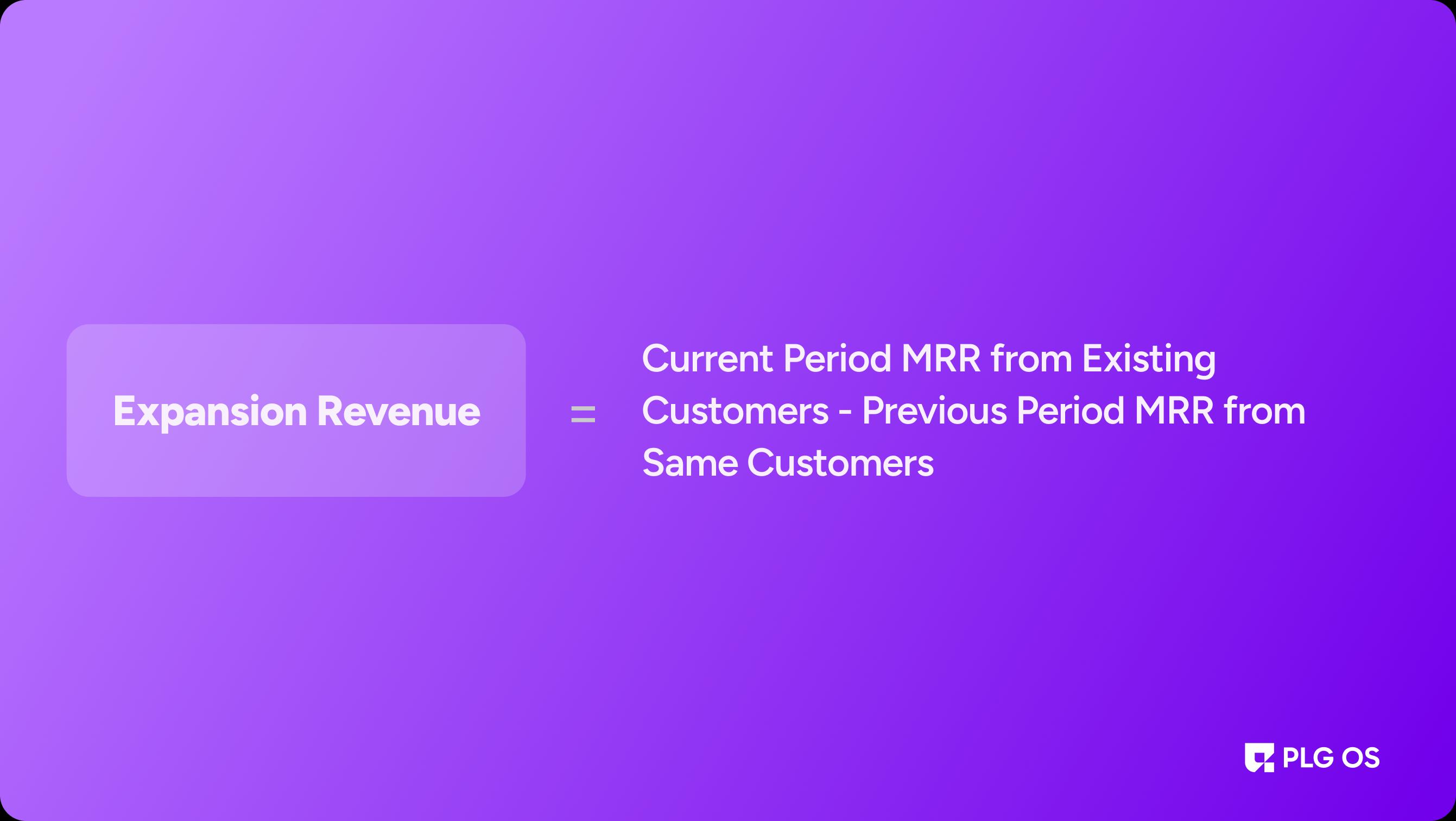
Expansion Revenue = New MRR from Existing Customers - Previous MRR from Same Customers
For example, if a customer who used to pay $1,000 per month upgrades to a $1,500 plan, the expansion revenue is $500. Although simple in concept, calculating this across all customers and expansion sources can get complex.
Key Sources of Expansion Revenue
To effectively target expansion revenue, it helps to understand where it comes from:
Seat-Based Expansion
For products priced per user, growth comes as customers add more users to their accounts. This requires:
Process:
Seamless user addition processes
Value:
Clear value for each new user
Feature-Based Upsells
Many SaaS products offer additional premium features at higher price tiers. Success here depends on:
Packaging:
Strategic feature packaging
Communication:
Clear value communication for each plan
Usage-Based Growth
In a consumption-based model, revenue increases as customers use more of your product. To maximise this:
Optimization:
Help customers optimise their usage
Expectations:
Prevent 'bill shock' by setting clear usage expectations
Strategies for Driving Expansion Revenue
Product-Led Growth (PLG) Approach
A PLG strategy lets your product guide customers toward expansion. This involves:
Scalability:
Scalable features that grow with customer needs
Analytics:
Usage analytics for identifying expansion potential
Upgrade Paths:
Clear, in-product upgrade paths
Customer Success-Driven Expansion
Your customer success team is critical to revenue growth. They can:
Goal Alignment:
Understand customer goals and align product solutions
Opportunity Identification:
Identify upgrade opportunities through business reviews
Proactive Suggestions:
Proactively suggest upgrades based on usage trends
Measuring Expansion Success
To gauge expansion efforts, track these key metrics:
Net Revenue Retention (NRR):
Shows both revenue retention and expansion, with healthy SaaS businesses aiming for NRR above 100%.
Expansion MRR Growth Rate:
Measures the pace at which expansion revenue grows.
Average Revenue Per Account (ARPA) Growth:
Indicates if customer accounts are increasing in value.
Time to First Expansion:
Tracks how long it takes for new customers to start expanding.
Customer Lifetime Value (CLV):
Helps you understand the long-term financial impact of customer expansion.
Best Practices for Maximising Expansion Revenue
Timing and Approach
Timing matters for expansion conversations. To make the most of this:
Analytics Usage:
Use analytics to identify the best moments for upgrade discussions
Milestone Alignment:
Align expansion talks with key customer success milestones
Value Communication
To drive upgrades, customers need to see the value. Effective methods include:
ROI Showcase:
Showcasing ROI and potential benefits of additional features
Success Stories:
Sharing success stories from similar customers
Transparent Pricing:
Providing transparent pricing and packaging details
Common Challenges (and Solutions) with Expansion Revenue
Price Sensitivity
Challenge:
Customers resist price increases.
Solution:
Emphasise the value gained for the cost, using ROI examples to justify the expense.
Low Product Adoption
Challenge:
Customers aren't fully using current features.
Solution:
Strengthen onboarding and educational resources, using product data to encourage feature adoption.
Future Trends in Expansion Revenue
AI-Driven Expansion
AI is being used to:
Prediction:
Predict expansion opportunities
Personalization:
Personalise upgrade offers
Automation:
Automate parts of the expansion process for efficiency
Hybrid Pricing Models
More companies are blending subscription pricing with usage-based elements, allowing customers to scale flexibly with their needs.
Building a Culture of Expansion
Maximising expansion revenue isn't just a task for one team. It requires a culture shift that:
Department Alignment:
Aligns all departments around customer success and long-term value
Product Development:
Prioritises ongoing product development to meet evolving customer needs
Value Focus:
Values retention and growth from within over constant new acquisition
Conclusion
Expansion revenue is a vital growth engine for any SaaS business. When customers are willing to invest more in your product, it's a clear indicator that your solution is aligned with their evolving needs. Building a robust expansion revenue strategy isn't just about increasing sales but about enhancing the customer experience, maximizing product value, and fostering long-term loyalty.
For companies looking to streamline their approach, PLG OS offers a suite of tools that simplifies the expansion process by focusing on key elements like customer onboarding, usage analytics, and engagement. By automating customer success workflows, PLG OS helps businesses identify and act on expansion opportunities at the right moment. With PLG OS, you'll have access to features like in-app messaging, upgrade nudges, and detailed usage insights, enabling you to create a seamless path for revenue growth.
If your goal is to maximise your expansion revenue, PLG OS can be your partner in building a scalable, customer-centered growth strategy.