Fueling Success: The Power of Product-Led Growth
A product-led growth strategy is one in which the product itself serves as the primary means of attracting, activating, and retaining consumers. With PLG, businesses can achieve organic growth through satisfied users who become advocates and drive word-of-mouth and viral growth through the delivery of excellent value and a smooth user experience.
Unlike sales-led organizations, which prioritize guiding buyers through the sales cycle, product-led businesses challenge the traditional sales model. Product-led businesses achieve this by providing customers with a free trial or freemium product to test out the product. Read this article to find out why product-led growth is becoming more popular, how to become a product-led company and the key advantages of this growth strategy.
What is Product-Led Growth?
91% of companies adopt PLG plans to increase their investment in PLG. 47% plan to double their investment. So, what is PLG? A product-led growth strategy prioritizes the development and release of a company's software products over all other considerations during the customer's path to purchase and beyond. The product's attributes, functionality, and potential for spreading word of mouth are the main selling points in a product-led growth approach.
Differentiating product-led growth from other approaches is making the product the focal point of all marketing initiatives. An organization's sales and marketing departments shift their focus to the product (and the goodwill it creates) in a product-led model.
For businesses that offer a freemium product, for instance, the product can double as a marketing strategy by drawing in new customers without the need to invest in costly advertising campaigns or recruit more salespeople. The goal of offering a free version of a product as part of a product-led growth strategy is to get people to try it out and then pay for the full version.
6 Product-led Growth Metrics and Principles
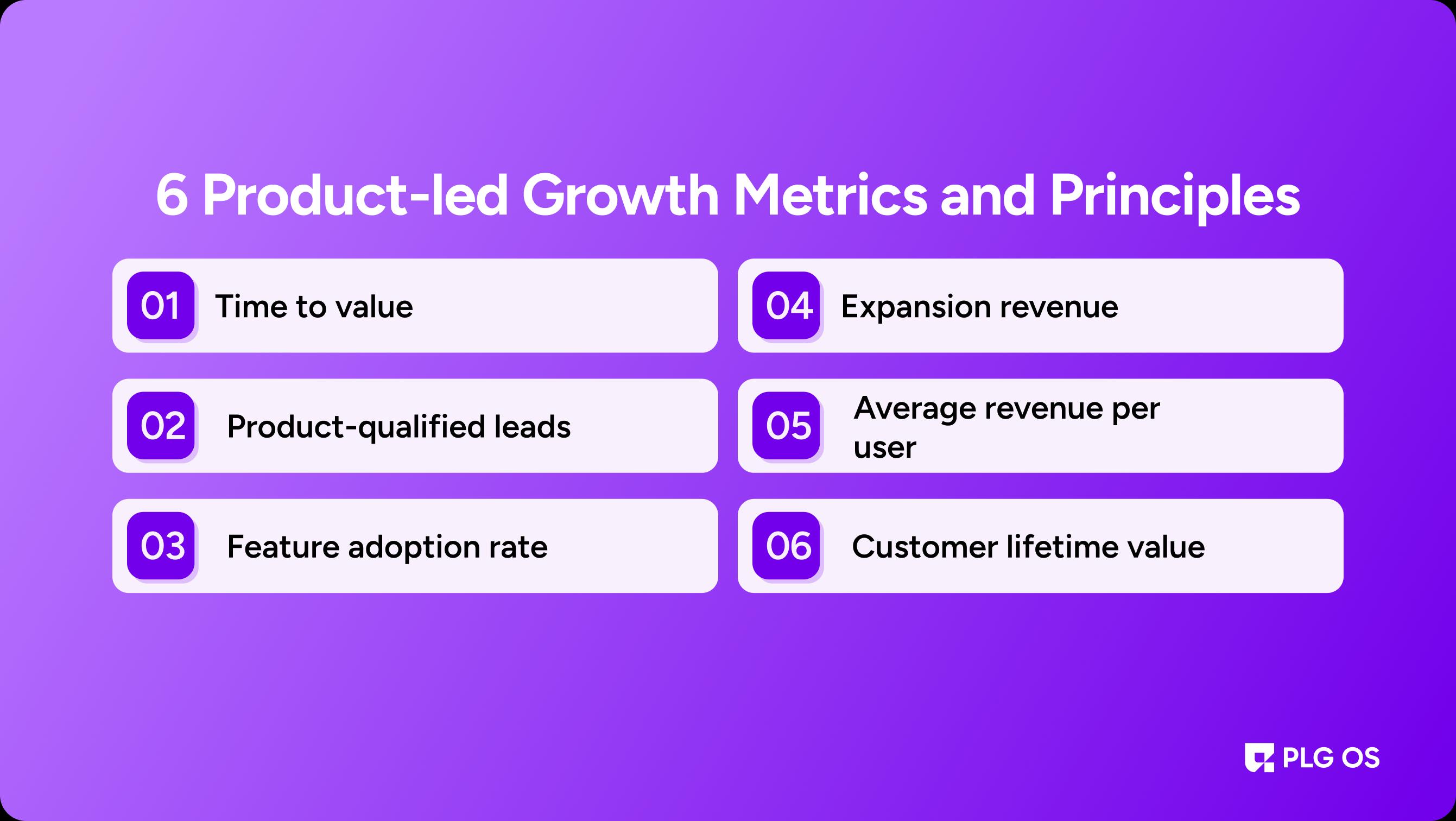
1. Time to value
The TTV measures how long it takes for new customers to see the value in your offering. The faster customers may experience their initial "aha!" moment or activation event, the better, thus you should aim to minimize time to value to the greatest extent feasible.
In order to do this, you should center your user onboarding efforts on the product behaviors that lead to activation, such as introducing coworkers to use your platform, importing customer data, or connecting with other tools in their tech stack.
2. Product-qualified leads
Activated users are usually product-qualified leads (PQLs). These customers have accomplished a critical task inside your product, had an epiphany, and seen the benefits of your product firsthand.
Finding the activation event of your product and the actions that users do inside it to show they are ready to go to the next stage of their journey will help you define what a product-qualified lead looks like for your product. To accomplish this, you can conduct A/B tests, listen to user interviews, and analyze session recordings to determine which user behaviors lead to conversions and retention.
3. Feature adoption rate
When introducing a new product to the market, product management teams usually prioritize monitoring the adoption rate among their key performance indicators. Adding the feature adoption rate to that list is crucial for a complete PLG analysis.
You can tell how well your target users receive your product by looking at both rates. What percentage of people actually use the product? That's what the adoption rate tells you. If you want to know why consumers keep coming back to your product, you can go no further than the feature adoption rate, which is a percentage as well. The pace of adoption of a new feature could be the culprit behind your total product adoption rate's upswing.
4. Expansion revenue
Keeping existing customers pleased and paying is far easier than finding new ones. Upselling to current customers is around twice as expensive as acquiring new ones, and generating expansion income is more than three times less expensive than the customer acquisition cost (CAC) of a new customer, so it's economical too.
For this reason, expansion revenue is a key factor in ensuring the long-term viability of SaaS businesses. This metric, which evaluates the revenue gained from current customers through upsells, add-ons, and cross-sells, is also known as expansion monthly recurring revenue (MRR).
5. Average revenue per user
One way to measure the potential earnings from a user is by looking at their average revenue per user (ARPU). Analysts commonly use ARPU to compare SaaS companies since it is a good, high-level indication of business health.
To get the ARPU for each user category, you can use the various components of the Product-Led Growth. Although it may be apparent, the evaluator group's ARPU is lower than your beginners'. It might come as a surprise, nevertheless, if your regulars have a greater ARPU than your champions. On the other hand, your beginners' ARPU is higher than what you had anticipated.
6. Customer lifetime value
The amount of money your company may expect to make from a single client throughout their account's lifetime is known as customer lifetime value (CLV or LTV). Gain a better grasp of appropriate acquisition and retention costs and identify profitable customer segments, all of which are outlined in the Product-Led Growth, by calculating lifetime value. The average PLG organization is worth double the public SaaS index.
Predictive and historical methods abound for determining CLV. One of the most critical SaaS metrics is client lifetime value, regardless of how you calculate it. You may learn the current value of a customer and also estimate their future worth to your company with its help.
Benefits of Product-Led Growth
1. Lower customer acquisition costs
One major selling point of product-led growth is the potential for reduced customer acquisition costs (CAC).
The fact that most customers use the product's self-service capabilities to research it, get instructions, and buy it makes this feasible.
Compared to sales-led or marketing-led growth strategies, product-led acquisition is more efficient and less costly because it requires less time and effort from the sales or customer service team.
Investing in product development to provide a better product experience and lowering acquisition costs allow you to lower prices and make your product more competitive. More consumers will be yours to keep with one of these options.
2. Greater chances of benefitting from product virality and network effects
Viral marketing of PLG products is another mechanism via which CAC can be decreased.
Loyal consumers are more than willing to participate in referral programs and spread the word about your product.
Compared to other types of advertising, both of them work much better. After all, if customers weren't satisfied with the product, they wouldn't recommend it.
In addition, PLG tactics can take advantage of network effects, which happen when the product's value grows in proportion to the number of users. What this implies in reality is that the number of happy consumers grows at an exponential rate.
3. Boosted product engagement and uptake
Providing customers with seamless experiences is a top priority for PLG organizations. Users are more likely to activate and accept the product when there is no friction.
It is accomplished by:
- Making the registration procedure easier.
- Streamlining the welcome surveys by removing superfluous questions.
- To assist consumers in discovering only the most relevant features, we are developing tailored onboarding experiences.
- Making the customer journey more efficient so that users may finish their jobs faster.
- Also, working on the user interface to make it more attractive and easy to use.
4. Shorter sales cycle leading to more paying customers
With the product-led strategy, companies may shorten the time it takes to close a deal.
To begin with, it expands the funnel's opening. Users can personally witness the product's worth through freemium or trial versions. Key decision-makers and the ability of sales representatives to do demos and presentations were the traditional boundaries.
Second, they can try out the product whenever it's convenient for them thanks to self-service onboarding and aid. They get through the adoption and conversion stages of the funnel more quickly because of this.
5. Sales and customer success teams have less work to do
An aspect of the product-led growth strategy, the self-serve model lessens the reliance of users on the sales and customer success teams, as previously stated.
Onboarding and in-app assistance through resource centers or chatbots powered by artificial intelligence allow consumers to grasp the product's features and get beyond any problems they may have without interacting with agents.
The burden on customer success and support is alleviated as a result.
They can also buy it without contacting salespeople, which is something that many customers choose to do, especially for large orders (above 500k).
This frees up your sales force to concentrate on developing relationships with valuable corporate clients who may benefit from a more individualized approach.
6. Higher customer satisfaction and user engagement
The foundation of product-led growth is the value-first strategy. What this implies in practice is that they make excellent products that address real consumer needs.
More user engagement and happiness for customers is the result of product development that helps people with real problems and accomplishes real goals. It improves their life in a tangible way. According to Emerge, "PLG companies have 60% more ARPU (Average Revenue Per User) than non-PLG companies."
7. A rise in client retention and lifetime value
Increased customer retention is a common result of happy customers.
Imagine it in this manner:
Customers won't bother looking elsewhere if your product meets all their needs and is priced competitively. Since moving to a competitive product necessitates substantial financial and time investments, many would prefer to stay away from it.
Customer lifetime value often rises as user retention rates rise. You will earn more money from them the longer they continue to pay you.
Plus, when you try to grow their account, they're more likely to accept, which means they could buy more from you or upgrade to a better plan.
Why is Product-Led Growth the Future of SaaS?
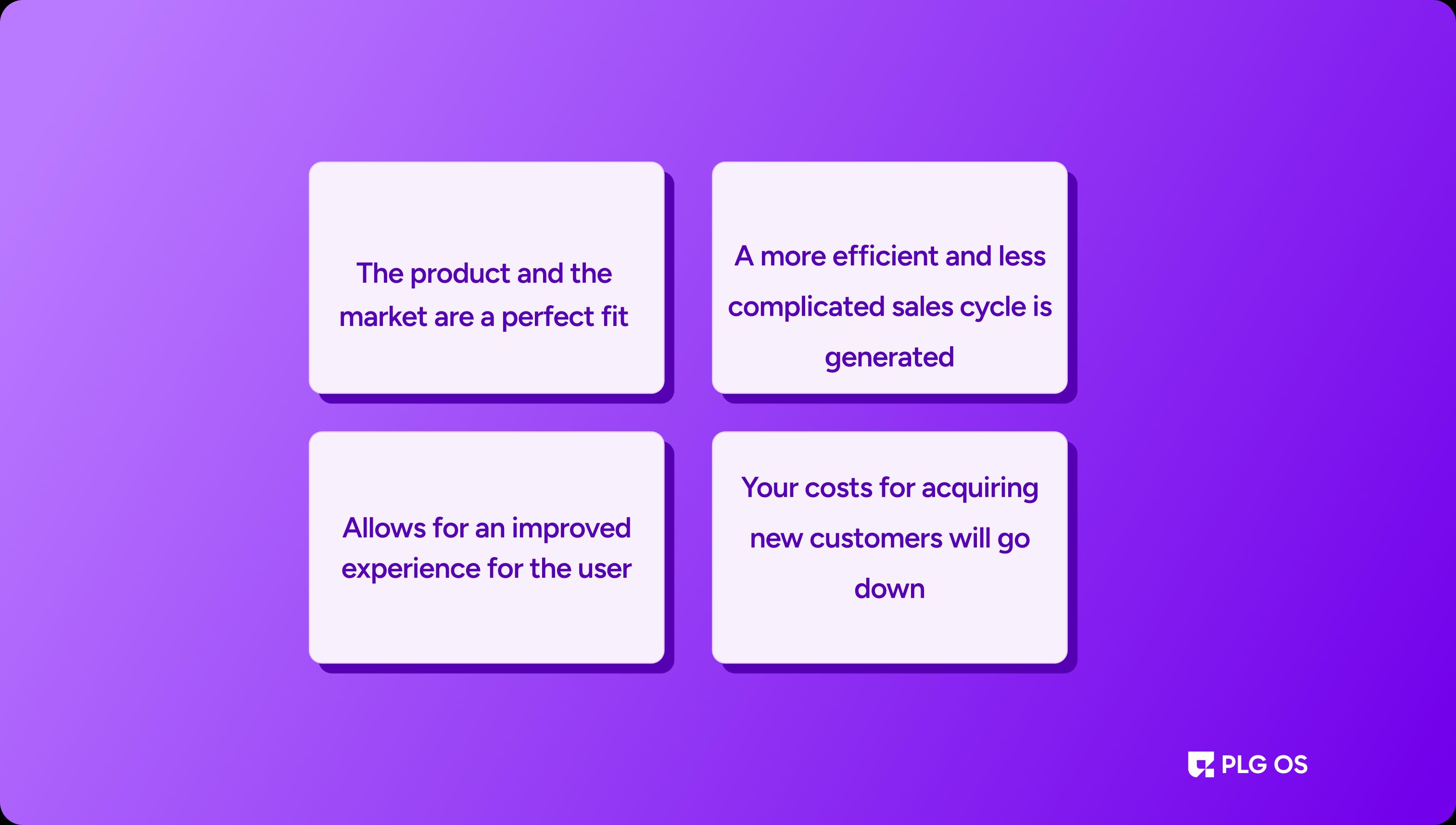
1. The product and the market are a perfect fit
Placing your product at the core of your growth plan and prioritizing customer experience is the primary idea of PLG. In this way, you can learn more about your target market's wants and requirements, which in turn allows you to design a better product.
2. A more efficient and less complicated sales cycle is generated
With product-led growth, clients may onboard themselves, which shortens sales cycles and increases return on investment. In order to turn free users into paying customers as soon as possible, your solution must allow users to achieve a critical goal.
3. It allows for an improved experience for the user
An important component of product-led growth is a product that allows users to self-onboard and earn valuable experience. You won't have to spend time guiding your customers because this user experience promotes real product value.
4. Your costs for acquiring new customers will go down
Marketing and sales are unnecessary when product costs are driving acquisition costs. A more efficient growth strategy and higher profit margin are possible with lower client acquisition costs.
Three Ways to Use PLG With SaaS
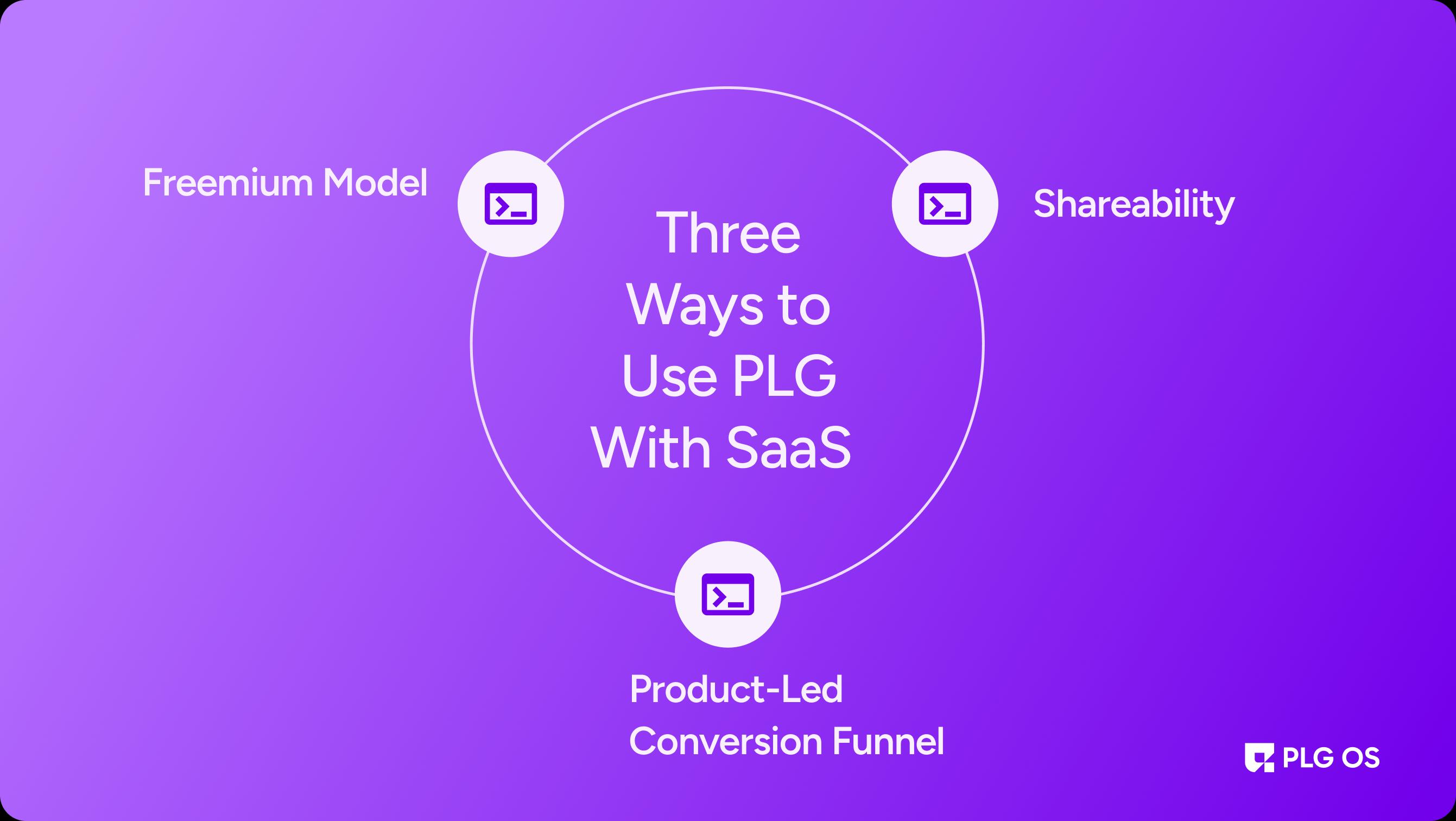
1. The Freemium Model
To give value right away, think about implementing a freemium model or self-service free trial in your SaaS. Based on my observations, this technique may frequently circumvent sales engagement, accelerate adoption, and gather valuable user data all at the same time. The idea behind freemium models is to make it easy for consumers to upgrade for more features once they're hooked.
Example: Spotify offers a free tier with limited features and ads. Once users are hooked on the convenience and quality of the platform, they're encouraged to upgrade to a premium subscription for ad-free listening and offline downloads.
2. Shareability
Make it easy for users to share your goods on social media and reward people who bring in new clients to encourage word of mouth advertising. This mutually beneficial arrangement has the potential to transform happy customers into devoted brand champions who attract new clients.
Example: Dropbox's referral program is a classic case. By offering extra storage to users who referred friends and to those who signed up through referrals, Dropbox achieved exponential growth and a loyal user base.
3. Product-Led Conversion Funnel
Lead generation used to be the lifeblood of marketing funnels; after that, sales would close the deal. The primary goal of PLG models is to create a sales funnel that starts inside the product itself. As part of this effort, we will be reducing friction and highlighting the instant benefit of our product across the user journey, from sign-up to long-term usage.
Example: Slack uses its product-led funnel effectively. Teams can start using the platform for free with minimal setup, quickly experiencing its value in streamlining communication. As usage grows, organizations naturally upgrade to paid plans for enhanced features like integrations and admin controls.
Conclusion
The overarching goal of a product-led growth strategy is to make the product the central focus and the driving force behind the company's success. You may unleash enormous growth potential for your SaaS company in today's competitive landscape by focusing on giving immediate value and motivating consumers to become advocates.
Ready to transform your SaaS business with a product-led growth strategy? Explore the comprehensive tools and insights of PLG OS—your ultimate resource for implementing and scaling a product-led approach.
FAQs
What is Product-Led Growth (PLG)?:
PLG is a strategy where the product itself serves as the primary driver of user acquisition, retention, and expansion, focusing on delivering value directly through the product experience.
How is PLG different from traditional growth models?:
Unlike sales-led or marketing-led approaches, PLG relies on the product's usability and value to attract and retain customers, minimizing dependency on external sales or marketing efforts.
Who benefits most from PLG?:
SaaS companies, freemium-based businesses, and organizations offering self-service products often see the greatest benefits from PLG due to the scalability of their offerings.
What are key elements of a successful PLG strategy?:
A great user experience, quick time-to-value, intuitive onboarding, and features that promote self-service adoption are vital for PLG success.
How does PLG drive growth organically?:
By delighting users and enabling them to achieve their goals effortlessly, PLG turns customers into advocates who promote the product through word-of-mouth and referrals.