Product-Led Growth vs. Traditional Growth Strategy: Which is Right for Your SaaS?
There are two main ways that SaaS companies might expand: Product-Led Growth (PLG) and more conventional methods. In contrast to more traditional approaches, which frequently use sales teams and marketing funnels, PLG emphasizes user experience and organic growth via self-service.
Successful PLG businesses include Dropbox and Slack, which have demonstrated decreased customer acquisition costs and increased user adoption. In complicated sales contexts, though, tried-and-true growth tactics continue to produce excellent results. Your company's objectives, the complexity of your product, and the market will dictate which of these models you choose.
What is PLG and How Does It Work?
The term "product-led growth" refers to a method of expanding a business's customer base that starts with acquiring new users and ends with expanding the product itself.
The software as a service (SaaS) product serves as the solution, salesperson, and ultimate truth serum for applications such as survey polling (SurveyMonkey), video conferencing (Zoom), code scanning (Snyk), and DevOps tooling (Datadog). From within the product, it provides all the necessary information to the consumer, including cost, contract length, feature FAQs, and more.
With a product-led model, users are able to skip the annoying parts (long sign-up processes, demos, onboarding, and hidden fees) and focus on the parts they like (a user-friendly product that boosts their productivity), usually in the form of an initial freemium or trial offer.
The product-led companies are beginning to take over the software as a service market, with pioneers like Slack and more seasoned switchers like HubSpot in the forefront.
Reason:
- The typical PLG company is worth twice as much as the public SaaS index, indicating that they are worth more.
- Quicker scalability: product-led strategies are employed by 83% of publicly traded SaaS companies that reach $100 million in annual revenue during the first five years.
- Their popularity is on the rise. From 2016 to 2020, PLG's market cap increased from $21 billion to $687 billion.

Benefits of PLG for SaaS businesses
Numerous well-known SaaS companies like Slack and Dropbox employ a product-led growth approach. How does this strategy benefit these product-led companies?
Presented here are a few examples:
Wider top of the funnel (TOFU)
For a broader TOFU (top of the funnel), product-led strategy, offering a free trial or freemium bundle is a common way to get customers to try your product. They encourage people to begin a free trial using calls to action on their landing pages. As a result, more people will be interested in your offering, increasing your conversion rate at the very top of the sales funnel.
Since your SaaS growth strategy is the safest and most beneficial for your consumers, you will likely attract and onboard more of them than with any other options.
While a high acquisition rate is great in and of itself, it won't translate to high retention unless your product is compelling enough to hold on to a significant portion of these new subscribers.
Save money on acquiring customers
The customer acquisition costs of product-led businesses are often lower than those of marketing-led businesses since they use a freemium or free trial model. The reason behind this is the ever-increasing expense of utilizing various marketing channels to acquire, engage, and ultimately convert users. Customers say they hate being sold to, and these channels are already quite crowded.
The freemium pricing model is a customer acquisition approach that product-led businesses use to lower their client acquisition cost. The best way to get people to use your product is to give them a free trial. It's also less expensive than having your marketing team test and monitor many techniques.
Customer acquisition costs: product-led vs. sales-led
Customers will swiftly see your product's worth if you make it easy for them to try it out. Customers are more likely to stick around if they perceive your product as an excellent answer to their problems. The importance of providing an experience is much more compelling than merely describing it.
Additionally, you will always be thinking of methods to improve your product since it is the engine that propels growth in this model. User retention rates are enhanced when you prioritize creating an exceptional product and experience for your users.
PLG vs. SLG: Key Differences and Similarities
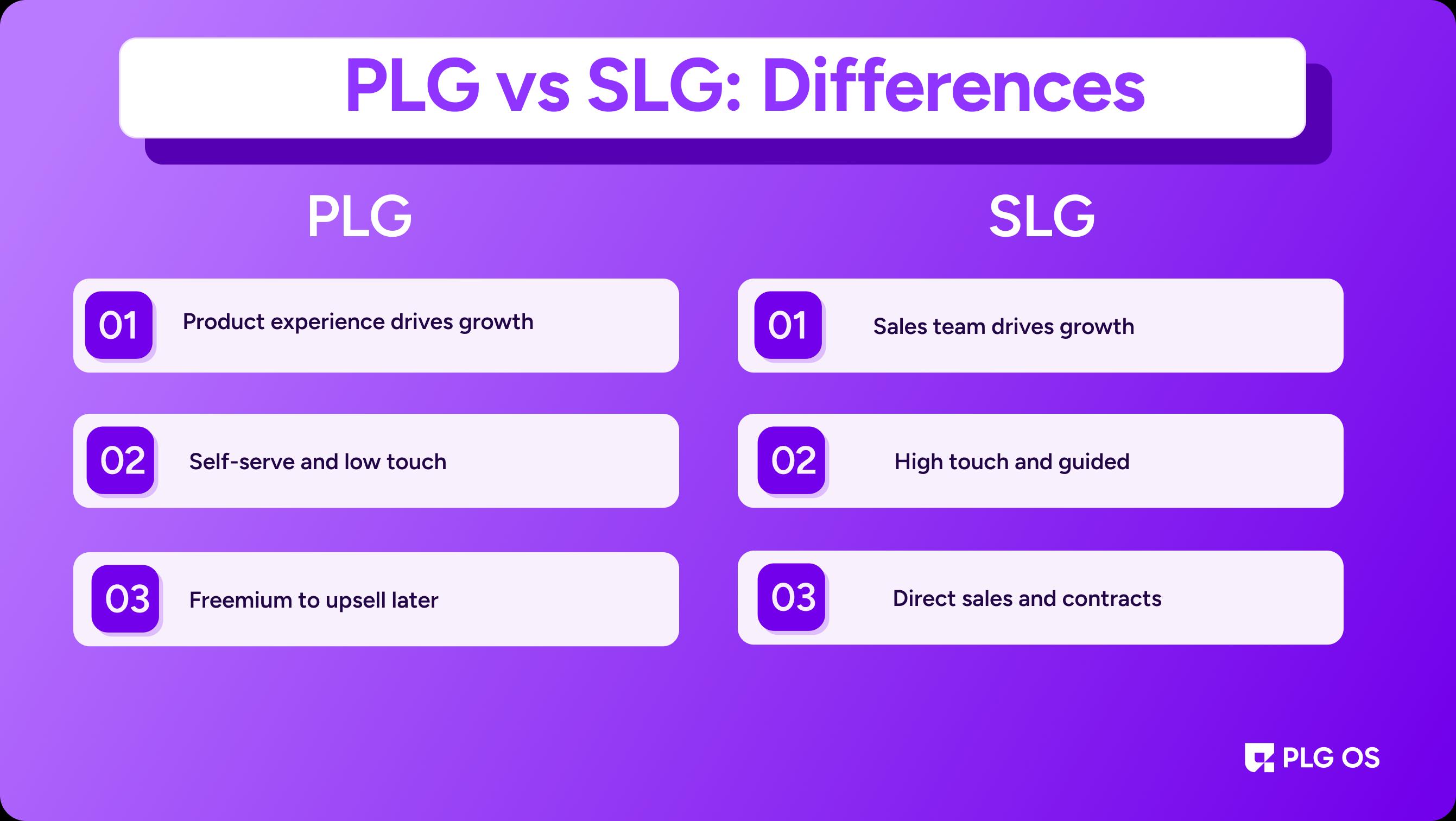
When examining the contrasts and overlaps between Product-Led Growth (PLG) and Sales-Led Growth (SLG), it is akin to contrasting two distinct philosophies in the SaaS universe regarding customer engagement and growth tactics.
Role of Sales Teams in PLG and SLG
We can simplify the process of adjusting sales roles in response to various growth strategies:
PLG's Influence on Sales Team
Support Overselling:
In PLG, the product is self-contained. Sales teams redirect their attention from direct selling to assisting users with product adoption and troubleshooting.
Fostering high-value Leads:
'They are more engaged in strategic follow-ups and nurturing high-value leads that the product initially attracts' (McKinsey & Company).
Sales and SLG Teams
Direct Engagement:
Sales teams are the heroes of direct engagement. They are directly interacting with clients, gaining a comprehensive comprehension of their requirements, and developing customized pitches.
Complex Sales:
This model shines in environments with complex products or where a detailed understanding of the client's needs is crucial (Salesbricks).
Hybrid Models
Best of Both Worlds:
Combining PLG and SLG allows sales teams to maximize their impact by leveraging initial product interest to secure larger deals.
Role Flexibility:
Sales professionals in these environments need to be adaptable, able to switch between nurturing leads generated by the product and engaging in intensive, hands-on selling (McKinsey & Company, Salesbricks).
This transformation shows a clear trend– the integration of sales with other departments like marketing and the customer success teams, reflecting a more holistic approach to growth and customer engagement.
Customer Acquisition and Retention in PLG vs SLG
Understanding the subtleties of customer acquisition and retention in Product-Led Growth (PLG) and Sales-Led Growth (SLG) strategies is critical to a company's longevity and success in the highly competitive SaaS industry.
PLG: Ease and Automation
PLG strategies frequently have reduced client acquisition costs due to their focus on self-service models. This approach makes it easier for users to try products without heavy sales interaction and allows companies to scale rapidly without proportional increases in sales resources.
Retention Through Product Excellence: In PLG, retention is determined by the product's capacity to engage users continuously. The better the product experience—from ease of use to addressing user needs—the greater the chance of client retention. The ProductLed, Product School concept emphasizes product satisfaction and usability as key factors in building loyalty.
SLG: Personalization and Relationship
Targeted Acquisition: In SLG models, customer acquisition costs are generally higher due to the need for a dedicated sales force. However, this cost is often justified by the ability to target and customize outreach to high-value customers, particularly in B2B or complex sales scenarios.
SLG excels at building long-term customer relationships through direct and personalized contacts. Sales teams provide personalized solutions and assistance, leading to increased client loyalty and retention, particularly in industries where trust and service personalization are crucial.
Conclusion
In conclusion, selecting the right SaaS growth strategy - PLG, SLG, or MLG - depends on your product, target audience, and business objectives. Many successful SaaS companies combine these strategies, leveraging the strengths of each to optimize growth.
Ultimately, aligning your plan with your users' needs and business goals ensures sustainable growth and long-term success in an increasingly competitive market. Looking to explore the best growth strategy for your SaaS business? Whether you're leaning towards Product-Led Growth (PLG) or traditional strategies, we have the tools to guide you. Visit PLGOS to explore more about how PLG can be the right for your business.
FAQs
1. What is the main advantage of Product-Led Growth (PLG)?:
PLG focuses on letting the product drive user acquisition, reducing costs and offering faster scalability compared to other strategies.
2. When is Sales-Led Growth (SLG) the best choice?:
SLG works best for complex, high-ticket SaaS products that require personalized demos, relationship-building, and tailored solutions.
3. How does Marketing-Led Growth (MLG) differ from PLG?:
MLG relies on campaigns to create awareness and drive leads, while PLG focuses on the product itself to engage and convert users.
4. Can SaaS companies combine PLG, SLG, and MLG?:
Yes, many companies use a hybrid approach to target different segments or optimize various stages of the customer journey.
5. What metrics are critical for PLG success?:
Key metrics include product usage, activation rates, retention, and conversion from free trials or freemium models.