What is a Customer Engagement Score? How to Use it to Improve SaaS Engagement
The Customer Engagement Score (CES) quantifies how actively and meaningfully your customers are interacting with your brand. It’s not just about how many purchases they make or how satisfied they are—it considers the entire customer journey and every touchpoint along the way. By measuring the frequency, depth, and quality of interactions, CES provides a more nuanced understanding of customer loyalty and involvement.
Unlike static metrics, CES changes over time. A high engagement score today might drop if the customer stops interacting with your brand, or it might rise as they discover new features or use your product more intensively. This dynamic nature makes CES a vital metric for tracking ongoing customer relationships.
How to Calculate Customer Engagement Score
- Identify Key Engagement Metrics
- Assign Weights to Metrics
- Determine a Time Frame
- Calculate the CES
1. Identify Key Engagement Metrics: These will vary based on your industry, product, and business model but can include metrics such as:
- Frequency of logins or app usage
- Time spent on your platform
- Features or services used
- Responses to marketing emails or in-app notifications
- Participation in events or community forums
- Customer support inquiries and resolutions
- Social media interactions
- Repeat purchases and overall transaction volume
2. Assign Weights to Metrics: Not all interactions are created equal. A purchase might be more significant than opening an email. Assign weights to each engagement metric based on its importance.
3. Determine a Time Frame: CES is dynamic, so decide how often you’ll measure engagement—weekly, monthly, or quarterly.
4. Calculate the CES: Use this formula to calculate CES:
CES = (W1 * M1) + (W2 * M2) + ... + (Wn * Mn)
Example: For a SaaS product, you might track three key metrics:
- Logins per week (weight: 2)
- Features used per session (weight: 3)
- Support tickets resolved (weight: 1)
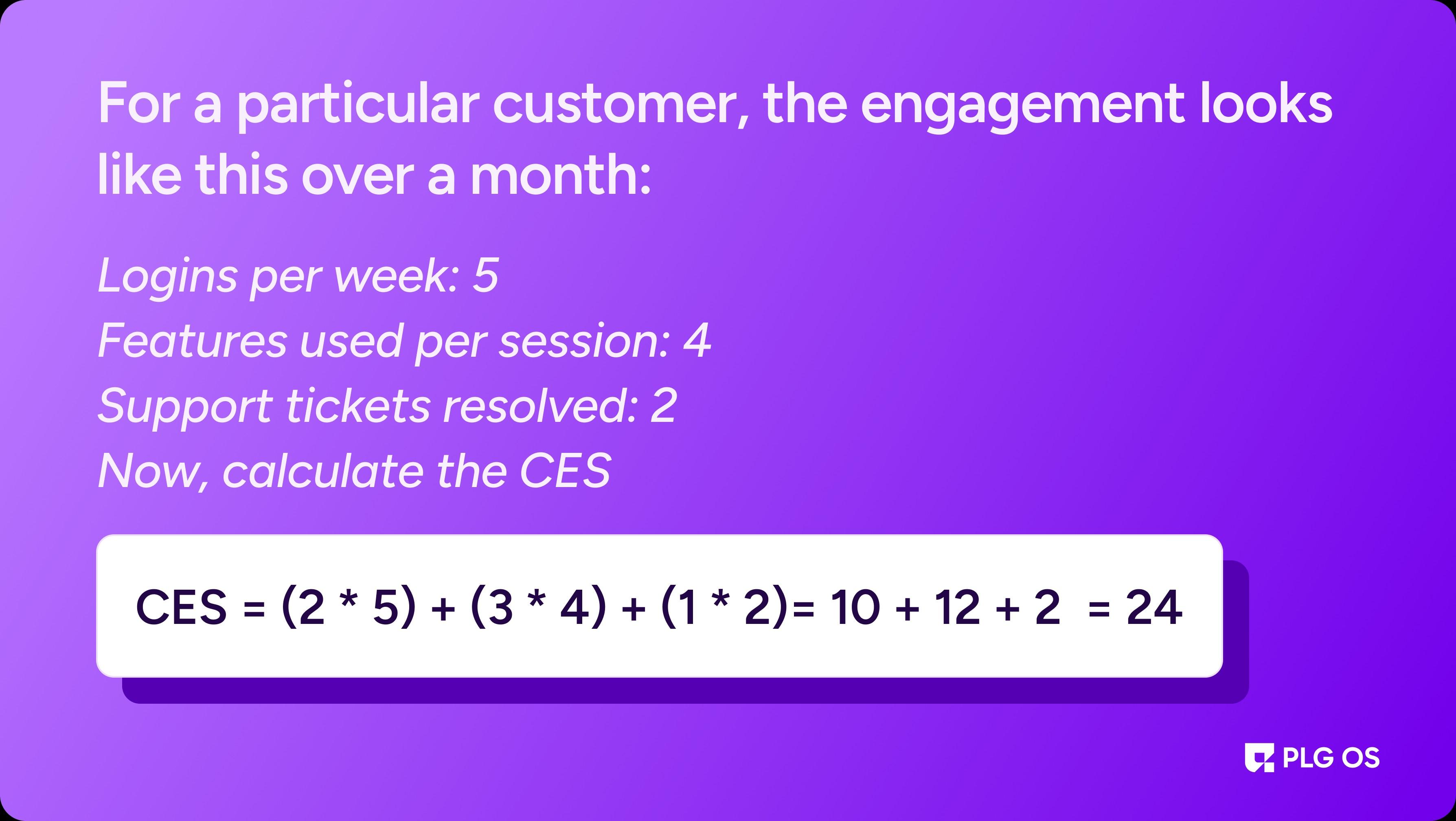
You can normalise this score to fit a 0-100 scale, depending on the maximum score a customer could achieve
The Benefits of Measuring Customer Engagement Score
Tracking CES offers numerous benefits:
1. Predictive Customer Behaviour
A high CES suggests a strong likelihood of future loyalty, repeat purchases, and referrals, while a declining score might indicate potential churn.
2. Churn Prevention
By regularly monitoring CES, you can spot when engagement starts to drop, signaling that a customer is at risk of leaving.
3. Tailored Customer Experiences
Understanding what drives customer engagement helps deliver personalized experiences. Promote features heavily used by high-engagement customers to low-engagement users.
4. Product Development Insights
CES reveals which features or services are most engaging, guiding product development to increase customer value.
5. Optimized Marketing Campaigns
Customers with high CES are more likely to respond to cross-sell or upsell offers. Segmenting customers based on CES can help target marketing efforts.
6. Improved Customer Success
The customer success team can prioritize efforts, focusing more on customers with lower scores to prevent churn.
7. Revenue Forecasting
Engaged customers are often repeat buyers. By tracking engagement trends, you can more accurately forecast future revenues.
8. Competitive Edge
In industries with similar products, engagement becomes a key differentiator. By boosting CES, you create deeper, more meaningful relationships with customers that are harder for competitors to disrupt.
Strategies for Implementing CES in Your Business
To implement CES successfully, tailor it to your business needs:
Define Your Objectives:
Are you looking to reduce churn or improve upsells?
Select the Right Metrics:
Choose engagement metrics that reflect real customer value.
Start Simple and Scale:
Start with a basic CES model and refine it over time.
Segment Your Customers:
Create separate engagement scores for different customer segments.
Set Benchmarks:
Define low, medium, or high CES to guide strategy.
Challenges and Considerations
While CES offers valuable insights, approach it with caution:
Data Quality:
Ensure your data is accurate and up-to-date.
Balanced Metrics:
Combine CES with other metrics like Net Promoter Score (NPS).
Privacy Concerns:
Be transparent about how you collect customer data.
Avoid Gaming the System:
Ensure engagement activities genuinely add value.
Conclusion: The Engagement Imperative
Businesses that succeed are those that understand the value of CES and use it to create personalized, meaningful experiences for their customers. By implementing a robust Customer Engagement Score system, you’ll be able to track customer loyalty, predict behavior, and drive sustainable growth.
PLG OS provides seamless integration of your customer data, allowing you to track engagement across multiple touchpoints effortlessly. We also offer advanced analytics and AI-driven insights to help you interpret CES trends, predict customer behavior, and take action to improve retention, drive growth, and maximize customer lifetime value.
Moreover, with platforms like PLG OS, measuring and acting on CES insights becomes easier and more effective, ensuring you remain ahead of the competition. Start prioritizing customer engagement today, and watch your business grow as a result.