What is Monthly Recurring Revenue (MRR) and Why It Matters

In simple terms, Monthly Recurring Revenue is the predictable income your business generates each month from active subscriptions. Think of it as the heartbeat of your SaaS model—it represents the stable revenue that keeps your business thriving. Importantly, MRR doesn’t include one-time fees or any non-recurring charges. It’s all about the subscriptions!
How to Calculate MRR
Calculating MRR might sound daunting, but it’s pretty straightforward. Here’s the basic formula:
MRR = Number of Customers × Average Revenue Per User (ARPU)
However, it can get more complicated if you offer different pricing tiers or annual subscriptions. Here's a breakdown:
Monthly Subscriptions:
Just add up the monthly fee for each active customer.
Annual Subscriptions:
Divide the annual fee by 12 and add that to your monthly total.
Custom Subscriptions:
Use historical data to find the average monthly rate.
For example, let’s say you have:
- 100 customers on a $50/month plan
- 50 customers on a $100/month plan
- 25 customers on a $1,200/year plan
Your MRR would be:
(100×50)+(50×100)+(25×(1200/12))=5000+5000+2500=12,500(100 × 50) + (50 × 100) + (25 × (1200/12)) = 5000 + 5000 + 2500 = 12,500(100×50)+(50×100)+(25×(1200/12))=5000+5000+2500=12,500
So, your MRR would be $12,500!
How to Increase MRR
Growing your MRR is essential for scaling your SaaS business. Here are some strategies to consider:
1. Acquire More Customers
The simplest way to boost MRR is to attract more paying customers by optimizing your marketing and sales funnels.
2. Reduce Churn
Retaining customers is often more cost-effective than acquiring new ones. Improve onboarding, offer excellent customer support, and continuously add value to reduce churn.
3. Upsell and Cross-sell
Encourage current customers to upgrade to higher-tier plans or add complementary services, increasing your Average Revenue Per User (ARPU).
4. Consider a Price Increase
If your product delivers significant value, raising your prices could lead to a substantial boost in MRR.
5. Offer Annual Plans
While this doesn’t technically increase MRR, offering discounted annual plans can improve cash flow and reduce churn by locking in customers for a longer period.
6. Expand Your Product Offering
Introduce new features or complementary products that appeal to your current customers and attract new ones.
7. Optimize Your Pricing Strategy
Experiment with different pricing models (like per-user or usage-based pricing) to find what works best for your audience.
8. Implement a Referral Program
Encourage satisfied customers to refer others. It’s a cost-effective way to acquire new customers and increase MRR.
Why is MRR Important?
Tracking MRR is crucial for several reasons:
1. Predictable Revenue
MRR gives you a clear picture of your reliable monthly income, which is essential for planning and budgeting.
2. Growth Tracking
Monitoring MRR over time helps you visualize your company’s growth trajectory, especially important for startups.
3. Business Valuation
Investors often look at MRR when evaluating SaaS businesses. A higher MRR can lead to a higher valuation.
4. Cash Flow Management
Knowing your MRR helps manage cash flow, providing a baseline for expected income.
5. Churn Analysis
Breaking MRR down into new, expansion, contraction, and churned MRR can provide insights into customer behavior and business health.
6. Performance Benchmarking
MRR allows you to measure your performance against industry standards and competitors.
7. Investment and Funding
For startups seeking investment, MRR is a key metric that investors watch closely.
8. Product-Market Fit
Consistent growth in MRR can indicate that you’ve achieved strong product-market fit.
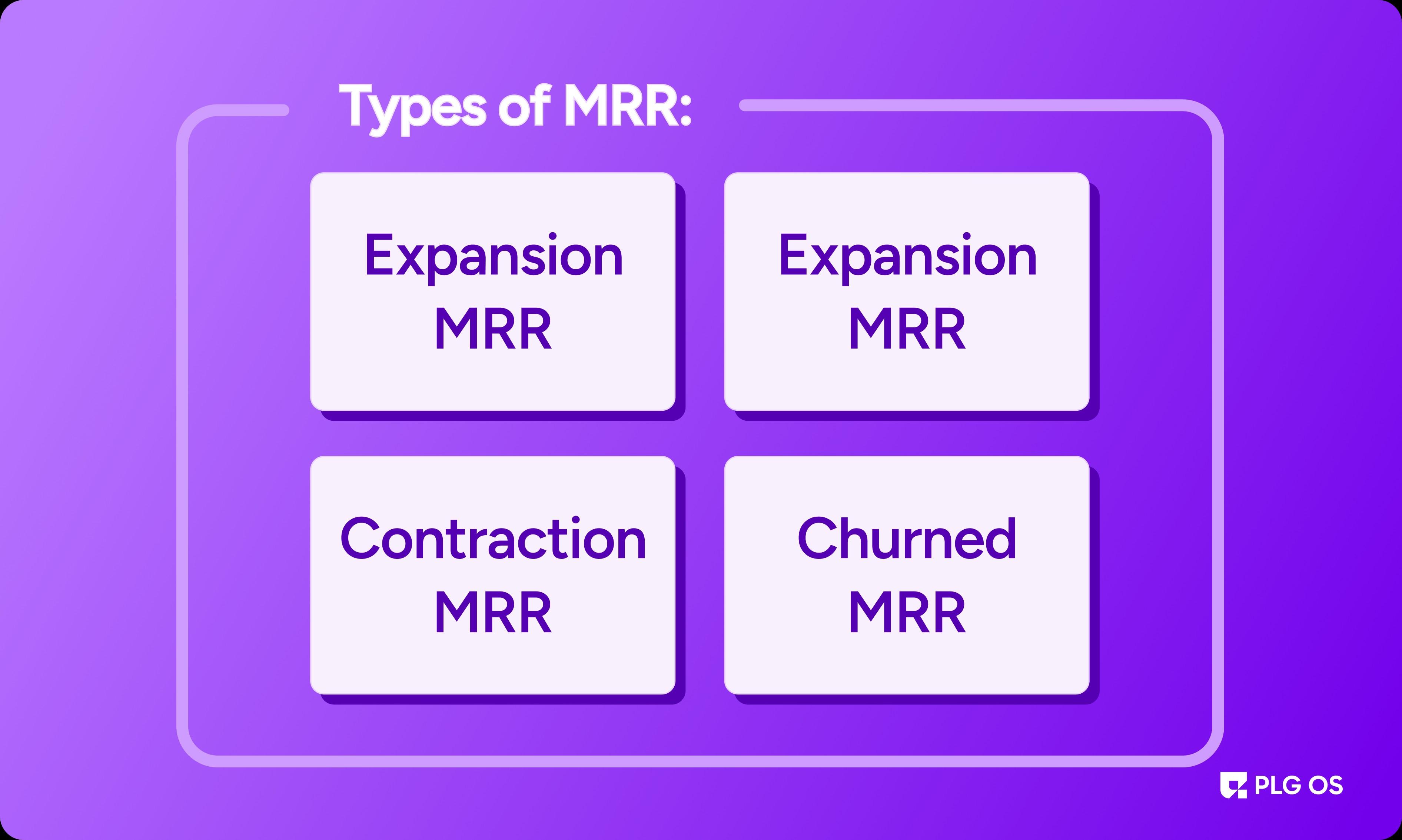
Breaking Down MRR
To gain deeper insights, it’s helpful to break MRR down into these components:
New MRR:
Revenue from new customers.
Expansion MRR:
Additional revenue from existing customers (e.g., upgrades).
Contraction MRR:
Revenue lost from customers downgrading.
Churned MRR:
Revenue lost from customer cancellations.
Conclusion: MRR as Your Guiding Metric
For SaaS businesses, MRR serves as a crucial guiding metric. It provides a consistent measure of financial health and growth, helping you make informed decisions for long-term success. However, MRR should be considered alongside other key metrics like Customer Acquisition Cost (CAC), Lifetime Value (LTV), and churn rate for a complete picture of your business's performance.
PLGOS helps streamline onboarding, reduce churn, and encourage upselling through its customizable in-app tools. By leveraging these tools, SaaS companies can create a stable foundation for long-term growth and improve MRR efficiently.
By understanding, tracking, and working to improve your MRR, you’re setting your SaaS business on a path to sustainable growth and long-term success. Whether you’re a founder, product manager, or SaaS executive, keeping a close eye on your MRR will empower you to make informed decisions and drive your business forward.