Customer Effort Score (CES): Definition, Calculation and Strategies
While metrics like NPS (Net Promoter Score) and CSAT (Customer Satisfaction Score) have been mainstays in measuring customer satisfaction, the Customer Effort Score (CES) has emerged as a crucial indicator of customer loyalty and retention. In this guide, we'll explore what Customer Effort Score is, why it matters, and how to leverage it effectively for your SaaS business.
What is Customer Effort Score?
Customer Effort Score measures the amount of effort a customer needs to exert to achieve their goals with your product or service. Gartner research indicates that 96% of customers with high-effort experiences are disloyal, while only 9% of customers with low-effort experiences are disloyal. This can include various customer interactions such as:
Technical Support:
Accessing technical support
Onboarding:
Onboarding to your platform
Issue Resolution:
Resolving issues
Information Access:
Locating information
Task Completion:
Completing key tasks within your product
The idea is simple: the easier it is for customers to achieve their goals, the more likely they are to continue using your service and recommend it to others.
How to Calculate Customer Effort Score
The Basic Formula
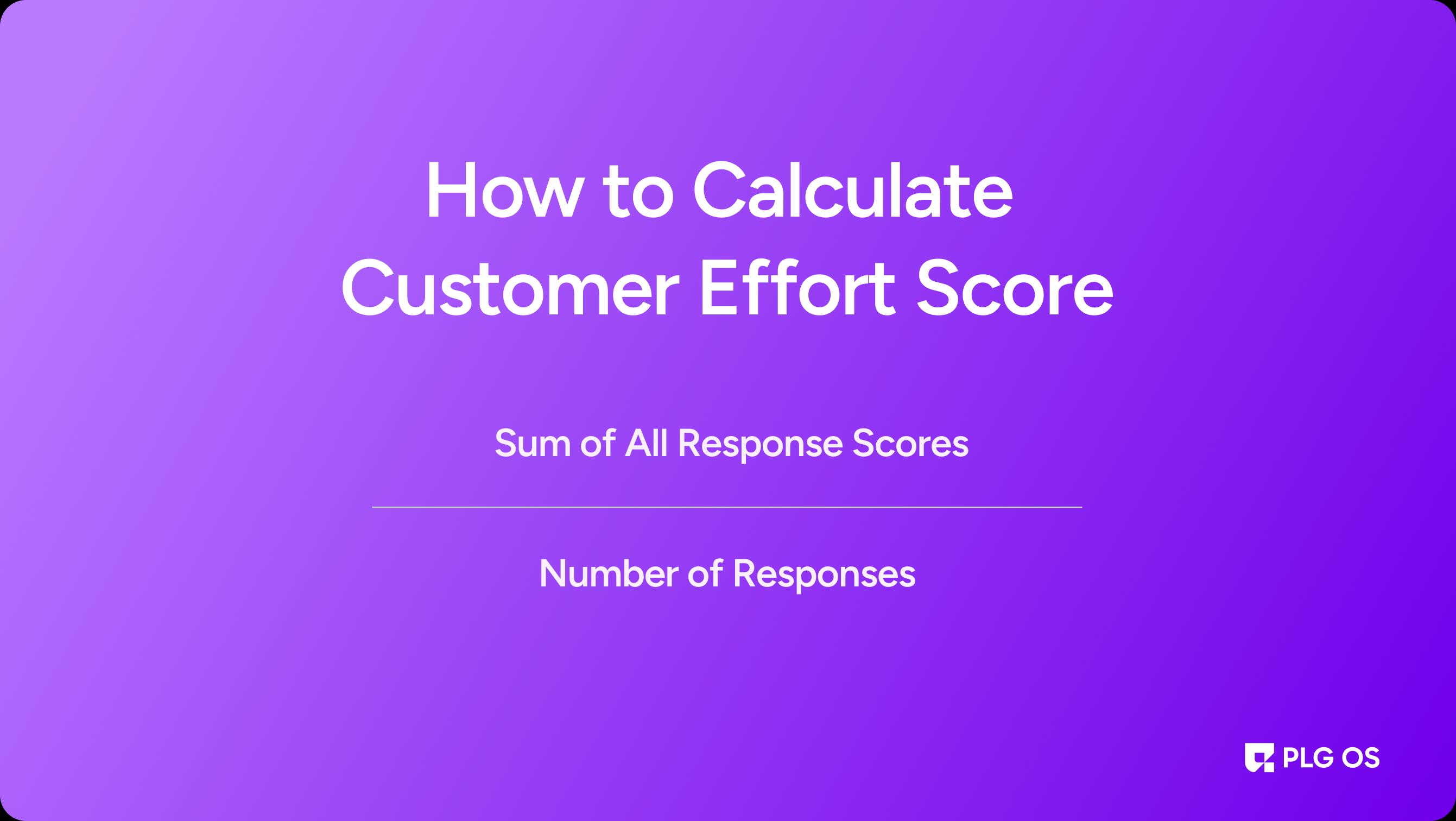
Traditionally, Customer Effort Score is calculated using a 7-point scale where customers respond to the statement: "PLG OS made it easy for me to handle my issue." Responses range from "Strongly Disagree" (1) to "Strongly Agree" (7).
Modern Variations
Many SaaS companies have adopted simplified scales, such as a 5-point or even a binary-plus-neutral scale, which can yield higher response rates:
5-Point Scale:
Very Difficult (1), Difficult (2), Neutral (3), Easy (4), Very Easy (5)
Binary Plus Neutral:
Difficult (1), Neutral (2), Easy (3)
When to Measure Customer Effort Score
Post-Interaction:
After customer support interactions, onboarding, or new feature adoption
Task Completion:
After completing critical workflows, document uploads, or integration setups
Milestone Achievement:
Upon reaching key success metrics, completing training, or following major updates
Why does Customer Effort Score Matter in SaaS
Predictive Power
Customer Effort Score is 40% more accurate at predicting customer loyalty than CSAT. This makes it invaluable for SaaS businesses where recurring revenue is vital.
Direct Impact on Revenue
A high customer effort score often correlates with increased churn, reduced expansion revenue, and higher support costs. Customers get frustrated when something they want to do with your brand requires a lot of effort, or unexpected effort for them,” said Jeannie Walters, CEO and chief experience investigator at Experience Investigators.
Competitive Advantage
In the crowded SaaS market, ease of use is a key differentiator. A low CES can serve as a compelling advantage over competitors.
How to Improve Your Customer Effort Score
1. Product-Level Improvements
UI Streamlining:
Simplify navigation, reduce clicks, and provide contextual help
Self-Service:
Build a comprehensive knowledge base, implement intelligent search, and offer video tutorials
2. Support-Level Improvements
Channel Optimization:
Offer omnichannel support, live chat, and callback options
Team Empowerment:
Train for first-contact resolution, provide decision-making authority, and improve ticket routing
3. Process-Level Improvements
Onboarding Simplification:
Provide guided workflows, templates, and quick-start guides
Automation:
Enable automatic setups, one-click actions, and integrations
Best Practices for Customer Effort Score Implementation
1. Survey Design
Question Design:
Keep questions simple and consistent, avoiding leading language, and provide optional comment fields for context
Timing Strategy:
Survey customers immediately after interactions and be mindful of survey fatigue and user time zones
2. Data Analysis
Data Segmentation:
Analyze by customer type, feature usage, interaction channel, and track trends over time
Planning:
Set clear improvement targets, create actionable plans, and monitor your progress
Common Customer Effort Score Pitfalls to Avoid
Survey Mistakes:
Avoid surveying too frequently, using complex language, and neglecting mobile optimization
Analysis Errors:
Don't focus solely on averages—be sure to examine trends, properly segment, and consider the context of responses
Implementation Issues:
Close the feedback loop by addressing customer concerns, avoid inconsistent measurement, and ensure timely survey deployment
Integrating Customer Effort Score with Other Metrics
1. Complementary Metrics
Create a comprehensive view of customer experience by combining Customer Effort Score with other metrics like NPS, CSAT, Time to Resolution (TTR), and First Contact Resolution (FCR).
2. Business Impact Metrics
Link Customer Effort Score improvements to business outcomes by monitoring metrics such as Customer Lifetime Value (CLV), churn rate, expansion revenue, and support costs.
Future Trends in Customer Effort Score Measurement
AI and Automation:
Innovations like predictive effort scoring, real-time feedback analysis, and automated survey timing can enhance CES measurement and insight
Advanced Analytics:
Techniques like sentiment analysis, journey mapping, and predictive churn modeling are increasingly being used to extract deeper insights from CES data
Conclusion
Customer Effort Score is more than just a metric—it's a powerful tool for understanding and improving customer experience. In the SaaS industry, where customer retention and expansion are key to growth, reducing customer effort can be the difference between success and stagnation.
To effectively implement Customer Effort Score:
Measurement:
Choose the right measurement scale for your needs
Timing:
Survey at key customer interaction points
Action:
Act on the feedback you gather
Tracking:
Track trends over time
Business Impact:
Link improvements directly to business outcomes
Remember, the goal isn't only to measure effort; it's to reduce it systematically. By making your product easier to use and your support more accessible, you'll not only improve your Customer Effort Score but also foster a loyal customer base. Start measuring and optimizing your Customer Effort Score today to enhance customer satisfaction, retention, and long-term growth.
FAQs
1. What is Customer Effort Score (CES)?
CES measures how easy it is for customers to interact with your business, especially when solving a problem or getting support.
2. How is CES calculated?
Customers rate their experience on a scale (typically 1 to 7); the average score is your CES.
3. Why is CES important?
A low-effort experience often leads to higher customer satisfaction, loyalty, and repeat business.
4. When should you use a CES survey?
Right after key interactions—like support calls, product purchases, or onboarding processes.
5. How can I improve my CES?
Simplify processes, reduce wait times, offer self-service options, and train staff for quick, effective resolutions.