The Impact of Customer Feedback on Product Development and Success

Customer reviews are very important for any SaaS company since you want to know what your users think about your product. It not only helps the SaaS company to improve its product but also encourages other new users to try the product.
Every comment, every review, every suggestion brings up a chance to make your product better whether it is about functionality, looks, or just about enhancing the existing features, feedback covers everything.
A study by HubSpot indicates that businesses should analyse the feedback and track performance over time to boost company growth.
What exactly is Customer feedback?
Customer feedback means what a user feels about your product, this includes everything about your product whether it is the UI or functionality of the product.
Theoretically, Customer feedback is of two types: Positive and Negative.
- Positive feedback tells you about what’s good about your product.
- Whereas negative feedback is a bunch of messages or suggestions that may contain frustration, problems, or hardships of the customer using your product.
Customer feedback helps to find the exact reasons that are responsible for your company’s low customer retention rate and high customer churn.
Now let’s take a look at how exactly customer feedback can help in product growth.
How can feedback be used for better product growth?
Product growth is highly correlated with customer satisfaction, the more demands of customers are fulfilled, the more they will be loyal to the business which automatically solves the problems such as low customer retention, high customer churn, etc.
Companies should treat user feedback and reviews as free tools that help them identify the positive and negative sides of their product.
For example: From 2016 to 2017, Uber worked on its app interface, and significant updates on location points, and user experience were made. Uber used customer feedback to enhance its app interface. By applying customer feedback from riders and customers Uber addressed location errors and other queries resulting in a user-friendly interface. They wouldn’t have known it without actively listening to customer feedback
Here is the short and simple step-by-step process for using customer feedback for better product growth:
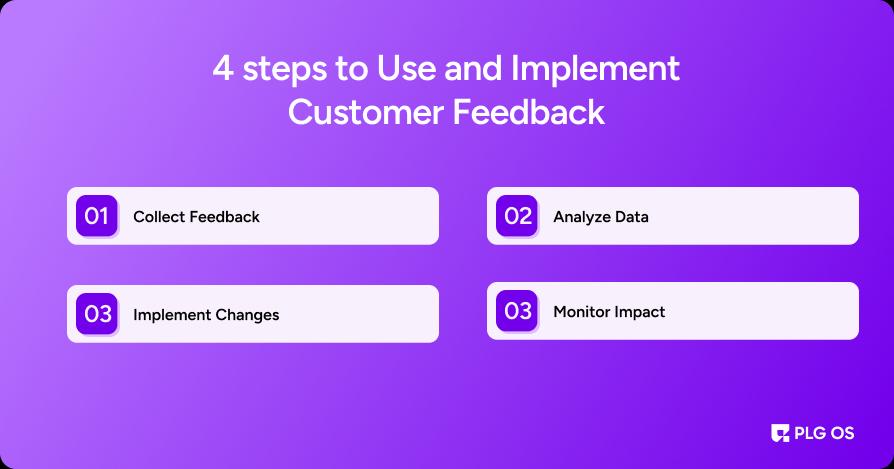
1. Collect Feedback:
- Use different social media platforms where open discussions occur regarding your products or similar products, this will help you to know exactly what customer needs are.
- Use surveys, and discussion forums to collect feedback.
2. Analyze Data:
- Now you have all the reviews and feedback, so appreciate the positive reviews and work on the negative feedback.
- Analyze the data and categorize them into different sections such as usability, features, and performance.
- Identify the pain points and work on the areas of improvement.
3. Implement Changes:
- Make major changes and maintain transparency.
- Update and give timelines to the users about the updates for better customer engagement.
4. Monitor Impact:
After the updates have been made, it is time to collect feedback regarding the new updates, if the feedback is positive “Celebrate” otherwise the process starts again.
How does customer feedback impact both users and companies?

Customer Satisfaction is directly proportional to business growth. The more your customers are happy with the product the more they are going to stay with your company. It’s like the give-and-take rule, the better product they get from you, the better business they give back to you.
Let’s take a look at how customer feedback impacts users:
1. Helps in making the product more user-friendly:
Regular feedback and reviews help the companies to understand what our users demand which helps them to make several changes that make it easy for users to use the product efficiently.
2. Better Customer Satisfaction:
Suppose you use a product, you often have specific features in mind that would make it even better. This is where your feedback comes in. By sharing your thoughts, you help the companies understand your needs. This feedback allows them to make important changes and improvements to the product, ultimately enhancing your experience and making the product more effective for everyone.
Now let's talk about how customer feedback impacts companies:
1. Helps in understanding Customer Needs and Expectations
Customer feedback works as a mirror for any product, it shows the expectations of customers for the product and gives direct insights. Companies should make sure that their products are suited to the demands of the customers. This customer-focused strategy helps in prioritizing the development of the product.
2. Helps in Identifying Areas of Improvement
Users can find errors that a developer, tester, or product manager might not find. So to promote product growth, it is crucial to use consumer input to identify areas that require development.
Actively listening to users always helps to identify technical issues, functional challenges, and performance flaws that affect product growth.
We don’t want any imperfections in our product so by carefully examining the feedback, businesses should make solid decisions to improve the services and provide more reliable and better consumer experiences.
3. Building Strong Customer Relationships
Building good customer relationships is an art since customers don’t just buy products, they buy the relationships you build with them.
Strong customer relationships are key to a business's long-term success, and feedback is a critical component of this process.
A sense of collaboration is created when you interact with clients, whether it's to resolve issues, offer praise, or carry out suggestions. This exchange encourages customer retention and gives clients a sense of being valued and heard.
Additionally, by including customers in product development processes through feedback loops, businesses can build a community around their brand and boost customer happiness and engagement. Good connections with customers result in improved retention rates, more referrals, and long-term success.
5 Ways to Get Feedback from Customers

Customers are always sharing feedback on the products they use, whether they are sitting at a family function or surfing around the internet.
You can easily tap into the conversations regarding your product over the internet using primary websites such as Reddit, Facebook, and Quora. These websites are the primary home for unlimited reviews, never-ending group discussions, and thousands of queries.
Gathering customer feedback and taking quick action always results in better customer engagement and better product success. It gives companies a clear picture of what customers think about their products.
Some of the best techniques to gather feedback are mentioned below:
1. Surveys
The best methods for getting feedback from customers are surveys. If you are looking for organized data on customer preferences and experience then surveys are the best.
Keep the survey short and concise, don’t make it a burden for the users since nobody wants to invest their valuable time on long and complex surveys.
For Example, Netflix sends surveys via email, these surveys are user-friendly and engaging. This technique helps them to reach a large amount of diversified customers to gather feedback and information regarding their product.
Surveys, whether conducted online or offline, are a vital tool for gathering consumer input and comprehending their preferences. They are simple to convey by email, social media, or websites, and businesses can rapidly get feedback from a variety of audiences. Online surveys also frequently make it easier to gather and analyze automatic data and offer quick insights into the opinions of clients.
2. Social Media Engagement
People use social media not just for entertainment but also for sharing reviews and feedback about any particular product. Companies should keep a close eye on every mention, every post related to their product, and any particular comment, this will help them to gather information about their product.
These sites are effective means of gathering customer feedback because they provide businesses instant access to the thoughts and feelings of their users.
Customers express their opinions on social media sites like Facebook, Instagram, Reddit, and Twitter, which is crucial for figuring out public opinion. This process provides businesses the ability to monitor discussions, see patterns, and instantly address customer inquiries.
3. Direct Customer Interactions
What can be better than a face-to-face interaction with your customer, you can gather an infinite amount of data, opinions, and feedback related to your products and this can be done by organizing a social gathering (like a Halloween party for your customers) or a Christmas celebration, everyone loves celebrations. This process will not only help you to gain feedback but will also help in gaining new customers.
If not celebrations then one-on-one talks, group discussions, or live events, these events are also very promising. Interviewing customers is a successful strategy. These interviews provide the chance to go further into your product and provide open-ended questions. You can gain insights that online surveys and feedback cannot by encouraging a welcoming environment where customers feel free to offer ideas.
4. Online Reviews and Ratings
As a customer, ratings are one of the easiest ways to give feedback on any product, just click on the number of stars, and your feedback is done. No one likes spending their time writing long feedback about any product, unless you are too frustrated because of the product or the product has made your life difficult.
To make the process of customer feedback fun, in 2008 Starbucks started a platform "My Starbucks Idea" where Starbucks invited its customers to submit suggestions for new products, store improvements, and other innovations. This campaign was a huge success and helped Starbucks to gain more customers.
Businesses should come up with different techniques to encourage customers to post their opinions after purchasing which can help in gathering information and help in the evaluation process.
Well, to do that you can send follow-up emails or provide online instructions for giving reviews or you can use the Starbucks technique. You can also reward users with reward points or discounts if they post reviews about your product online, a win-win situation for both parties.
5. Internal Feedback
This is a type of feedback that does not require much effort since Internal Feedback is the feedback from team members, workers, and other stakeholders in the company.
This is also an important part since the people who build the product or who are highly invested in the product understand the aim of the product better than anyone else.
As the Harvard Business Review Study suggests businesses can’t improve operations without honest and substantive feedback. The more the number of feedback, the more people are exploring the product which means there is more room for improvement.
To get effective internal feedback you need to provide an environment to your team members where they do not hesitate to share what they actually feel about the product.
Frequent meetings, brainstorming sessions, and seminars can offer organized discussion opportunities that will let team members share their thoughts and experiences.
How to implement Customer Feedback?
Enhancing product quality, increasing customer happiness, and promoting product success all these three points depend on the correct implementation of customer feedback.
If the implementation process is not done properly there is no use in gathering information from the user, there is no use in organizing the data. It’s like purchasing all the required ingredients and then preparing your favorite dish but messing up the whole dish during the presentation.
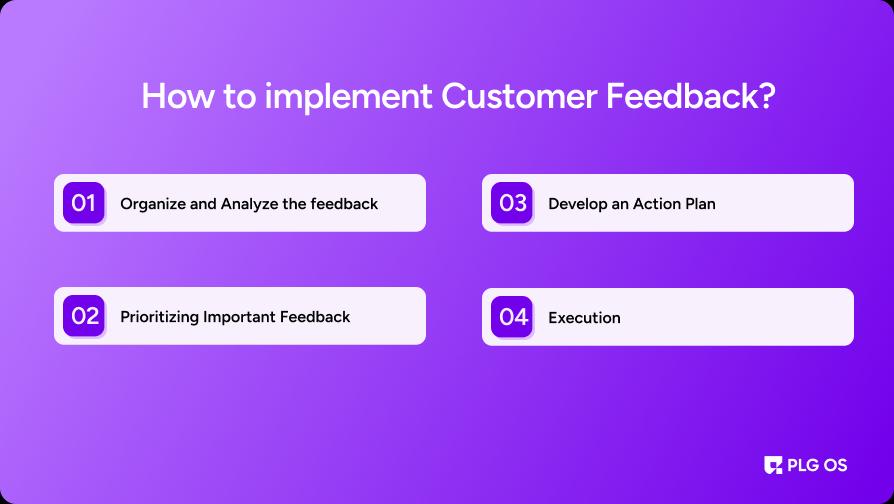
Implementation of customer feedback is divided into different stages that are mentioned below:
1. Organise and Analyze the feedback
Effective customer feedback implementation begins within the organization. You need to establish a single location for all feedback using tools for managing it or to make it simple to use customer relationship management (CRM) systems.
This makes data easily accessible to the appropriate team from a variety of sources, including research, social media, online reviews, and direct engagement.
You need to categorize the data into common sections like product features, functioning, customer service, and pricing after the data collection process is completed.
Categorization also helps in finding similarities and patterns in the data. It is critical to distinguish between qualitative feedback (such as comments and suggestions) and quantitative input (such as ratings). While quantitative data shows trends in consumer sentiment, qualitative insights offer a deeper knowledge of the user experience and context.
So the point is to use each and every type of data, analyze it, and understand the patterns and similarities which will result in better decision-making.
2. Prioritizing Important Feedback
Whether it’s about life or feedback you need to prioritize things. So there are different types of feedback.
To speed up the implementation process, it is very necessary to decide which feedback should be analyzed first. Analyze the frequency of particular issues brought up in the customer's feedback first.
Finding recurring queries where several customers have voiced similar complaints will help you identify important areas that require immediate action. So invest more time on recurring queries and resolve them first.
3. Develop an Action Plan
Now after prioritizing the queries you need to create an action plan. The main goal should be to “convert insight into observable changes”. Establish defined goals first, based on input that has been prioritized.
These goals have to be time-limited, meaningful, quantifiable, achievable, and specified.
To make tracking and necessary adjustments easier, break the strategy up into manageable segments. Each section can concentrate on a particular component of the input, enabling teams to work more efficiently implement changes slowly, and evaluate their effects. It’s like making a timetable for your day, dividing your entire day into different sections so that you can use your time more efficiently.
To evaluate progress toward the stated goals, regular checks and reviews must be conducted. This process not only helps in better customer engagement but also encourages a culture of continuous development.
4. Execution
Careful execution of the action plan is necessary when implementing changes based on customer feedback.
Set clear benchmarks to evaluate the process of execution. This helps to focus on short-term goals that lead to better implementation of long-term goals.
Keep a complete record of the implementation process, including the difficulties encountered and the strategies used. For upcoming projects, this material may prove to be an invaluable resource.
Conclusion
In today’s competitive SaaS landscape, a great user experience is essential. At PLGOS, we focus on enhancing user experience through our suite of components—such as intuitive onboarding, gamification, feedback surveys, and chatbots—that work together to create seamless interactions. By implementing these features, SaaS companies can not only meet but exceed user expectations, leading to higher retention and more referrals. Every interaction with your product is an opportunity to delight your users, and our solutions empower you to design engaging and user-friendly interfaces that keep them coming back. By investing in these UX improvements, you can unlock your SaaS company’s full potential and drive sustainable growth. Let PLGOS be your partner in transforming user interactions into positive experiences that fuel your success. PLG OS helps enhance the customer feedback experience by providing feedback collection tools, customizable surveys, and actionable insights. These features help you to gather customer feedback effortlessly which ensures faster decision making and efficient problem solving. The best part is integration takes just 30 seconds, making it easier than ever to solve customer queries in no time.