10 Real-Time Customer Engagement Strategies to Drive Retention
Gone are the days when businesses could afford to wait hours—or even minutes—to engage with their customers. In a world where users expect instant responses and hyper-personalized experiences, real-time customer engagement has become a game-changer for building lasting relationships.
Whether you're running a SaaS product, an e-commerce brand, or a digital service, engaging your users at the exact moment they need support, encouragement, or a nudge can make all the difference. And the reward? Higher user satisfaction, stronger loyalty, and better retention rates.
This blog explores over 10 actionable real-time customer engagement strategies that leading brands use to boost retention. From in-app messaging to smart automation tools and frameworks like PLG OS, these strategies are proven to drive long-term value and deepen customer relationships.
What Is Real-Time Customer Engagement?
Real-time customer engagement refers to delivering interactions, content, and support instantly, based on live user behavior or events. It drive customer retention. It’s the opposite of delayed responses or static messaging. Understanding your customers’ pain points is the first step toward crafting effective customer engagement strategies that truly resonate. By training your sales team to personalize interactions, you not only address individual needs but also build a lasting sense of community around your brand.
It involves:
- Trigger-based communication (like notifications or messages)
- Personalized, behavior-driven content
- Context-aware assistance or guidance
This dynamic engagement not only elevates the user experience but also plays a critical role in customer engagement retention.
Why Real-Time Customer Engagement Matters More Than Ever
Customer loyalty is no longer guaranteed by good products alone. Users now expect instant, relevant, and personalized experiences across all touchpoints. That’s where real-time customer engagement becomes a strategic advantage.
It enables businesses to:
- Interact with customers at the exact moment of need
- Resolve friction points quickly
- Offer context-aware recommendations and nudges
- Foster long-term loyalty and trust
In short, being present and responsive in the user’s journey, when it matters most, is the key to improving customer retention.
Challenges in Real-Time Customer Engagement
While real-time engagement can deliver impressive results, implementing it effectively comes with its own set of challenges. Here are some common hurdles teams face:
Fragmented Messaging Across Teams:
Without cross-functional alignment, different departments often send conflicting messages. For example, product teams might push in-app tooltips while marketing sends unrelated emails and support discusses something else entirely—confusing the customer and weakening the overall experience.
Lack of a Shared Engagement Playbook:
When there’s no unified strategy guiding communication, users receive inconsistent or redundant information across touchpoints. This disconnect can lead to frustration and lost opportunities for engagement.
Overdependence on In-App Messaging:
Solely relying on in-app messaging limits your reach. While it's useful for immediate interaction, it doesn’t cover scenarios where users are inactive, disengaged, or not logged in.
Limited Visibility into Customer Behavior:
Without integrating multiple communication channels (email, push, support, etc.), teams struggle to capture comprehensive user data—making it hard to personalize messages or improve retention effectively.
No Follow-Through on Engagement:
Many teams fail to plan what comes after an in-app nudge. Engagement doesn’t stop at a tooltip—it should be a continuous journey with timely next steps, feedback loops, and encouragement.
Disconnected Messaging from Product Usage:
If engagement efforts don’t align with real product behavior, messages lose relevance. When users struggle with a feature, helpful prompts and real-time support should guide them—not confuse or overwhelm them.
Increased Operational Costs:
In the absence of intelligent automation or alignment, businesses risk incurring higher expenses on support, training, or manual messaging as a result of inadequate engagement.
Lack of Multi-Channel Strategy:
A robust customer engagement strategy requires a blend of channels—email, chat, push, in-app, and even offline touchpoints. Focusing on just one limits your ability to engage customers where they are.
What is customer retention?
Customer retention is the practice of keeping customers engaged and satisfied with a company's products or services over time, resulting in repeat sales. For example, a subscription-based business like Netflix focuses on client retention by constantly providing new content and tailoring recommendations to users' tastes. A mere 5% increase in retention can boost profits by 25% to 95%. This not only keeps subscribers coming back, but also minimizes the likelihood that they would switch to a competitor.
10 Real-Time Customer Engagement Strategies
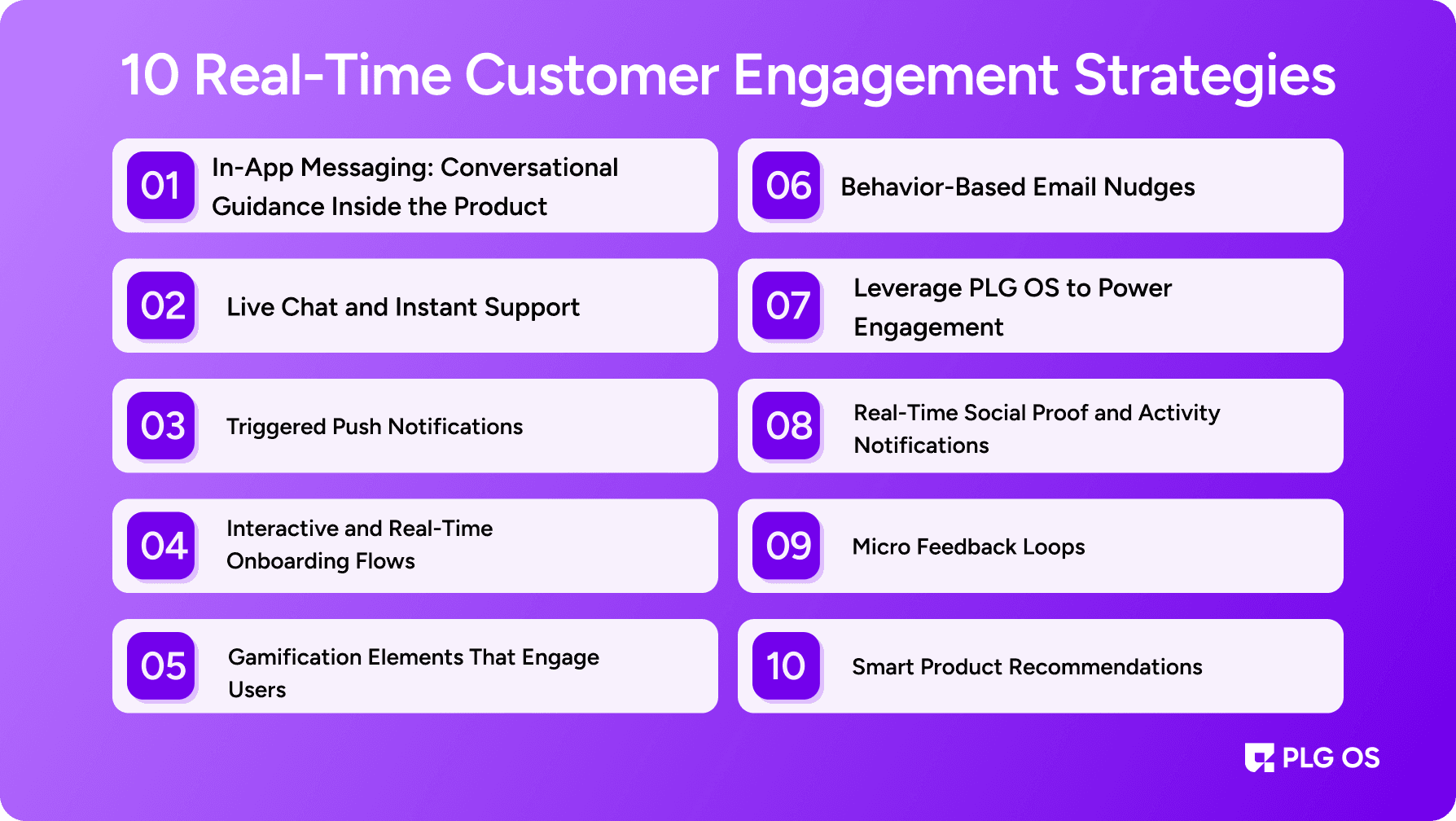
1. In-App Messaging: Conversational Guidance Inside the Product
One of the most effective ways to engage users in real time is through contextual in-app messages. These can welcome new users, highlight features, provide tips, or congratulate milestones. Businesses using real-time messaging see a 40% higher engagement rate compared to static campaigns.
Instead of waiting for users to seek help, proactive in-app messaging ensures they receive relevant prompts right when they need them.
Tools to try: Intercom, Userpilot, Appcues
Why it works: Reduces drop-offs, accelerates onboarding, and enhances the perceived value of the product.
2. Live Chat and Instant Support
Instant support is now a baseline expectation. Live chat options, whether via bots or real agents, allow you to resolve queries in real time—while the user is still active on the platform.
Quick issue resolution not only improves satisfaction but also prevents frustration that could lead to churn.
Tools to explore: Zendesk, Drift, Freshchat
Strategy tip: Use AI-powered chatbots for handling FAQs, while escalating complex queries to human agents seamlessly.
3. Triggered Push Notifications
Push notifications are powerful when they are relevant, timely, and personalized. Triggered push messages based on user behavior—such as abandoning a cart, achieving a milestone, or missing a deadline—keep users connected and prompt action.
This form of real time customer engagement directly influences customer retention by driving timely interactions.
Tools: OneSignal, CleverTap, Firebase Cloud Messaging
Best Practice: Keep messages concise, contextual, and optional for the user to control frequency.
4. Interactive and Real-Time Onboarding Flows
A seamless onboarding experience is essential for engagement and retention. Real-time onboarding adapts to a user’s progress and provides relevant prompts based on in-app behavior.
Rather than showing all features upfront, smart onboarding breaks down steps and responds to what the user is doing in the moment.
Impact: Lower abandonment, faster activation, better long-term usage.
Recommended approach: Implementing onboarding through a product-led growth lens, such as with PLG OS, ensures that onboarding is tightly aligned with usage metrics and goals.
5. Gamification Elements That Engage Users
Gamification introduces elements like badges, points, leaderboards, and streaks to drive continuous user engagement.
When users are rewarded for consistent actions or given challenges with real-time feedback, they stay more engaged and invested in the product.
Real-time engagement examples:
- LinkedIn's profile completeness meter
- Duolingo’s daily streak rewards
Why it works: Adds fun, encourages habit formation, and builds emotional investment in the product journey.
6. Behavior-Based Email Nudges
Emails don’t have to be static. In fact, real-time emails—triggered by user behavior—are among the most effective retention tools.
For example, if a user hasn’t logged in for a week, send a personalized reminder with a summary of what they’re missing. If they’ve used a feature three times, offer tips to go deeper.
Tools: Customer.io, Iterable, Vero
Strategy tip: Focus on segmentation, timing, and personalization to avoid generic messaging.
7. Leverage PLG OS to Power Engagement
PLG OS is a comprehensive framework built for product-led growth, designed to help companies optimize for user engagement, activation, and retention through real-time data and actions.
Here’s how it strengthens your customer engagement strategy:.
- Real-time data tracking to understand user behavior
- Automated triggers for personalized engagement
- Frameworks for scaling onboarding, upsells, and support
- Measurement tools for retention and activation metrics
Incorporating PLG OS into your product strategy ensures your team has a unified system to deliver personalized, timely, and relevant experiences at every touchpoint.
8. Real-Time Social Proof and Activity Notifications
Displaying user activity in real time creates trust and urgency. When users see others interacting with your product, it validates their choices and encourages further exploration. Real-time analytics reduce average handling time by 15–20% and boost agent productivity by 25%.
Examples include:
- "John from New York just signed up"
- "This item was purchased 5 times in the last hour"
- "150 people are viewing this right now"
These social signals enhance credibility and boost conversions, thereby influencing retention indirectly.
Tools: Fomo, Proof, Nudgify
Pro tip: Keep it subtle and relevant. Too many pop-ups can be counterproductive.
9. Micro Feedback Loops
Real-time feedback mechanisms such as thumbs-up/down buttons, quick star ratings, or short in-app surveys help you capture valuable insights instantly.
By collecting feedback immediately after a user interaction, you:
- Learn what’s working and what’s not
- Show users that their opinions matter
- Identify friction points before they lead to churn
Tools: Wootric, Survicate, Delighted
Why it matters: Closing feedback loops quickly contributes to a better user experience and higher retention.
10. Smart Product Recommendations
Personalized recommendations based on real-time behavior are essential, especially in SaaS and e-commerce platforms. By analyzing what the user is currently doing, you can suggest relevant features, products, or content that enhances their experience.
Whether it’s suggesting the next article, the next lesson, or an upsell opportunity, smart suggestions demonstrate understanding and relevance
Technologies used: AI/ML engines, collaborative filtering
Impact: Higher engagement rates, increased time-on-site, and better retention metrics.
Your Real-Time Engagement Strategies Comparison
Here’s a summary of real time customer engagement strategies discussed above:
| Strategy | Purpose |
|---|---|
| In-App Messaging | Deliver guidance exactly when needed |
| Live Chat | Provide instant assistance |
| Push Notifications | Trigger timely nudges based on actions |
| Real-Time Onboarding | Personalize early product experience |
| Gamification | Motivate continued use with interactive elements |
| Behavioral Emails | Re-engage users through personalized outreach |
| PLG OS Integration | Centralize and automate real-time strategies |
| Social Proof | Build credibility through live activity feeds |
| Feedback Loops | Capture and act on live user input |
| Smart Recommendations | Suggest next steps for deeper product value |
Final Thoughts
The shift toward real-time engagement is not just a trend—it’s a necessity. Businesses that embrace real time customer engagement tools and tailor interactions to live user behavior will consistently outperform those who rely on outdated, one-size-fits-all approaches.
By incorporating strategies like real-time onboarding, smart notifications, instant support, and frameworks such as PLG OS, companies can significantly improve customer retention, drive loyalty, and turn users into lifelong advocates.
Customer engagement is no longer a campaign; it’s an ongoing conversation—one that starts now, not later.
FAQs
1. What is real-time customer engagement?
Real-time customer engagement refers to interacting with users instantly based on their live behavior, preferences, or actions—such as through in-app messages, push notifications, or live chat.
2. How does real-time engagement help improve customer retention?
By addressing user needs in the moment, you reduce friction, solve problems faster, and increase satisfaction—leading to better long-term loyalty and reduced churn.
3. What are some examples of real-time engagement strategies?
Examples include triggered onboarding flows, behavior-based emails, live chat support, in-app nudges, and smart product recommendations.
4. What tools are best for real-time customer engagement?
Popular tools include Intercom, CleverTap, OneSignal, and product-led growth platforms like PLG OS for a more integrated engagement approach.
5. Can real-time engagement be automated?
Yes, with the right tools, you can automate real-time messages and workflows based on user actions, ensuring timely and relevant communication at scale.