Chatbot vs. Real-Time Support: Which One Should Your SaaS Use?

Seamless customer communication is the essence of a great customer experience.
If you’re running a SaaS business, you already know that customer support can make or break the user experience. And when it comes to providing instant support, you’re probably stuck at the age-old question:
Should we use a chatbot or Real-time support?
Companies are increasingly emphasising on improving customer communication in response to rising consumer expectations.
Choosing between chatbots and Real-time support is crucial for your business since it defines your brand's interaction with its audience. Rather than being a cookie-cutter option, this decision should be based on what would interest your clients the most while still satisfying their varied requirements. Real-time support offers a personal touch, while chatbots are great for efficiency and speed.
What is Real-time support?
With Real-time support, businesses may communicate with potential consumers and clients in real-time through messaging on their website, mobile app, or social media messengers like Facebook, Instagram, or WhatsApp. Immediate responses from salespeople or customer service agents allow customers to ask inquiries and get help quickly, improving the overall customer service experience.
Benefits of Real-time support
- Regarding human connection, Real-time support engagements provide an advantage over all others. They allow for more nuanced talks and higher levels of customer satisfaction by bringing a sense of warmth and empathy to the table.
- The ability to adjust one's communication style to fit the customer's tone and understanding level is a key feature of Real-time support agents.
- Agents can use Real-time support to start discussions based on customers' or prospects' actions on the website or app, assisting before they even ask for it. This leads to better customer experience and effective lead nurturing.
- Improving customer satisfaction with personalized assistance is another key benefit. Real-time support enables support interactions to be tailored to each client's unique use case/context and past purchases or interactions.
- There will be less cart abandonment if customers can get instant answers to their questions through Real-time support at critical points in the buying process.
- Real-time support agents are well-equipped to manage complex inquiries requiring in-depth product knowledge, analytical thinking, and problem-solving abilities.
Real-time support agents can spot upsell and cross-sell chances while a customer is talking to them, which means they can increase income by capitalising on these opportunities.
What is a chatbot?
As the name suggests, a chatbot is a software that can talk or write like a real person. Chatbots can be added to websites, mobile apps, and instant messaging apps to help customers with their questions, walk users through a product, or complete deals without any help from a person. Tools like PLG OS can help integrate chatbots into your business.
- They're available 24 hours a day, seven days a week. This means that buyers can get help even when businesses aren't open.
- Chatbots can handle common questions, so you don't need a big Real-time support team. This saves money on staffing and training.
- Chatbots can answer customers' questions 2x faster, making them generally happier and reducing wait times.
- Chatbots can handle any number of chats at the same time, which makes it easier to handle a lot of chats at busy times.
- Chatbots can interact with people who visit websites, ask them basic questions, collect leads, and decide if they are good enough for sales teams to follow up with.
- Chatbots can speed up the sales process by answering initial questions immediately. This cuts down on the time it takes to turn leads into buyers.
- Chatbots can't get tired or burned out, so the tone of their responses and the quality of their service are always the same.
Chatbot vs Real-time support: differences
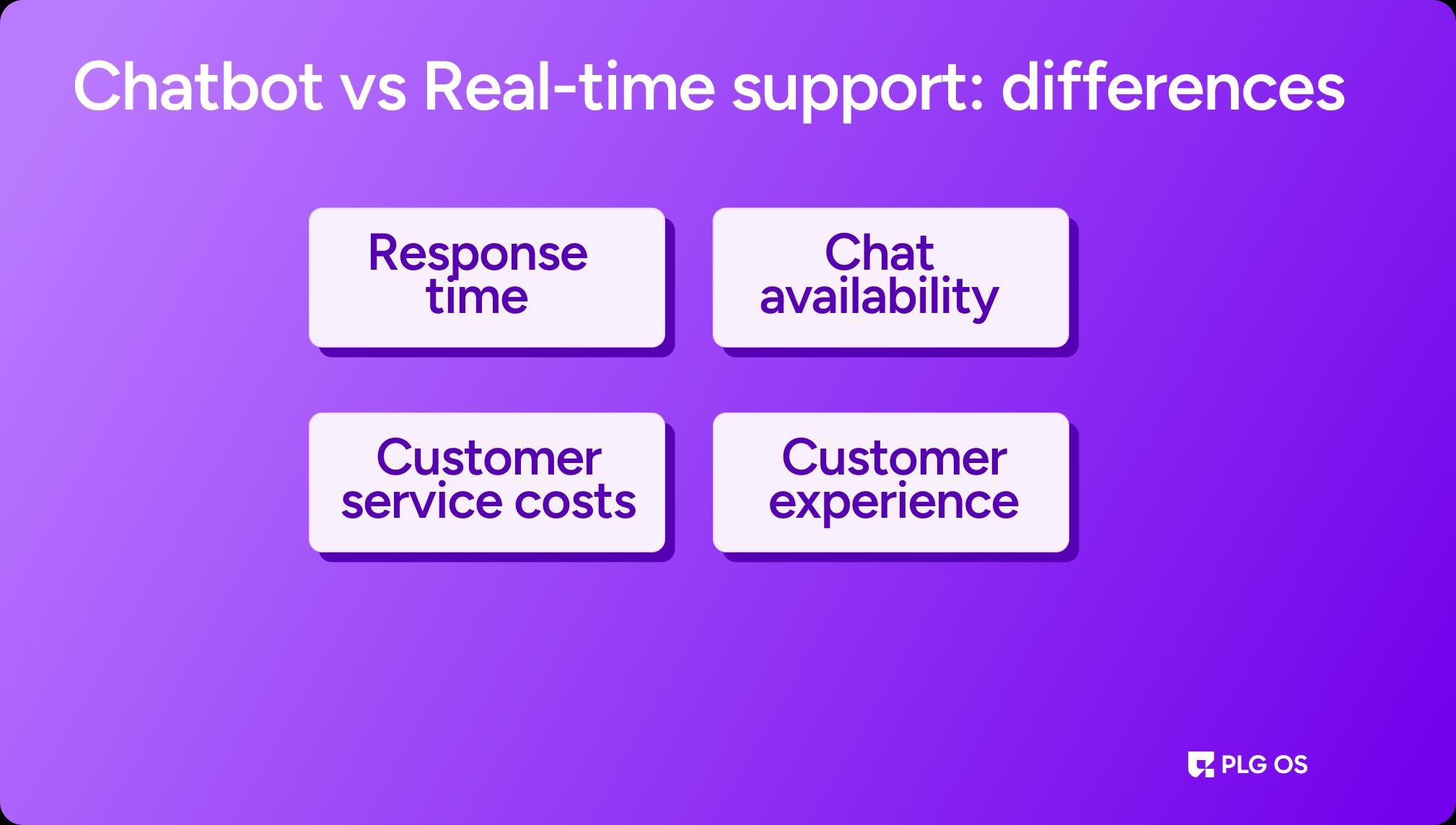
| Feature | Chatbots | Real-time support |
|---|---|---|
| Availability | 24/7 availability without breaks | Limited to working hours unless globally staffed |
| Response Time | Instant, automated responses | Real-time but can have wait times during peak hours |
| Human Interaction | No human touch, AI-driven | Direct human-to-human interaction |
| Complex Queries | Handles simple, repetitive tasks well | Best for complex, nuanced issues |
| Cost | Cost-effective in the long run | Higher costs due to staffing and training |
| Scalability | Easily scales to handle thousands of users | Scaling requires hiring more agents |
| Setup and Maintenance | Requires initial setup and periodic updates | Requires continuous staffing and training |
| Learning and Adaptation | AI learns over time, improving responses | Humans adapt quickly during conversations |
| Data Collection | Collects and analyzes data automatically | Manual data collection and analysis |
1. Response time
Businesses need to have a quick response time because it shows how happy the customers are. Also, 55% of customers leave websites and shopping carts without being able to get answers quickly. This means that if you can't answer customer questions quickly, you could lose half of your sales.
There is a good difference between the usual response time of a human agent in Real-time support software and 45 seconds. Conversely, chatbots are likely to be faster than even the most skilled and experienced customer service reps who can answer questions in less than a minute.
On the other hand, robots can help and support customers right away after they ask for it. They can cut wait times down by a lot, making your customers happier. Chatbot statistics show that 40% of customers don't mind using them as long as they get answers quickly.
Tip
As your first line of customer help, use a chatbot. By sending instant responses, the bot can solve easy problems. It can also sort through spam and only send cases to real support agents that need expert knowledge.
2. Chat availability
You can use Real-time support during business hours, when your customer service team is ready to take calls. Customers won't be able to get help right away when your team isn't available unless you offer Real-time support support 24 hours a day, seven days a week. In this case, the customer can either leave a word through messaging or make a support ticket.
Chatbots, on the other hand, aren't limited by work hours or time zones, so customers can talk to them at any time. Website viewers can easily talk to them without having to wait for Real-time support agents to open up. In terms of availability, AI helpers are much better than Real-time support because of this.
Tip
Chatbots can be used for customer service as an "after-hours" agent to help people when your live workers aren't available. To meet rising customer expectations, you can offer continuous customer help in this way.
3. Customer service costs
Real-time support costs vary based on how many conversations you have with customers and how many Real-time support workers you need to hire. Real-time support services that work well for many customers and get many of the same questions every day will cost a lot to keep up.
You might have to pay more up front for robots because they take longer to build and set up. On the other hand, the chatbot is cheaper than hiring and keeping a Real-time support support team once it is up and running.
Tip
Use a ready-made Bot Template to add a bot to your Real-time support app. You can change it however you want and your bot will be running in minutes without having to know how to code.
4. Customer experience
Customer experience is important for any business because it can make customers happier, more loyal, and more likely to tell their friends about the business. Customers are more likely to keep doing business with a company and tell others about it if they have a good experience with it.
Not only that, but unhappy customers hurt the business's income. According to data, over 60% of customers stop buying from brands whose customer service isn't good enough.
Real-time support software can help you give your customers a great experience when used right. Customers can use it to get in touch with real people when they have a problem, which makes them feel less stressed.
Chatbots let you help customers immediately, 24 hours a day, seven days a week so that you can meet their growing demands. Customers are more interested in digital assistants because they have interactive cards and videos and users can solve their problems by hitting buttons. But robots might not always know how to answer a user's question. If they don't, they must direct the user to a real person who can assist them.
Tip
Find out who you're trying to reach before choosing a customer service tool. Millennial customers, especially 70% of them, like to talk to brands through text-based channels like SMS, chatbots, and Real-time support.
If you sell to older people, you could offer Real-time support, email, and phone customer service. This makes you more likely to meet their communication wants and goals.
Cons of chatbots
- Chatbots won't be able to answer complicated questions. Because they are programmed, they may be unable to answer specific questions or deal with complex issues outside of their field.
- You might not have time for chatbots all the time. The best bidirectional software for customer service can improve customers' experience and make services run more smoothly, but it can be hard to set up and keep up to date.
Cons of Real-time support
- An agent can handle one or two Real-time supports at a time. In this area, chatbots do better than real people because AI reps can hold more than one talk at once, while real people have to focus on just a few questions at a time.
- Scalability isn't always easy. As the number of them rises, a business will need to hire more workers to handle more customer questions.
- It can cost a lot to provide good customer service over time. If your customer base is big, you'll need to hire a lot of Real-time support workers to help your visitors. It will cost a lot to keep Real-time support services running smoothly 24 hours a day, seven days a week, even though the costs will be low at first.
How to Choose What’s Right for Your SaaS
Still on the fence? Here are some key questions to ask yourself:
What’s your budget? :
If you’re tight on budget, start with a chatbot.
What type of support queries do you receive? :
Simple queries = chatbot; complex queries = Real-time support.
How quickly are you scaling? :
Rapid growth? Go for a chatbot.
Do you need a human touch? :
For premium customer service, Real-time support is essential.
Can you handle the maintenance? :
Chatbots need setup and regular updates, while Real-time support needs ongoing staffing and training.
If you have decided to use a chatbot to upscale your customer engagement and want to find the right tool which helps you, you can contact us. We offer customized chatbot solutions according to your queries. Book a call with us today and get your journey started.
FAQs
1. Which is more cost-effective for a SaaS business: chatbots or Real-time support?
Chatbots are more cost-effective as they reduce staffing costs and handle multiple inquiries simultaneously.
2. Can chatbots handle complex technical support issues?
Chatbots are best for simple, repetitive queries. Complex issues often require human intervention through Real-time support.
3. Is Real-time support better for customer satisfaction?
Yes, Real-time support offers personalized support and human interaction, which enhances customer satisfaction, especially for complex queries.
4. Can I use both chatbots and Real-time support together?
Absolutely! Many SaaS businesses use chatbots for initial queries and Real-time support for more complex support needs.
5. Which is easier to scale: chatbots or Real-time support?
Chatbots are easier to scale since they can handle thousands of users at once, unlike Real-time support, which requires additional staffing as demand grows.