8 Customer Retention Strategies for SaaS Startup
Why do some businesses thrive while others struggle?" The secret lies in keeping customers happy and coming back for more! To ensure your customers stick around, you need proven strategies that keep them happy and coming back for more.
From personalized communication to loyalty programs and excellent customer service, each tactic plays a crucial role in strengthening relationships. In this guide, we explore 9 customer retention strategies that truly work, helping you turn one-time buyers into lifelong brand advocates. Ready to boost your retention game? Let’s dive in!
What is customer retention?
Keeping consumers and converting them into loyal buyers is the goal of customer retention, which encompasses a range of actions. The ultimate objective is to increase the lifetime value (LTV) of clients by turning them from one-time buyers into loyal patrons.
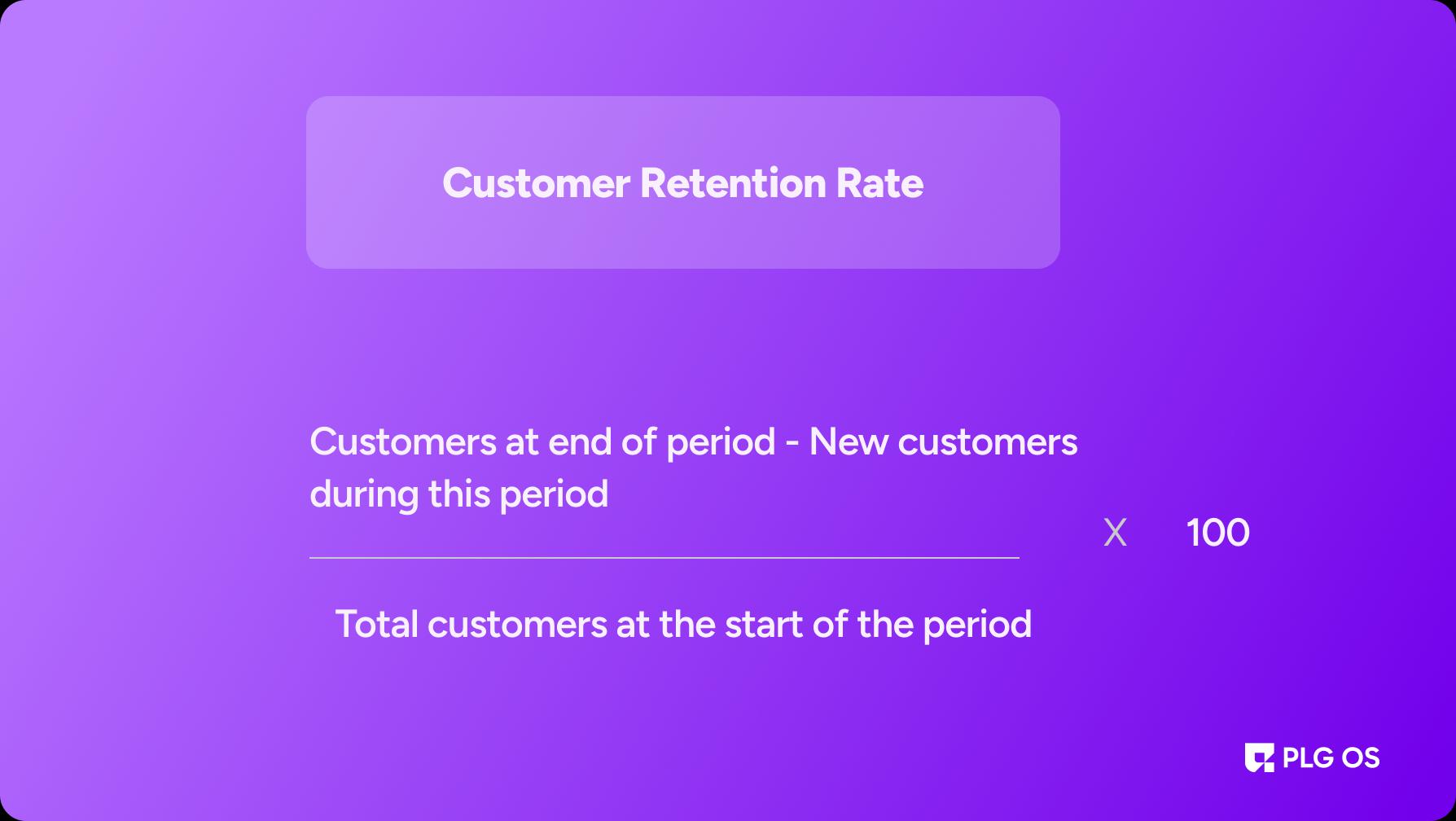
The Customer Retention Rate measures the proportion of original customers that have remained loyal to a business over time.
The customer retention rate (CRR) can be determined by deducting the number of new customers gained from the total number of customers at the conclusion of the period. Simply divide that figure by the initial total of clients and then multiply by 100 to get the percentage.
An organization's customer retention rate is the inverse of its customer churn rate, which is the proportion of customers it has lost within a given time frame.
Why is it important to retain customers?
You may learn a lot about your customer service, the level of loyalty and satisfaction your customers feel, and any warning signs that could turn off future consumers by keeping an eye on client retention rates.Customer retention is an investment that yields long-term benefits:
- Retaining current customers is less expensive than acquiring new ones; nonetheless, many businesses put more resources into acquiring new customers than into cultivating relationships with the ones they already have (82% of organizations say this, according to Econsultancy).
- A higher AOV is the result of two factors: first, the obvious cost savings from keeping existing consumers, and second, the increasing propensity of those customers to spend more over time. A customer's likelihood to spend with you increases by 23% when they are loyal, according to research.
- Providing excellent customer service and retaining them for the long term will also boost your bottom line. According to the data, a just 5% improvement in customer retention can lead to a profit gain of 25% to 95%. It's worth noting that a company's business is generated by 65% of its existing customers.
- The nicest part about having loyal consumers is that they will become advocates for your business when they tell others about their great experiences. Well, that is absolutely invaluable. Yotpo reports that 60% of regular customers share positive experiences with their friends and family when discussing their favorite brands. Customer retention is crucial for your business's success, as word of mouth grows at an exponential rate.
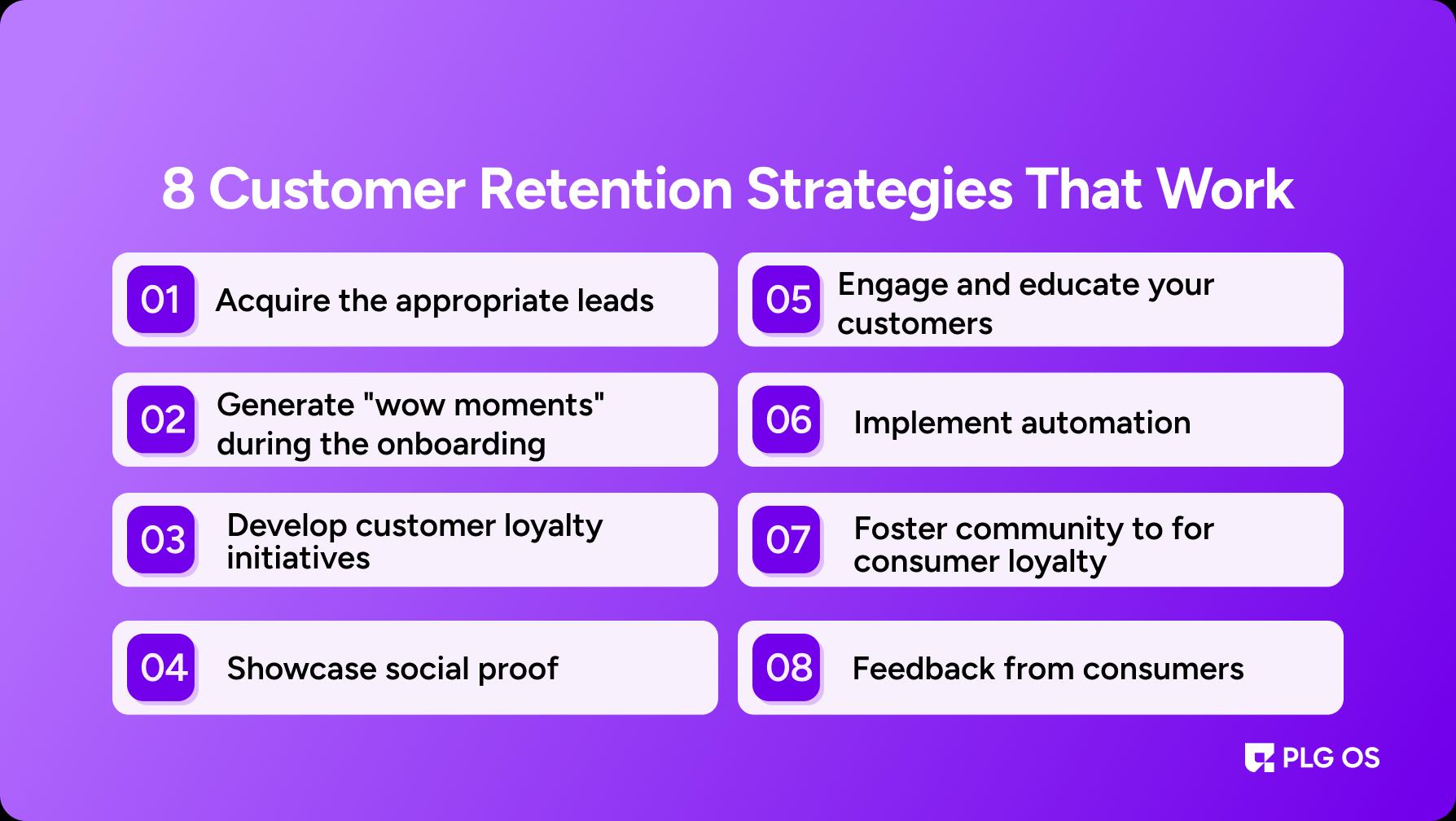
8 Customer Retention Strategies That Work
1. Acquire the appropriate leads
Given that customer retention fundamentally commences at the conclusion of user acquisition, it is advantageous to examine the initial stages of the funnel. If your teams are generating leads that do not align well with your product, customer attrition can rapidly escalate.
For Example:
Say you have 5 bad fit customers that churn at $50k annual recurring revenue a pop. This represents a loss of $250,000 annually that your business is no longer generating. Over a period of five years, this results in a loss of $1.25 million; conversely, this amount in customer attrition can be offset by successfully enrolling five highly compatible clients.
2. Generate "wow moments" during the onboarding
Having successfully attracted the appropriate prospects, it is imperative to ensure their optimal preparation for success. In general, the extent to which you provide guidance and education to your first-time users significantly increases the likelihood that these prospects will evolve into long-term customers.
Concentrate customer education on the product's features in a manner that facilitates the achievement of a "wow moment" for the customers. This represents the instant when a user achieves their initial significant success with your product. At this juncture, they recognize how your product has effectively addressed their concerns, and as a result, they are now fully engaged. Users who do not attain this "wow moment" are highly likely to disengage.
3. Develop customer loyalty initiatives
Loyal consumers are invaluable, as they are more inclined to engage in repeat purchases and to advocate for your business through word-of-mouth and referrals. A customer loyalty program can provide your clientele with substantial incentives and motivations to remain committed to your organization over an extended period.
A study conducted in 2023 indicates that 81% of consumers who participate in a loyalty program believe it significantly affects their purchasing decisions. Furthermore, 78% of consumers would prefer to patronize a brand with which they are affiliated through a loyalty program, even when presented with more expedient alternatives.
4. Showcase social proof
Have you ever selected one restaurant over another based on favorable Google reviews? Alternatively, did you purchase a product as a result of its promotion by your preferred Instagram account? Social proof significantly influences individuals' perceptions of the value of your business, which can have both positive and negative implications for user acquisition and customer loyalty.
5. Engage and educate your customers
As your clientele progresses, their requirements will fluctuate. Consistent communication and ongoing education are essential for perpetually demonstrating your value. Education constitutes a collaborative endeavor that engages various departments, including consumer success, content, and marketing teams.
Respond to consumer inquiries and concerns via your blog or through webinars. Automate email campaigns to disseminate educational and value-enhancing content to your clientele, including announcements of new feature releases, customer success stories, product tips, and additional relevant information.
6. Implement automation for the recovery of unsuccessful payments
Involuntary, or passive, churn represents the most straightforward revenue loss to address, as these consumers do not deliberately discontinue their use of your product. In contrast to customers who discontinue their patronage due to product-related concerns, these customers terminate their relationship primarily as a result of billing discrepancies.
7. Foster a community that encourages consumer loyalty
The sense of community serves as a remarkable source of motivation. Brands that cultivate vibrant communities around their products and services simultaneously establish one of the most effective strategies for consumer retention. A survey conducted by Higher Logic indicates that 88% of professionals within the community sector believe that granting access to a community has significantly improved their consumers' experience.
Customers are not solely returning due to the brand or its offerings. They are returning to one another. The benefits derived from their interactions encompass knowledge acquisition, the establishment of connections, and the cultivation of a sense of belonging, among other advantages.
8. Solicit Feedback from consumers
Customer insights are essential for enhancing retention rates and minimizing attrition. Comprehending the areas in which your product excels and those in which it is perceived to be lacking by your customers can motivate your entire team to resolve concerns and enhance customer satisfaction.
The incorporation of customer feedback facilitates the ongoing enhancement of your product, thereby ensuring an improved customer experience. It is a prevalent misconception that failed payments and billing discrepancies are inconsequential to one's financial performance; after all, what significance do a few unsuccessful transactions hold? As much as 50% of your overall customer attrition may be ascribed to unsuccessful payment transactions.
5 Examples of Customer Retention Strategies
Building customer retention is crucial if you want your business to stand out. Learn how to increase the longevity and profitability of your brand with these five tried-and-true methods for keeping customers coming back.
1. The Lenovo Vantage is one way that Lenovo keeps their consumers pleased. Managing device settings and improving personal computers are both made easier with the Lenovo vantage app. Maximizing battery life, preventing network disasters with a proactive warning system, and automatically updating PCs with professional help are the three perks that Lenovo put into their device.
2. Amazon Prime is a great tool for upselling and cross-selling products. A prime example of a client retention scheme is Amazon Prime. In order to increase consumer loyalty and repeat purchases, Amazon offers free delivery, special bargains, and access to a variety of services to customers who become members.
3. YouTube videos are used by Ikea to educate their customers. Ikea has a whole YouTube channel dedicated to how-to tutorials. In addition to the printed instructions that come with the furniture, these videos provide a wealth of information that helps buyers put the pieces together. Various instructional videos, including those that teach you how to arrange, set up, decorate, and more, make up the playlist.
4. The premium membership program at Barnes & Noble Widely used website for selling books The loyalty program at Barnes & Noble is paid for. Customers can become VIP members by joining this program and paying $39.99 each year.
All purchases are discounted by 10% for these VIP members. Customers are asked if they are members of the Barnes & Noble reward program when they check out. If so, we will gladly give them 10% off, no questions asked. The checkout clerk will explain the program's benefits and ask the consumer to enroll if they aren't already.
5. Customer service at the online shoe and apparel store Zappos is legendary. With a 365-day return policy and free shipping and returns, they make buying a breeze, which is why customers keep coming back.
What are the factors that influence customer retention?
For what reasons do some clients leave while others remain loyal? Your client retention rate and the elements that drive it are affected by several things, some of which are objective and others of which are subjective. A lot of the elements that influence client retention are industry, company type, and size specific, but here are a few basics:
- How your customers view the value and excellence of your offerings
- How satisfied your clients are with the service they receive from your business
- The level of assistance and service offered to customers
- How customized your interactions are with clients
- Competition, how much it costs, and how hard it is to switch
Conclusion
Although there are numerous approaches to retaining customers, no one-size-fits-all solution exists. Why should we think that commercial relationships are immune to hacking just like personal ones?
While the aforementioned tactics may spark new ideas for retention efforts, it's important to remember that they aren't a panacea. There are no shortcuts to ensuring customer loyalty; the bulk of the work is done by your product or service. Ready to optimize your customer retention with a Product-Led Growth strategy? Explore PLG OS today for scalable, data-driven solutions that drive lasting customer loyalty.
FAQs
What is customer retention, and why is it important?
Customer retention refers to the strategies and practices a business uses to keep its existing customers engaged and satisfied, ensuring long-term loyalty and repeat business.
How can personalized communication help with customer retention?
Personalizing communication shows customers that you understand their needs and preferences, fostering a deeper relationship and increasing the likelihood of retention.
What role does customer feedback play in retention strategies?
Customer feedback helps businesses identify pain points, improve products or services, and show customers that their opinions matter, strengthening customer loyalty.
How do loyalty programs improve customer retention?
Loyalty programs reward customers for repeat business, offering incentives that encourage them to keep coming back, while also creating a sense of exclusivity and value.
What is the importance of customer service in retention?
Excellent customer service resolves issues quickly and effectively, building trust and ensuring customers feel valued, which is key to retaining them long-term.
Can content marketing contribute to customer retention?
Yes, content marketing provides value and relevant information to customers, keeping them engaged with your brand and reinforcing their decision to stay loyal.
How does regular engagement through email campaigns help retention?
Email campaigns keep customers informed about new products, services, or promotions, and they offer personalized content that maintains the relationship over time.
What are the benefits of having a seamless onboarding process for new customers?
A smooth onboarding experience helps customers quickly understand how to use your product or service, creating a positive first impression that contributes to long-term retention.
How do exclusive offers and rewards encourage retention?
Exclusive offers make customers feel special and appreciated, motivating them to remain loyal to your brand rather than considering competitors.
Why is monitoring customer behavior important for retention?
By tracking customer behavior, businesses can anticipate needs, identify potential issues, and provide proactive solutions, improving customer satisfaction and retention.