Chatbot Responses That Instantly Improve Customer Satisfaction

Chatbots are rising to satisfy customers' expectations for instant, efficient service in the modern digital era. But here’s the catch: it’s not just about being fast; it’s also about being smart and empathetic.92% of businesses are considering investing in AI-powered software.
A chatbot's response time is crucial to the success of the customer service experience. Envision a chatbot that outshines all others in terms of efficiency, friendliness, understanding, and initiative. It seems perfect, doesn't it?
Whether it’s showing empathy, solving problems, or making customers feel heard, these responses will have your chatbot winning hearts in no time! Let’s get started.
What are chatbots?
Chatbots are software that can handle talks that seem like they are between people and make your customer service more scalable. Chatbots have been used in customer service for a while, but with the rise of generative AI, the chatbot space is moving quickly.
There are two main types of chatbots: rules-based chatbots and AI-based chatbots:
Rules-based chatbots
Rules-based robots are more like Rube Goldberg's inventions than Terminators. You set up a decision tree-like list of rules, and the robot follows them exactly.
You could make a flow that shows people how to reset their password. They are taken to the information or place where they can change their password when they look for "password reset."
These bots can only do what people tell them to do; they can't handle errors or subtleties. They're good at doing simple tasks but not so good at sentiment analysis, writing in a conversational style, or making complicated rerouting trees.
AI-based chatbots
AI-powered chatbots don't need a set of rules to work. Statistics report that worldwide artificial intelligence software market revenue is expected to reach $126 billion by 2025. This includes applications in natural language processing (NLP), robotic process automation, and machine learning.
They use the power of large language models (LLMs) to make it seem like people are talking to each other. That is, they can understand what your customer is asking in natural language and give comments that sound like they came from someone.
Benefits of conversational chatbots in customer service
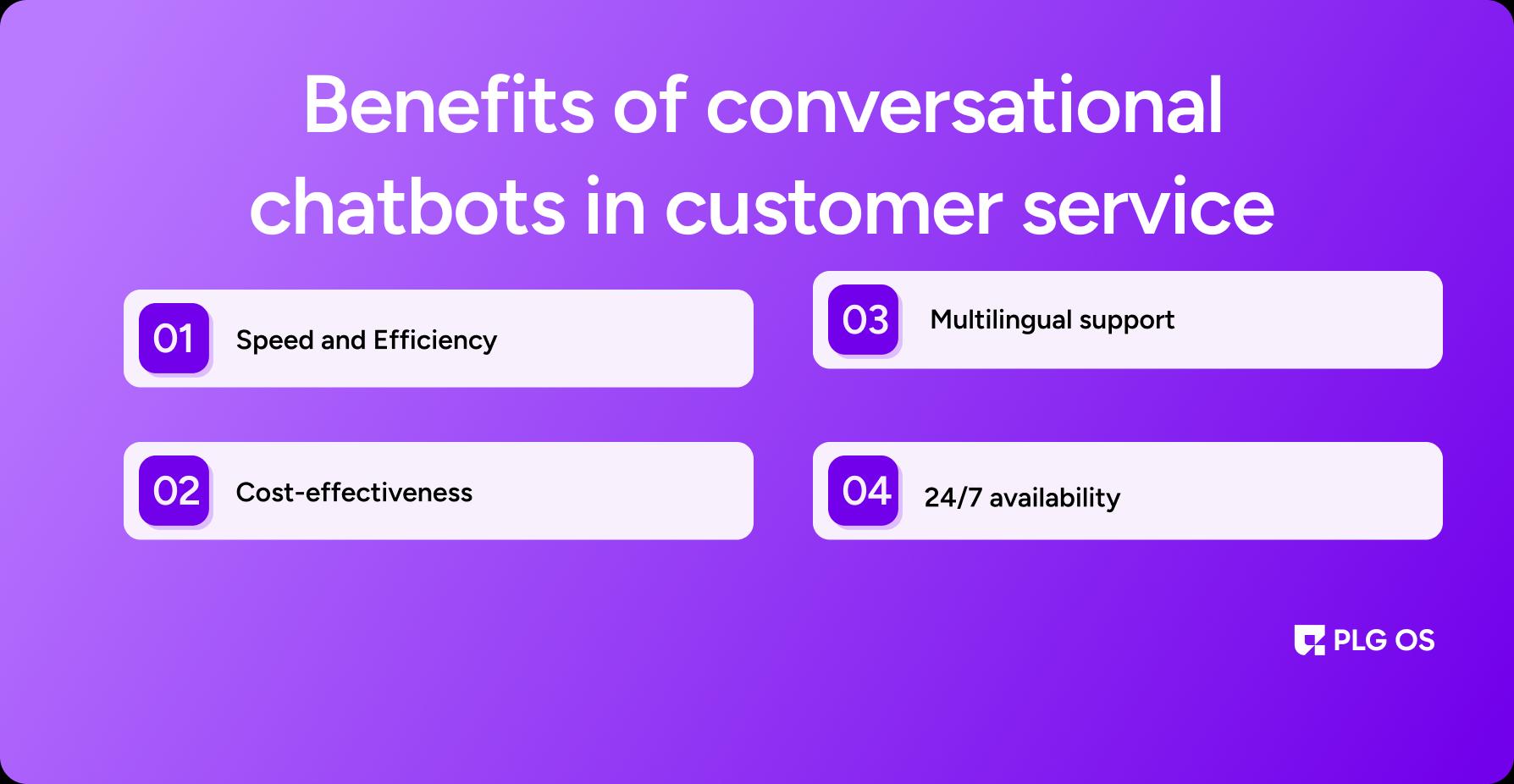
Speed and Efficiency
An AI chatbot may answer a customer's question in real-time and eliminate the need for a human agent. Because of their automated and efficient nature, they can quickly answer routine queries, which improves customer satisfaction.
Cost-effectiveness
By automating repetitive processes, offering 24/7 help, and handling a large volume of questions, conversational AI improves productivity, saves costs, and expands revenue potential, reducing operational costs and increasing profitability.
Multilingual support
With the help of AI chatbots, businesses can reach a wider audience in more places by connecting with customers in their preferred languages. This helps break down barriers caused by language and ensures that customers from all over the globe have a positive experience with support.
24/7 availability
Conversational bots can work nonstop, unlike human help workers who may have limited availability or work in shifts. They are available to respond to user inquiries any time, any day of the year. Customers will always have access to help, including during holidays and other non-business hours.
6 Ways Chatbots Can Improve Customer Service
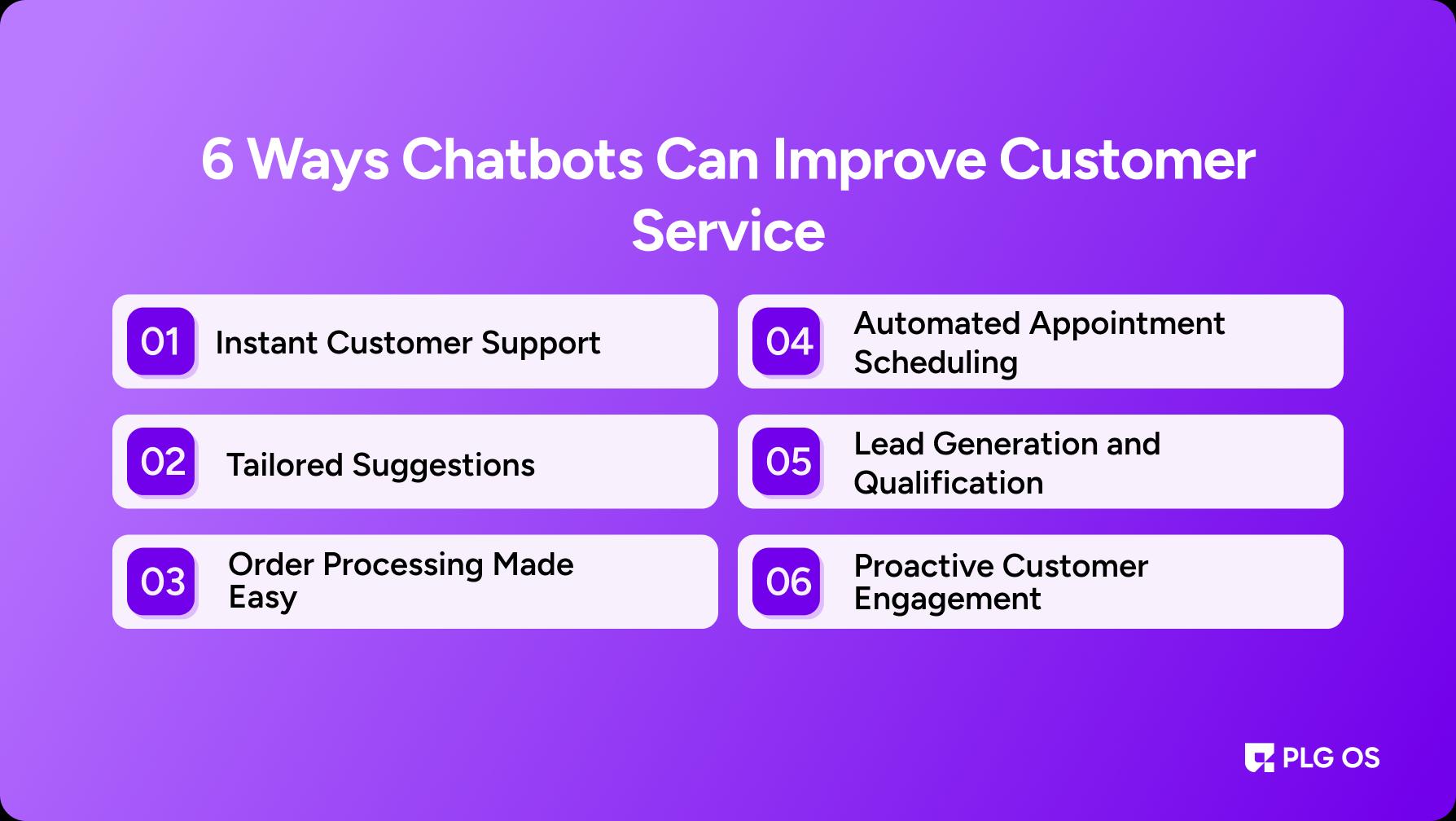
1. Instant Customer Support
The capacity to offer immediate customer help is a major advantage of chatbots. By automating the handling of common questions and inquiries, chatbots enable organizations to offer 24/7 support without the need for human agents. Customers will not have to wait in line and will obtain responses quickly because of this. In addition, chatbots can read between the lines of client communications to determine the tone and level of urgency of their questions, which helps them to prioritize and escalate problems appropriately.
2. Tailored Suggestions
By studying user actions and preferences, chatbots can provide tailored suggestions. With the help of ML algorithms, chatbots may learn about each user's unique tastes and recommend products and services accordingly. Both the user experience and the possibility of conversions are improved by this. To increase customer happiness and boost sales, top e-commerce companies are implementing chatbots that study customers' browsing and buying habits to provide personalized product recommendations.
3. Order Processing Made Easy
The overall customer experience may be made more efficient with the help of chatbots integrated into order processing systems. Through conversations with the chatbot, customers can make purchases, pay for them, and monitor their deliveries in real time. Customers can have a more streamlined and expedited ordering experience because they won't have to deal with complicated websites or different systems. In addition, chatbots may update consumers on the status of their orders in real-time, which keeps them informed and saves them the trouble (and time) of having to contact the vendor directly.
4. Automated Appointment Scheduling
Automating the appointment scheduling process using chatbots can save businesses a lot of time and effort. No human interaction is required for customers to schedule appointments, view available times, and receive confirmation. With the help of an organization's scheduling software, chatbots can inform clients of their availability in real time and even remind them of their meetings before they are due. The initial businesses to implement automated appointment scheduling powered by chatbots were, unsurprisingly, service-based firms such as healthcare providers and utilities companies.
5. Lead Generation and Qualification
Chatbots are a great tool for lead generation and qualifying since they can have meaningful conversations with potential customers. Chatbots can find qualified leads and put them in the right sales queue or staff member's hands by asking specific questions and collecting key information. Thus, Companies can better concentrate their efforts and streamline their sales procedures. Additionally, chatbots can filter leads according to certain parameters, allowing sales teams to concentrate on the most promising prospects.
6. Proactive Customer Engagement
Based on predetermined triggers, chatbots can start proactive discussions with clients. For instance, a chatbot can offer advice or a discount to a consumer who abandons their shopping basket. Increased customer happiness, recouped sales, and strengthened connections are all outcomes of proactive engagement for organizations. In addition to meeting or exceeding specified KPIs for customer success, organizations may show their dedication to provide great service by deploying chatbots to handle customer complaints or provide support proactively.
10 Chatbot Responses That Instantly Improve Customer Satisfaction
So, how can a chatbot instantly elevate the customer experience? Let’s check out 10 chatbot responses that will leave your customers smiling!
1. "Hi (Name of Customer), I'm here to help!"
What your robot says first is important. A friendly welcome like "Hi [Customer Name], I'm here to help!" can set the tone for the whole conversation. Personalizing the answer makes the customer feel like they are being heard, and a nice tone immediately makes them feel at ease.
Why it works: Personalization is the key to making it work. Customers will see that you're not just a machine but a tool made to meet their wants.
2. “I understand how frustrating that can be, let’s fix it together.”
People don't like it when their troubles are laughed off. Saying something like, "I know how frustrating that is; let's work it out together" shows that you understand how the customer feels and are on their side.
Why it works: Empathy is strong, which is why it works. Customers are more likely to be patient and work with you if they feel like you understand them.
3. “I’m sorry for the inconvenience. Let me resolve that for you right away.”
A simple "I'm sorry" can help a lot when something goes wrong. Saying, "I'm sorry for the trouble." "Let me take care of that right away" shows that you are responsible for what happened and are trying to fix it.
Why it works: People want answers and to know that their problems are being heard, which is why this works. When you say sorry, it makes the talk more personal.
4. “Let Me Get That Information for You in Just a Moment.”
From time to time, the robot needs a moment to remember something. When you tell a customer, "Let me get that information for you in just a moment," you comfort them that the process is already under way.
Why it works: Transparency is very important. It lets people know exactly what's going on, which makes them less angry while they wait.
5. “I Can Help You With That. Here’s What We Can Do.”
Being left in the dark is the worst thing that can happen. When someone asks for help, you should know what to do. A “sure, I can help you with that." "Here's what we can do" makes things clear and gives people a sense of being in charge.
Why it works: Customers can be sure that their problem will be solved if there is clear contact and steps that can be taken.
6. “Thanks for Your Patience. Here’s What I Found.”
It's annoying to have to wait, but thanking customers for their time shows that you value it. An answer like, "Thanks for your time, [Customer Name]." "Here's what I found" not only lets them know what's going on but also lets them know that you appreciate them waiting.
Why it works: Being thankful makes a big difference. It's a small thing that makes people feel good and lessens the stress of having to wait.
7. “What Else Can I Do for You Today?”
When a problem is fixed, it's important to see if the customer needs anything else. A simple question like "What else can I do for you today?" lets people know you're there for them if they need anything else.
Why it works: It lets the customer know that you care about their experience and are ready to assist them with any further requirements.
8. “I Can’t Solve This Right Now, But I’ll Escalate It to a Human Agent.”
A chatbot can't always fix problems. You should never leave a customer hanging. Saying something like, "I'm sorry, I can't solve this right now, but I'll get it for you" shows that you know when to ask for help.
Why it works: Being open is important. Customers like to know that their problem will be taken care of by a real person, not a robot.
9. "Thank You for Your Thoughts!"
Good feedback is gold. Saying "Thank you for your feedback!" after a person gives you feedback shows that you value their opinion, whether it's good or bad.
Why it works: Showing appreciation makes customers feel heard and valued, which leads to a good interaction that could have been missed otherwise.
10. "I'm here to make your time better, let's begin!"
Lastly, start every conversation with a message that is upbeat and sure of itself. "Let's start! I'm here to make your experience better!" immediately sets the tone for a smooth, friendly conversation.
Why it works: A good start sets a positive tone for the whole talk, making the customer feel good about how things will be solved.
Final Takeaway
Customer service chatbots have changed the way businesses interact with customers, collect customer data, and provide great user experiences. They can do everything from providing instant customer help to making personalized suggestions and getting involved before they're asked to.
Companies that want to see what the future holds for customer service chatbots can expect more hyper-personalization, seamless integrations, intelligent automation, emotional intelligence, and the ability to work together with human workers. Want your company to integrate chatbot and make personal connections with your customers? Book a call now and let us help you to integrate chatbots in your business today.
FAQs
1. Why is personalization important in chatbot responses?
Personalization, like using the customer’s name, makes the interaction feel more human, which helps build trust and makes customers feel valued.
2. How can empathy improve customer satisfaction?
Empathetic responses show customers that you understand their frustrations, creating a positive emotional connection that helps resolve issues more smoothly.
3. What should a chatbot do if it can’t solve a customer’s problem?
If a chatbot can’t resolve an issue, it should escalate it to a human agent, reassuring the customer that their problem is still being taken seriously.
4. How can chatbots manage customer wait times?
Chatbots can keep customers informed by saying things like, "Let me get that information for you in just a moment," reducing frustration during wait times.
5. What’s the value of thanking customers during chatbot interactions?
Thanking customers for their patience or feedback makes them feel appreciated and shows that their time and opinions matter.