15 SaaS Customer Success Best Practices to Improve Retention
In SaaS, growth isn’t just about winning new customers; it’s about keeping them. Even with the most impressive product and the fastest-growing signup list, if users don't remain engaged, it's like trying to pour water into a leaking bucket. That’s where customer success comes in.
Customer success isn’t customer support. It’s not just answering tickets or troubleshooting bugs. It’s a proactive strategy to make sure your customers get real, measurable value from your product day after day, month after month. Done right, it transforms users into loyal advocates, fuels expansion, and creates the kind of sticky growth every SaaS company dreams of.
Let’s check out the 15 SaaS customer success best practices that leading companies use to improve retention, reduce churn, and scale sustainably.
What is Customer Success?
At its core, customer success is the practice of ensuring customers achieve their desired outcomes when using your SaaS.
93.7% of companies that measure the impact of Customer Success are using a revenue target (GRR, NRR or both). It’s not just about providing support when something goes wrong it’s about understanding your customers’ needs, goals, and challenges, then proactively guiding them toward success with your product.
That involves:
- Delivering the right solutions at the right time.
- Offering support and education that match customer maturity
- Acting as a trusted partner who helps them succeed, not just a vendor
Customer success is a strategic growth function in SaaS. When done right, it ensures customers continuously derive value from your product, making churn less likely and loyalty much stronger.
Why is Customer Success Important for SaaS?
Customer success is essential because the SaaS business model depends on recurring revenue. 37% of the companies don’t have a clearly defined CS strategy which impacts retention. Unlike traditional software sales, your revenue isn’t secured upfront it’s earned continuously as customers renew, expand, and advocate for your product.
Here’s why customer success is critical in SaaS:
- Higher retention, lower churn – When you help customers achieve outcomes, they’re far less likely to leave for a competitor.
- Increased lifetime value (LTV) and revenue – Delivering ongoing value opens the door for upsells, cross-sells, and referrals.
- Improved advocacy and word-of-mouth – Satisfied customers become your best marketers, recommending your product to peers and colleagues.
Customer Retention Rate Formula
CRR = ((E - N) / S) * 100
Where:
- E = Number of customers at the end of a period
- N = Number of new customers acquired during that period
- S = Number of customers at the start of the period
In short, customer success is the engine that powers long-term SaaS growth.
Retention vs Acquisition: Where Should SaaS Companies Focus?
While both customer acquisition and customer retention are essential for growth, many SaaS businesses mistakenly put most of their effort into acquiring new users instead of retaining existing ones.
| Aspect | Customer Acquisition | Customer Retention |
|---|---|---|
| Definition | Attracting new customers through marketing, sales, and promotions. | Keeping existing customers engaged, satisfied, and loyal over time. |
| Cost | 6–7x more expensive than retention due to high marketing and conversion costs. | Lower cost, focused on engagement, value delivery, and proactive support. |
| Revenue Impact | Brings in new revenue but often at high cost. | A 5% increase in retention can boost revenue by 25–95%. |
| Customer Behavior | New customers require education, onboarding, and persuasion. | Existing customers already trust your brand and often spend more over time. |
| Scalability | Growth can plateau without retention. | Retention fuels sustainable, compounding growth through renewals, upsells, and referrals. |
The Role of Your Customer Success Team
Customer success isn’t just a concept it’s a dedicated team function within modern SaaS organizations. Our goal is to ensure that every customer achieves their desired outcome while using your product. Over 72% of the businesses surveyed by Forrester Research say that improving customer success would be their top priority.
A strong CS team typically focuses on:
- Building and executing a success playbook that guides customers through key milestones.
- Managing churn and retention by spotting risks early and stepping in proactively.
- Designing frictionless onboarding so customers experience value as quickly as possible.
- Enhancing the customer experience with seamless processes and helpful resources.
- Driving account expansion by identifying opportunities for upselling and cross-selling.
- Collecting customer feedback to inform the product roadmap and improve satisfaction.
With tools like PLG OS, customer success teams can scale these responsibilities, automate workflows, and operationalize playbooks that drive consistent results.
Why Customer Success is the Growth Engine in SaaS
A strong customer success strategy ensures SaaS companies proactively guide users to achieve their goals, boosting retention, loyalty, and long-term growth. The SaaS model thrives on recurring revenue. Unlike one-time sales, SaaS depends on long-term relationships where value is delivered month after month. That means:
- A 5% increase in retention can boost profits by 25% to 95%.
- Reducing churn even slightly creates a massive compounding effect on growth.
- Retention fuels word-of-mouth and referrals, lowering acquisition costs.
In short: if you want predictable revenue, strong NRR (Net Revenue Retention), and sustainable growth, you can’t treat customer success as an afterthought.
Instead, you need a retention-first playbook.
15 SaaS Customer Success Best Practice to Improve Retention
Let’s see the top SaaS customer success practices every company should adopt, with real-world tactics you can execute.
1. Onboarding as a Retention Strategy, Not Just a Feature Walkthrough
The first 30–60 days make or break your SaaS relationship. Many companies still treat onboarding as a quick demo or self-serve tutorial but onboarding is the foundation of retention. It helps improve customer retention SaaS..
Best Practice:
- Map onboarding around time-to-value what’s the quickest path for your customer to get their first “aha!” moment?
- Use guided walkthroughs or playbooks to move users toward activation milestones.
- Set expectations early clear success metrics, a shared definition of outcomes, and what support will look like.
Tool Tip: With PLG OS, you can personalize onboarding and more, which is one of the SaaS retention best practices.
2. Segment Customers for Tailored Success Journeys
Not every customer needs the same level of handholding. About 61% of customers state they would move to a different brand after one bad customer service experience. SMB customers may thrive with self-serve, while enterprise clients expect high-touch engagement.
Best Practice:
- Create customer tiers (low-touch, tech-touch, high-touch).
- Align success strategies to customer size, value, and complexity.
- Personalize touchpoints to fit segment needs, without over-investing in the wrong areas.
3. Make Customer Success Proactive
Too many SaaS companies still think CS = “support when things break.” That’s not customer success that’s damage control.
Best Practice:
- Monitor usage signals to spot early signs of churn risk.
- Reach out before problems arise low logins, feature underuse, or stalled adoption should trigger intervention.
- Regularly share best practices, new features, and training opportunities.
This proactive approach shifts the relationship from “firefighter” to “trusted advisor.”
4. Track the Right Retention Metrics
Tracking the right retention metrics is essential. The wrong metrics (like vanity signup counts) tell you nothing about retention.
Key Metrics to Track:
- Net Revenue Retention (NRR)
- Customer Health Scores
- Product Adoption Rates
- Expansion Revenue (upsells & cross-sells)
- Churn Reasons
PLG OS makes this easy by aggregating health scores, product signals, and account metrics in one place, so CS teams know exactly where to focus.
5. Build Success Playbooks
Consistency is key. Instead of relying on ad-hoc interactions, create repeatable success playbooks that outline exactly how to drive outcomes at every stage.
Examples:
- New User Activation Playbook
- Renewal Prep Playbook
- Churn Risk Recovery Playbook
6. Deliver Value Beyond the Product
Your product solves a problem but retention comes when customers see you as a strategic partner.
Ideas to Deliver Extra Value:
- Exclusive webinars or training sessions.
- Benchmarking reports with customer data insights.
- Customer communities where users learn from each other.
The key is to go beyond “features and functions” and instead show customers how to win in their industry with your SaaS as the engine.
7. Make Renewals a Non-Event
If renewal conversations feel like a negotiation, something’s broken. Renewals should be the natural outcome of ongoing value delivery.
Best Practice:
- Don’t wait until the contract end review outcomes quarterly.
- Ensure executive stakeholders know the ROI story well before renewal.
- Automate reminders and renewal workflows so nothing slips.
8. Identify Expansion Opportunities Early
Retention is step one. Expansion is step two. Customers who grow with your product are less likely to churn.
Best Practice:
- Track usage signals that indicate upsell readiness (e.g., hitting feature limits).
- Align expansion with customer outcomes never upsell just for revenue’s sake
- Have success managers plant seeds early in the relationship.
This creates a flywheel: retention drives expansion, expansion strengthens retention.
9. Build a Customer Health Scoring System
Customer health isn’t just “active vs. inactive.” It’s a multi-factor score that considers:
- Product usage
- Support ticket volume
- NPS/feedback scores
- Renewal likelihood
Pro tip: Weight these based on your business model (for example, heavy product usage may matter more than NPS in PLG SaaS). 86% go as far as saying that they are willing to pay more to receive a better customer experience.
10. Invest in Customer Education
Customers don’t just need to know how to use your tool they need to know how to succeed with it.
Best Practice:
- Create knowledge bases, help centers, and video tutorials.
- Offer certifications or structured learning paths.
- Host customer success webinars on advanced use cases.
Education builds confidence, and confidence builds stickiness.
11. Use Customer Feedback as a Compass
The best customer retention strategies SaaS companies can use involve listening and acting on customer feedback.
Best Practice:
- Run NPS and CSAT surveys at key journey points
- Monitor customer community discussions.
- Close the loop tell customers how their feedback shaped your roadmap.
Feedback isn’t a checkbox it’s an engine for retention.
12. Align CS With Product and Sales
Customer success can’t live in a silo. Alignment is critical:
Best Practice:
- Sales → CS: Smooth handoffs with clear success criteria.
- CS → Product: Feedback loops on feature gaps and pain points.
- CS → Marketing: Success stories to fuel advocacy.
With PLG OS, data flows across teams so everyone shares one view of the customer.
13. Operationalize Success With Automation
As your SaaS scales, manual CS doesn’t scale with it. That’s where automation matters.
Best Practice:
- Automate health score alerts.
- Trigger onboarding checklists automatically.
- Use in-app messaging for personalized guidance.
Automation frees CS teams to focus on high-value strategic work.
14. Build Advocacy Programs
Retention thrives when customers don’t just renew they advocate.
Best Practice:
- Identify your power users.
- Create referral programs, beta programs, and user groups.
- Turn advocates into case studies and testimonials.
This creates social proof while reinforcing loyalty.
15. Embrace a PLG (Product-Led Growth) Mindset
In modern SaaS, product is the growth driver. Customer success should be deeply tied to product-led growth (PLG).
That means:
- Using product data to guide interventions.
- Enabling self-serve success journeys.
- Scaling CS efforts without scaling headcount linearly.
And this is exactly why tools like PLG OS gives SaaS companies the operational system to run CS like a true growth function.
4 Powerful Customer Success Tools
1. PLG OS
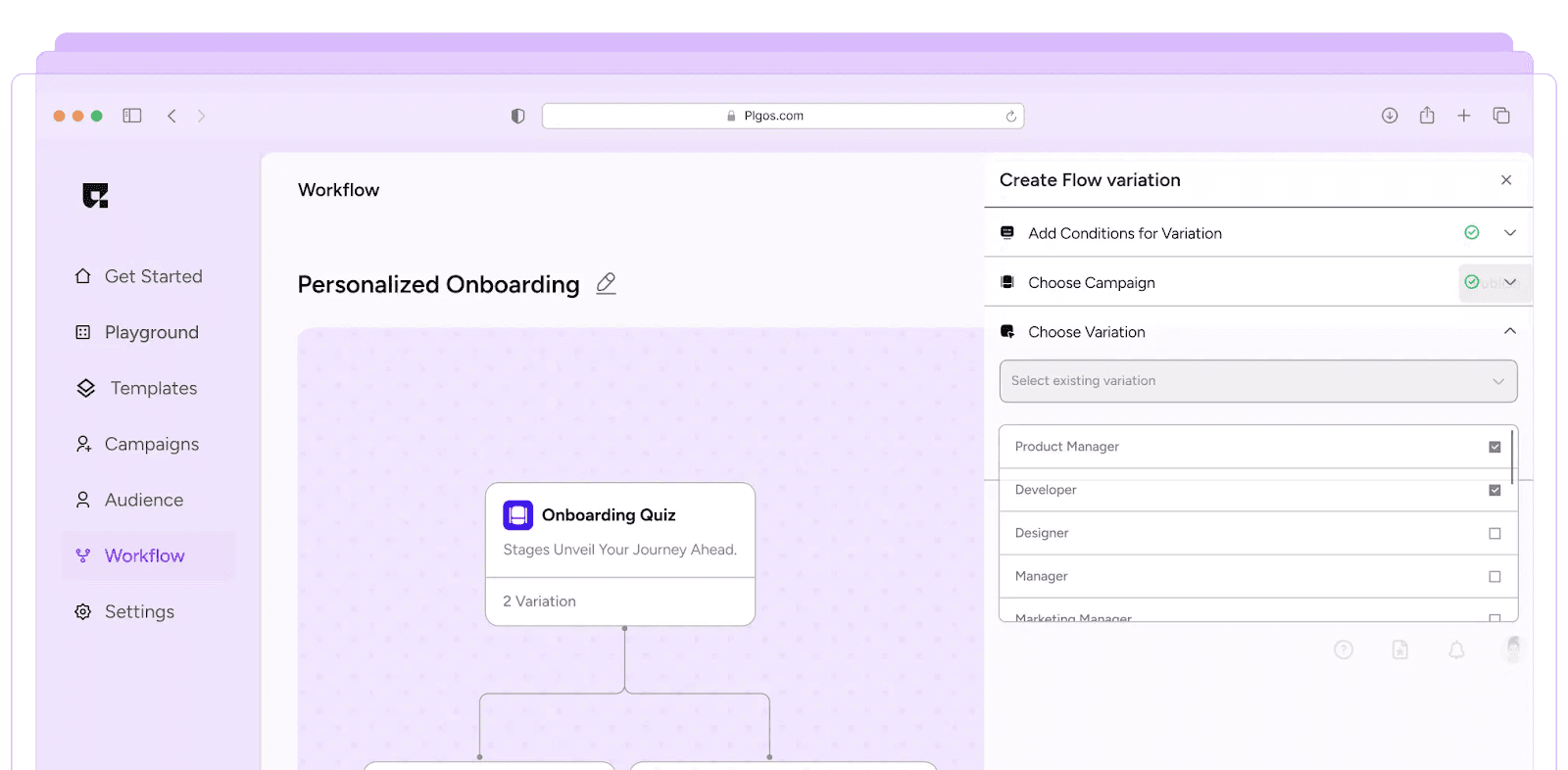
PLG OS is built for SaaS companies that want to drive retention and expansion with a product-led growth (PLG) strategy. Unlike traditional CS platforms, PLG OS focuses on helping customers succeed inside your product, making it easier to operationalize customer success at scale.
Key Features:
- Optimize Onboarding: Streamline onboarding flows and help users reach their first value faster.
- Expedite Time to Value: Ensure customers achieve outcomes quickly, reducing early-stage churn.
- User Assistance: Provide contextual guidance and proactively unstick users when they get lost.
- Feedback & Surveys: Collect in-app feedback and surveys to understand what your customers think in real time.
- Loyalty & Gamification: Make your product more engaging with gamified experiences that keep users motivated.
Why it stands out: PLG OS doesn’t just help you track health scores—it helps you take action inside the product to deliver outcomes, boost adoption, and improve long-term retention.
2. Gainsight
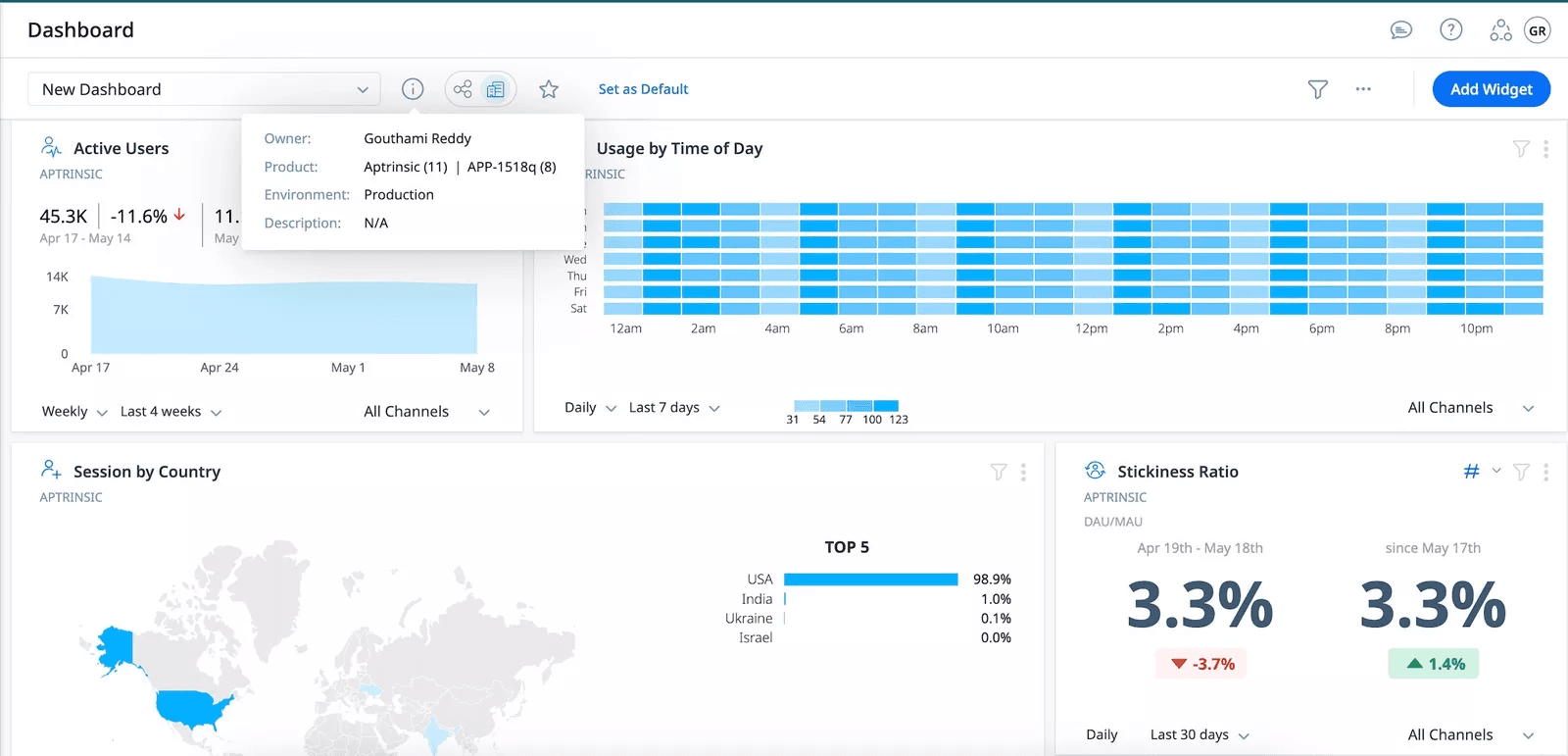
Gainsight is one of the most established names in customer success software. It’s widely used by large enterprise SaaS companies that need advanced functionality and are willing to manage a more complex system.
Key Features:
- Health Scorecards: Deeply customizable health scoring models.
- Renewal & Expansion Management: Forecast renewals and identify upsell opportunities.
- Journey Orchestration: Build structured customer journeys at scale.
- Robust Analytics: Visual dashboards and in-depth reporting.
Best suited for large CS teams that need comprehensive functionality and can invest in training and onboarding.
3. ChurnZero
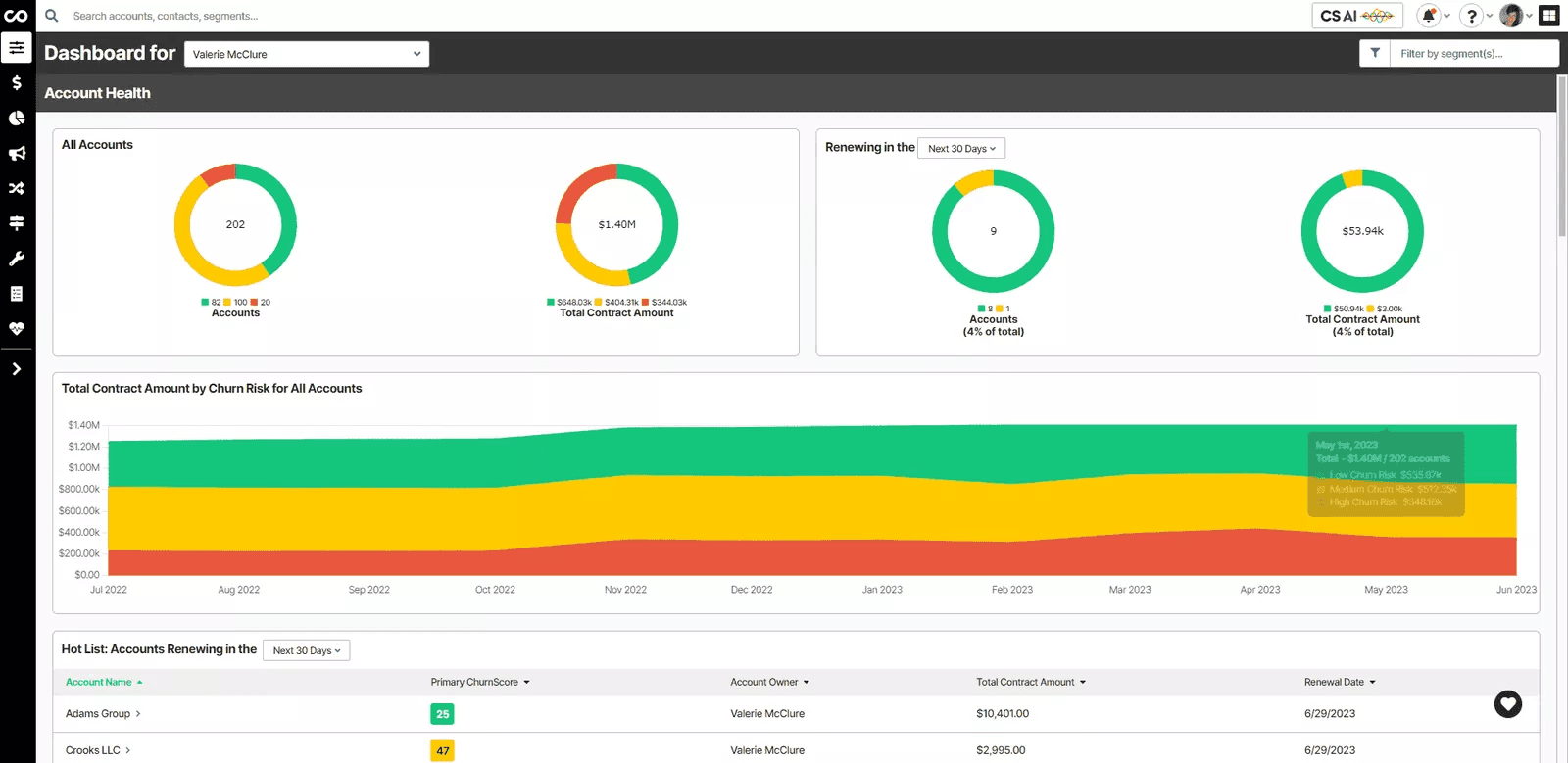
ChurnZero focuses heavily on helping SaaS companies understand, engage, and retain customers. It’s especially popular with mid-sized SaaS businesses looking for churn-fighting automation.
Key Features:
- In-App Messaging: Personalized onboarding flows, alerts, and feature announcements directly inside the product.
- Automation: Trigger alerts and actions based on customer behavior or health score changes.
- Usage Analytics: Detailed tracking of product adoption trends.
- Churn Forecasting: Predict at-risk accounts and intervene early.
Great choice if your priority is to reduce churn and increase product adoption without building everything manually.
4. Userpilot
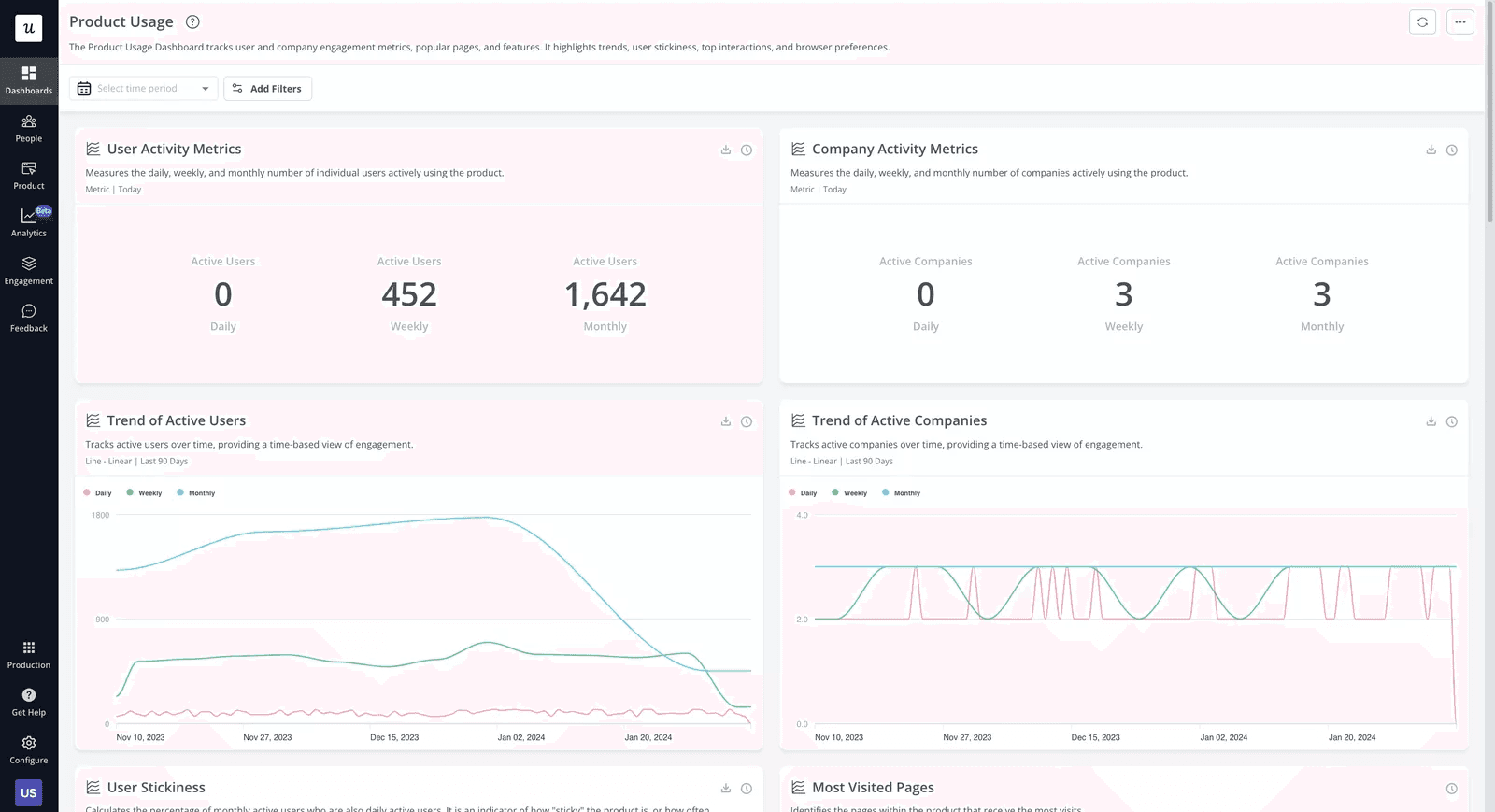
Userpilot helps SaaS companies deliver personalized in-app experiencesthat accelerate onboarding and drive adoption. It’s a strong complement to customer success platforms by focusing on user experience inside the product.
Key Features:
- No-Code Onboarding Flows: Build product tours, checklists, and tooltips without engineering help.
- Feature Adoption Tracking: See which features users adopt (and which they ignore).
- egmentation: Target experiences based on user role, behavior, or lifecycle stage.
- In-App Surveys & NPS: Collect feedback directly inside your SaaS product.
Best for SaaS teams that want to improve activation and feature adoptionwhile giving users a smoother self-serve experience.
Final Word
Customer retention isn’t a side project. It’s the backbone of every successful SaaS company. The companies that win aren’t just those who acquire the most customers—they’re the ones who keep them the longest, deliver the most value, and grow with them over time.
So if you’re serious about scaling, it’s time to rethink your CS strategy, implement these customer success tips for SaaS companies, and explore tools like PLG OS that give you the operating system to make it happen.
FAQs
1. What is customer success in SaaS?
Customer success is the proactive process of ensuring customers achieve their desired outcomes while using your SaaS product.
2. Why is customer success important?
It reduces churn, improves retention, increases lifetime value, and turns satisfied customers into advocates.
3. How do you measure customer success?
Key metrics include Net Revenue Retention (NRR), churn rate, product adoption, and customer health scores.
4. What’s the difference between customer support and customer success?
Support is reactive (fixing issues), while success is proactive (helping customers achieve goals).
5. What tools help with SaaS customer success?
Popular tools include PLG OS, Gainsight, ChurnZero, and Userpilot, which streamline onboarding, retention, and customer engagement.