How to optimize your pricing strategy for product-led growth?
The success or failure of any product-led growth (PLG) initiative hinges on your pricing strategy, which isn't always simple to nail. Consider this: a company's growth rate can increase by as much as 3.5 times with the correct pricing plan, but a 20% loss in revenue could result from an incorrect one. How therefore can one perfect it?
Getting your pricing right can lead to significant growth. Estimates suggest that a 1% price increase can boost profits by up to 11%. Enhancing your pricing strategy is crucial for effective scaling, regardless of whether you're utilizing freemium models, tiered pricing, or striking a balance between free and paid services.
What is Product-Led Growth (PLG)?
Business strategy that puts the product first in acquiring and retaining customers is known as Product-Led Growth (PLG). Unlike the more conventional sales-led methods, personalized learning guides (PLGs) use a product's intrinsic value to draw in, engage, and keep customers. The fundamental concept is to design a self-selling product due to its intuitiveness, value, and ease of use. To encourage organic development, this strategy goes beyond just providing a product and instead focuses on nurturing the customer journey.
In contrast to more conventional sales-led approaches, product-led growth is based on some essential concepts. The values outlined here include a dedication to providing excellent products, easy ways for users to self-serve, a streamlined onboarding process, and constant improvement based on user input.
Pricing Factors to Consider in a PLG Model
Finding the right price approach for a product-led growth (PLG) product is like trying to find your way through a maze. In the end, pricing selections are impacted by a number of things.
- One of the most important factors in setting prices is how users perceive the value. Important factors to consider include users' opinions on the product's worth, their priorities in terms of features, and the amount they are ready to pay for it. The pricing strategy and the product's perceived worth must be in sync for this to happen.
- One important consideration is the competitive landscape of the market. It is crucial to examine the offerings of competitors and their pricing strategies, and determine the distinct value proposition of the PLG product in comparison. It takes market expectations into account to position the product competitively.
- There is a direct correlation between product differentiation and the pricing approach. It is possible to charge more for a PLG product if it has special features, works better than the competition, or provides a better experience for the consumer. The perceived enhanced value justifies a potentially higher price point.
- To set prices that are competitive and attractive to the target market while still reflecting the product's worth, it is crucial to strike the correct balance among these criteria.
6 Winning Pricing Strategies for Your Business
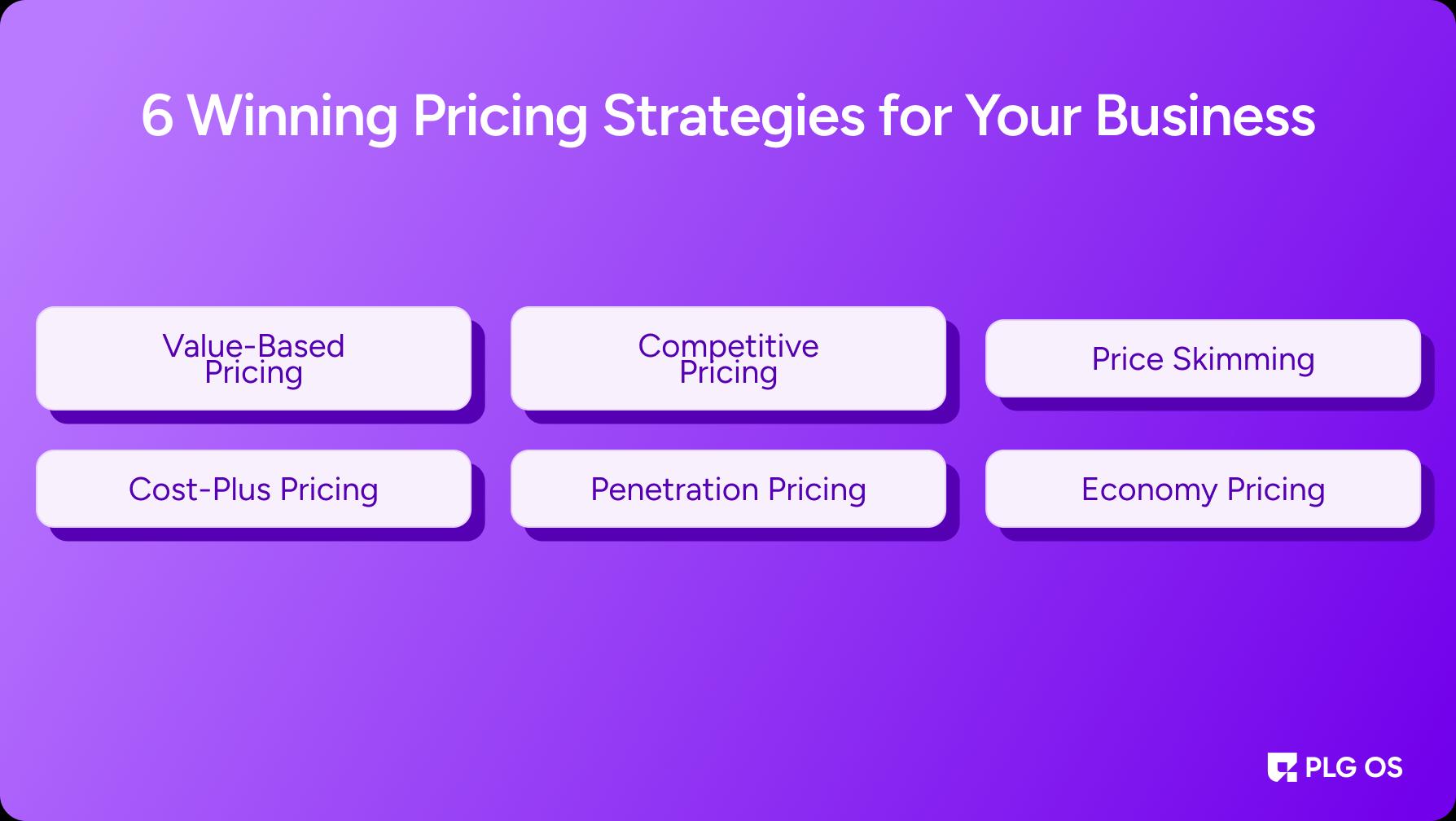
1. Value-Based Pricing
Software as a service and subscription companies typically use a pricing model based on customer value. The value-based pricing approach involves basing prices on how much your target market values your goods.
This means that you can charge whatever your clients are ready to spend.
Cost is not considered since the model presupposes that a business venture is not worthwhile if the product's production costs exceed what consumers are ready to pay.
Numerous B2B SaaS firms employ this method. Consider Asana as an example. With two premium categories, Premium and Business, Asana employs a freemium approach.
Keep in mind that the Premium plan is half the price of the Business plan. Considering the capabilities included in this package, Asana has priced it based on the value they can provide for their Business customers.
2. Competitive Pricing
Setting competitive prices is an easy business tactic to implement. Simply put, you're pricing your products and services in line with what your rivals are asking.
Assuming your product or service is extremely comparable to the companies you're competing with, this simple but effective technique will quickly help you find a suitable pricing range.
To decide if they want to sit slightly above, slightly below, or on par with the market, a company utilizing the competitive pricing approach would look at the competitive landscape and the different pricing strategies used.
You should just utilize competition-based pricing as a starting point, but it can be a reasonable strategy if you're fresh to a market with a few established competitors.
Assume that you have created a CRM specifically for sales representatives. With so much established and already saturated competition, you have a lot to work with when setting your prices in this market.
First, you check out Pipedrive.
Then, Copper.
And a third for good measure: Zoho CRM.
We have some reasonable approximations now. Here are some ballpark figures to work with when establishing prices for your three plans:
- First Level: $15–$20
- Two-Tier System: $40 to $50
- Price range: $60-$90
Keep in mind that these numbers are just that, a starting point. Once you have established and proven your product's value, you should proceed to test and optimize. Eventually, you should transition to a value-based pricing plan.
PLG OS pricing is also a good example of effective pricing strategy. It is convenient and value-based for users:
- Starter-$39/ per month
- Growth-$99/ per month
- Scale-$349/ per month
3. Price Skimming
Squeezing every last cent out of customers, especially the ones willing to pay top dollar is the whole point of the price skimming technique.
One way to profit from price skimming is to set your price as high as the market will bear. This tactic is also called the high-low pricing approach. Although most people won't be able to afford your goods or services, you'll still make money from those that really need it.
To gain a larger share of the market, you will progressively reduce your price as time goes on.
Console manufacturers like Sony and Microsoft employ this tactic for their respective PlayStation and Xbox product lines; it's quite typical in the electronic products sector.
The sweet spot for this price model is when you have products that can be positioned as luxury (like iPhones) and items that are purchased one-time, like electrical goods.
4. Cost-Plus Pricing
The most basic pricing method is cost-plus pricing, which is simply adding your costs to your markup.
When deciding how much to charge for a brand-new product, one adds a percentage to the overall cost of production.
Although it's simple to compute, it's not practical for most things unless you're dealing with tangible goods, where the production costs rise in tandem with the quantity.
On the other hand, most of the production expenses for software products are incurred initially. No matter how many new customers you have, the product development cost remains the same.
5. Penetration Pricing
A lot of new businesses utilize penetration pricing to get into an established industry and build a solid client base. Then, they use that customer base to build social proof and climb upmarket.
The idea behind the penetration pricing approach is to offer the same or comparable value at significantly lower rates than your competitors.
Even while you won't make as much money per customer as you would if you charged more, you can still acquire a footing in the market if customers transfer from your competitors to you. Companies that use penetration pricing may end up losing money, but they make up for it in the long run.
One company that has successfully used penetration pricing to gain traction in the industry is New Relic, which provides developers with an observability platform.
6. Economy Pricing
Sales volume is the main factor in economy pricing. The goal of the economy pricing strategy is to undercut the competition by making a lower-quality product and selling it at a cheaper price. Selling more of the product at a higher price point will result in the same net profit as selling less of it at a lower price point.
To compete with well-known and respected brands like Pepsi and Coca-Cola, generic soda brands employ this pricing strategy.
Can You Combine Freemium and Usage-Based Pricing?
Some pioneers in PLG do use hybrid pricing structures, which combine freemium and usage-based features. This combination of methods allows for more adaptability, satisfying the needs of a wider range of consumers.
Users can try out a free, bare-bones version with a hybrid approach that also offers paid, more advanced plans depending on their needs. Gaining more users and more money are both possible outcomes of this strategic merger.
Successful Hybrid Model Examples:
Hybrid models have been skillfully employed by trailblazers like Slack and Dropbox to carve out their success stories. They provide free plans with limited features to attract consumers, and then they offer premium plans with extra benefits.
Freemium Model of Pricing for PLG businesses
Combining the terms "free" and "premium," the freemium model entices customers by giving them free access to the product's core functionality while also providing an attractive path to upgrade for more advanced capabilities. The goal of this technique is to reach a big audience and maybe upsell premium services to them.
- Freemium models are great at drawing in a large number of users. Offering a free, bare-bones version of the product allows businesses to rapidly amass a sizable user base.
- The freemium model lays the groundwork for a planned upselling process. After trying out the free version and finding that it meets their needs, users will be more inclined to pay for the premium version.
- Offering a free version lowers the first barrier to entry, making it more appealing to users to give the product a try. More people will try out the product because it is easy to use and doesn't require any kind of payment up front.
- Freemium models frequently take advantage of the power of viral growth and word-of-mouth. If you enjoy using the free version, you can become an advocate by telling others about it and inviting them to sign up.
✅ Promptly Highlight Core Value — The free tier of your product should showcase its power to users, allowing them to witness its influence immediately. Consider Notion or Slack: the free version gives you access to all the features, but there are constraints that make you want to upgrade.
✅ Implement restrictions based on features or usage - Keep basic functions free but restrict access to more advanced ones (like Canva's Pro templates) or impose limits on how long users can spend on certain capabilities (like Zoom's 40-minute meeting limit).
✅ Make it so upgrading is obvious - Using in-app nudges, upgrade prompts, and limited-time trials, highlight the benefits of paying plans at the right moments.
Usage-Based Pricing for PLG Businesses
A dynamic method that adjusts prices according to how much a user uses the product is known as usage-based pricing. Common in systems where users' behavior varies, it guarantees that they only pay for the benefits they actually receive.
As a strategic instrument, usage-based pricing ensures that customers pay for the product in proportion to the value they extract from it within the context of PLG. Products that have unpredictable use patterns are ideal for this paradigm.
- With usage-based pricing, clients pay according to their actual product consumption, allowing for a fine-grained approach. Billing is made fair and transparent with this level of precision.
- The capacity to scale means that users only pay for the resources and features that they really utilize, which is great for them. This adaptability promotes a tailored and economical experience by lining up with the varying demands of various consumers.
- This paradigm promotes optimal utilization by users, leading to more deliberate and efficient product interaction. In order to keep expenses down, users are encouraged to use resources wisely.
- Usage-based pricing provides cost predictability for PLG providers. Revenue is directly proportional to user engagement. This makes sure that the provider's compensation is proportional to how popular and valuable the product is.
Companies That Nailed Their PLG Pricing Strategies
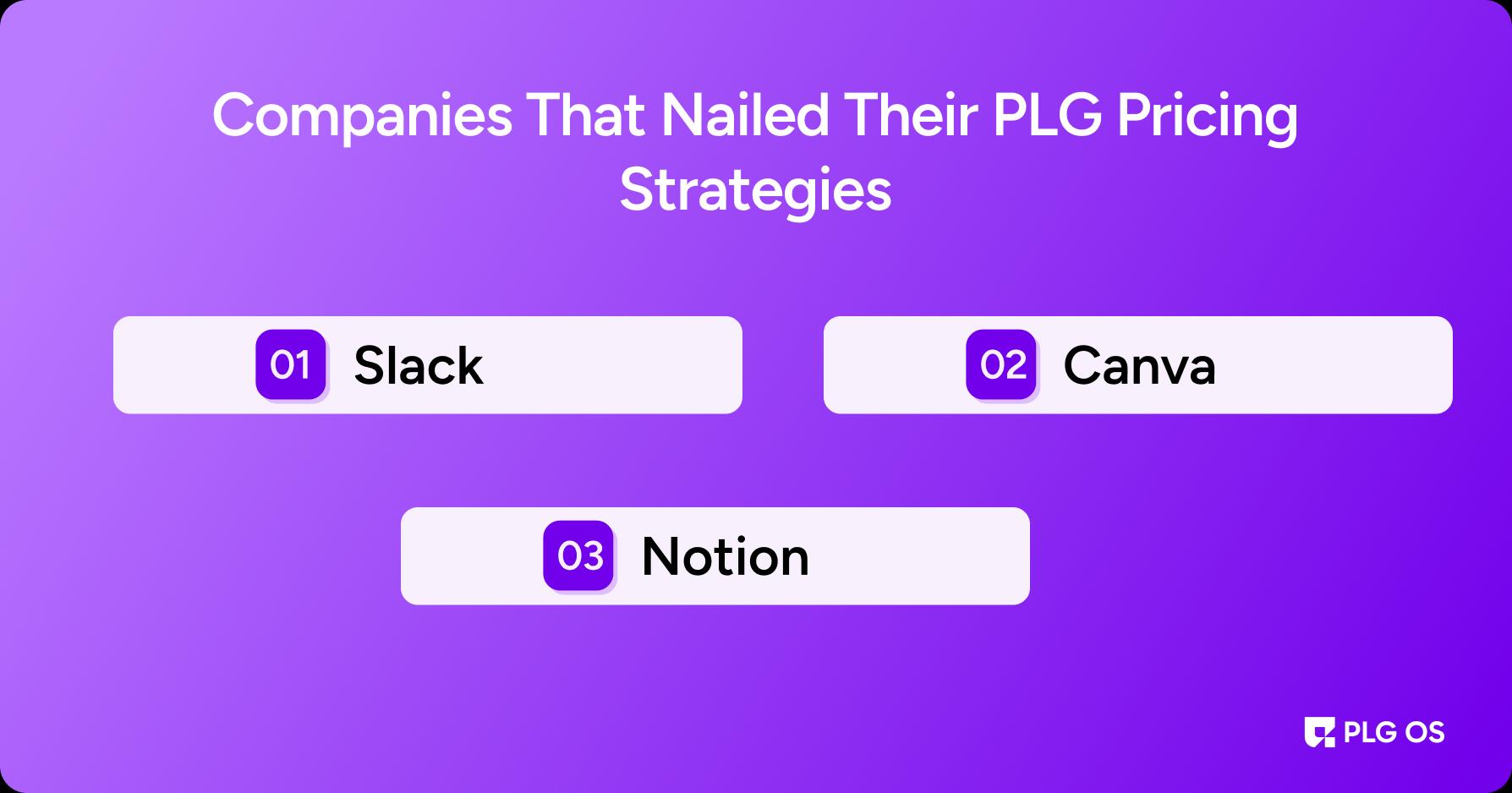
Successful product-led companies understand that pricing isn’t just about revenue—it’s about creating a seamless journey from free to paid. Let’s break down how Slack, Canva, and Notion have perfected their pricing strategies to drive conversions and growth.
1. Slack: Usage-Based Freemium That Encourages Upgrades
📌 Strategy:
Slack’s free plan gives users full access to its core functionality—messaging, channels, and integrations—but imposes limits on search history (90 days) and integrations.
📌 Why It Works:
Teams love Slack and naturally scale their usage. When they hit the free limits, upgrading to a paid plan becomes a no-brainer.
📌 Result:
Slack’s PLG model fueled rapid growth, leading to $1B+ in annual revenue and a $27.7B acquisition by Salesforce.
2. Canva: Feature-Based Freemium with Irresistible Premium Perks
📌 Strategy:
Canva offers free users a powerful design tool but restricts access to premium templates, stock photos, and brand kit features.
📌 Why It Works:
Users get hooked on the free features but soon realize the efficiency of premium design elements, pushing them to upgrade.
📌 Result:
Canva has over 135 million monthly users, with a significant portion paying for its Pro and Enterprise plans.
3. Notion: Free for Individuals, Paid for Teams
📌 Strategy:
Notion’s pricing is built on a hybrid freemium model—free for personal use but requiring payment for team collaboration and advanced features.
📌 Why It Works:
Individuals love Notion’s powerful workspace and organically introduce it to teams, where the paywall kicks in for advanced collaboration.
📌 Result:
Notion has grown to over 30 million users and a valuation of $10B+, thanks to its viral PLG strategy.
Key Takeaways from These PLG Giants
- Offer just enough in the free plan to hook users.
- Introduce strategic limits that nudge users to upgrade.
- Use a natural expansion model where teams and organizations drive paid adoption.
Want to build a winning pricing strategy like these brands? Focus on value, usability, and strategic limitations!
Conclusion
In product-led growth, pricing is about more than simply a number; it's about creating an experience that makes the most of users' money and keeps the business growing. Businesses need to adopt data-driven, adaptable, and customer-centric pricing structures to keep up with the changing market. On the first try, no pricing approach will be ideal.
Ongoing iteration is crucial. Try out several models, examine conversion rates, and consider user comments. The most successful PLG businesses consistently experiment with new pricing strategies to strike a balance between maximizing revenue and ensuring user satisfaction.
Don’t let an outdated pricing model limit your growth. Start optimizing today! Experiment, adapt, and unlock the full potential of product-led growth. Level up your PLG game with the right tools and strategies—start now at PLG OS!
FAQs on PLG Pricing Strategy
1. What is the best pricing model for product-led growth?
There’s no one-size-fits-all approach, but freemium, usage-based, and tiered pricing are the most effective models for PLG. The key is aligning pricing with user value and conversion triggers.
2. How do I know if I’m giving away too much for free?
If your free users aren’t upgrading or your paid plans don’t feel necessary, you may be over-delivering. Introduce feature limitations, usage caps, or premium perks to create a natural upgrade path.
3. How often should I tweak my pricing strategy?
Regularly! Monitor user behavior, conversion rates, and competitor pricing to adjust as needed. Small experiments can lead to big gains.
4. What’s the biggest mistake companies make with PLG pricing?
Either overcomplicating pricing (confusing users) or making free too generous, removing the incentive to pay. Keep it simple, transparent, and conversion-focused.
5. Can a PLG company succeed without a freemium model?
Yes! While freemium is popular, free trials, usage-based billing, or pay-as-you-grow can also work, depending on your product and market.