5 Powerful Ways to Use User Behavior Analysis to Drive Retention
User retention is the new growth. In today’s product-saturated world, getting users is easy. Keeping them? This is where the challenge—and the excitement—begins.
Every product leader talks about user engagement strategies and customer retention techniques, but here’s the truth: Most approaches still treat users like rational robots. They aren't. Users are emotional, cognitive beings with quirky habits, subconscious tendencies, and behavioral patterns.
If you really want to improve user retention, it’s time to ditch the generic advice and start tapping into something more primal: User thinking patterns how people think, react, and behave when they interact with your product.
n this guide, we’ll dive into five powerful (and often overlooked) ways to leverage user behavior analysis, psychology in UX design, andbehavioral patterns in users to drive retention. We’ll also show you how to use a brilliant system like PLG OS to operationalize all of it.
What Do We Mean by “User Behavior Analysis”?
Think of it this way:
User thinking patterns are the subconscious paths users follow as they move through your product. Only 4% of dissatisfied customers voice their complaints—the rest simply churn.
These include:
- How they make decisions
- What triggers satisfaction (or frustration)
- Why they stay or churn
- How they interpret friction
- What habits form, and when
Understanding these patterns requires more than analytics. It demands a deep dive into psychology in UX design, cognitive biases, emotion-driven actions, and behavior loops. Let’s unpack 5 powerful ways to tap into this goldmine.
5 Ways to Use User Behavior Analysis to Drive Retention
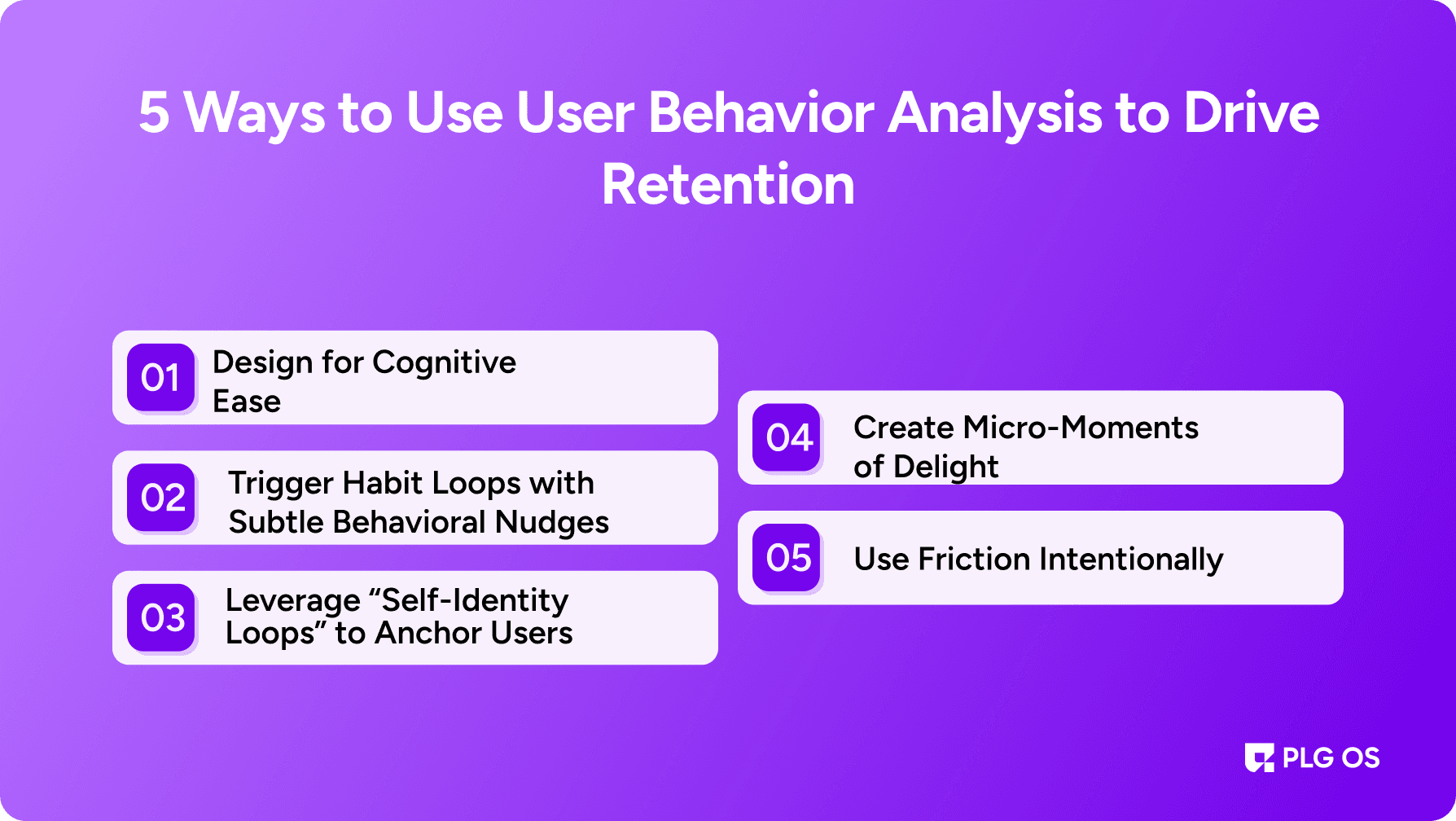
1. Design for Cognitive Ease
90% of users stop using an app due to poor performance or confusing UX.Cognitive ease is the psychological principle that users stick with what feels easy—mentally. Not necessarily what is easy, but what feels easy.
If your onboarding or feature set makes users feel overwhelmed, they’ll quietly vanish—even if the product is “useful.”
How to Leverage This:
- Fewer choices, more action: The Paradox of Choice is real. Simplify decision points. Show the best next action, not all possible ones.
- Consistency is comfort: Use familiar design patterns. A UX surprise should be delightful, not confusing.
- Chunk experiences: Break large tasks into small, rewarding micro-interactions.
Real-World Example:
Ever noticed how Duolingo feels “fun” to use, even though it’s just repetition? That’s cognitive ease in action.
2. Trigger Habit Loops with Subtle Behavioral Nudges
Let’s be honest—users don’t want another to-do. But if you embed your product into a habit loop, they’ll keep coming back without even thinking.
The Habit Loop:
- Cue → Notification, reminder, prompt
- Routine → The action in your app
- Reward → Satisfaction, progress, social validation
Use This to Drive Retention:
- Make the cue irresistible: Use smart, timely push notifications—not spammy ones.
- Create easy, repeatable routines: Keep actions short and satisfying.
- Give variable rewards: Surprise users with value. Think Spotify’s "Discover Weekly."
Unique Insight:
Most companies over-focus on cues (notifications) and neglect the reward phase. But users come back for how your product makes them feel, not just because they’re reminded. 80% of future profits come from just 20% of existing customers.
Implement with PLG OS:
With PLG OS, you can track behavioral patterns in users and identify what triggers positive routines. The system reveals retention-driving actions and lets you double down on them. You can literally blueprint your product’s stickiest behaviors.
3. Leverage “Self-Identity Loops” to Anchor Users
Here’s an underrated psychological insight: People stay loyal to products that reinforce their identity.
Think:
- Apple = Creative, premium
- Notion = Organized, modern
- Figma = Collaborative, design-first
Users don’t just use these tools—they identify with them.
How to Apply This:
- Mirror the user’s language and worldview in your product and content.
- Showcase user progress and personal growth (like Duolingo’s streaks or Fitbit’s step goals).
- Celebrate milestones that align with their goals or values.
Go Deeper:
Use user behavior analysis to learn who your power users are, then build identity loops around them. Want retention? Help users become the best version of themselves—with your product as the sidekick.
4. Create Micro-Moments of Delight (Without Overbuilding)
Every user journey has emotional highs and lows. Most companies obsess over features—but they forget the emotional flow of a product.
Delightful micro-moments often have disproportionate impact on retention.
Think:
- That perfectly timed animation after a win
- A cheeky confirmation message
- A clever loading screen that makes users smile
- A surprise upgrade or unlock
Why It Works:
Emotionally charged moments encode memory. If you want users to return, create moments they can’t forget.
Pro Tip:
You don’t need to overdesign. You just need to know when a user is vulnerable (like post-signup) or excited (like after achieving something). That’s when delight hits hardest.
5. Use Friction Intentionally (Yes, Really)
Here’s the twist no one tells you: Not all friction is bad.
Some friction—when used wisely—actually increases retention. Why? Because it boosts perceived value and investment.
Think about
- The act of building your Notion dashboard
- Uploading your profile pic on LinkedIn
- Setting up your Spotify preferences
That effort creates commitment.
How to Design “Good Friction”:
- Make users personalize early: If they set it up, they’ll stay.
- Build in effort-reward trade-offs: The more they do, the more they unlock.
- Gate valuable experiences behind micro-commitments: Like referring a friend to access a feature.
Caution:
This only works when friction feels purposeful—not annoying. Context is everything.
Why Most Retention Playbooks Fail (and What You Can Do Instead)
Let’s call it out: Most “user retention strategies” today are too tactical, too reactive, and too generic.
- “Send more emails”
- “Add gamification”
- “Offer discounts to churned users”
Those might get a bump—but not lasting change. You need to go deeper into the psychology of how users think, behave, and feel.
The secret? Product-Led Growth powered by user psychology.
PLG OS: The Operating System for Retention Through Thinking Patterns
If you’re serious about improving retention using thinking patterns, you need a tool that can:
- Decode user behavior in real-time
- Surface actionable engagement patterns
- Help you design, test, and scale changes based on user psychology
That’s exactly what PLG OS offers.
Why It Stands Out:
- Real behavior mapping, not just vanity metrics
- Journey analysis that connects UX with psychology
- Growth experiments based on user segments, not guesswork
- Playbooks that integrate retention tactics with PLG thinking
With PLG OS, you don’t just see who churns—you understand why. And you know exactly how to fix it.
TL;DR: Master the Mind, Retain the User
Let’s recap the five advanced, psychology-driven strategies to improve user retention:
- Design for cognitive ease – Make the product feel effortless.
- Trigger habit loops – Embed your product in subconscious routines.
- Use identity loops – Help users become who they want to be.
- Create micro-moments of delight – Surprise with emotion.
- Add purposeful friction – Make users invest to feel value.
And most importantly, operationalize all of this with PLG OS your backstage pass to real-time retention thinking.
Final Thought: Behavior > Features
In the retention race, it’s not the flashiest feature that wins.
t’s the product that understands how people think, what makes them stay, and what drives them to come back. Use that knowledge. Build for behavior. Measure with PLG OS.
And remember—your users are talking through their actions. Are you listening?
FAQS
1. What are user thinking patterns in UX design?
User thinking patterns refer to the subconscious ways users make decisions, interact with interfaces, and develop habits. Understanding these helps improve UX and boost user retention.
2. How can psychology in UX design help improve retention?
By using psychological principles like cognitive ease, habit formation, and identity triggers, you can design experiences that feel intuitive and emotionally rewarding—key for long-term retention.
3. What is the role of user behavior analysis in retention strategies?
User behavior analysis reveals what users actually do, not just what they say. This insight helps identify friction points, optimize engagement, and develop effective customer retention techniques.
4. Why is intentional friction sometimes good for user retention?
Intentional friction, like requiring profile setup or small commitments, increases user investment. When done right, it makes users value the product more and reduces churn.
5. How does PLG OS support user engagement strategies?
PLG OS helps track behavioral patterns in users, map their journeys, and test psychology-backed interventions—making it easier to design and scale effective user retention strategies.