6 Best Appcues Alternatives in 2025 for PLG and Onboarding

While Appcues has helped many teams get started, it’s not the only name in the game anymore. Are you looking for user onboarding software that does everything Appcues does but without the complex pricing and limited analytics?
If you’re serious about turning new users into power users (without the boring tours), it’s time to explore smarter, more dynamic options. Whether you're scaling a startup or fine-tuning enterprise adoption, we've compiled the top 6 Appcues alternatives that meet your needs and exceed them. Ready to upgrade your onboarding game? Let’s dive in.
Categories of digital adoption platforms
| Category | Description | Strengths | Limitations |
|---|---|---|---|
| In-product Messaging Platforms | Focus on guiding users while they’re actively using your software through tooltips, tours, and contextual prompts | Great for real-time user guidance and onboarding within the product. | No way to re-engage users once they leave the app. |
| Out-of-product Messaging Platforms | Specialize in re-engaging users outside your product via email, SMS, and push notifications. | Excellent at bringing users back and keeping them informed. | Can’t support users once they’re back in the product. |
| Multi-channel Messaging Platforms | Combine in-app and out-of-app messaging to create cohesive, end-to-end user journeys. | Seamless engagement across touchpoints, from onboarding to retention. | May be complex to set up and manage for smaller teams. |
What is Appcues?
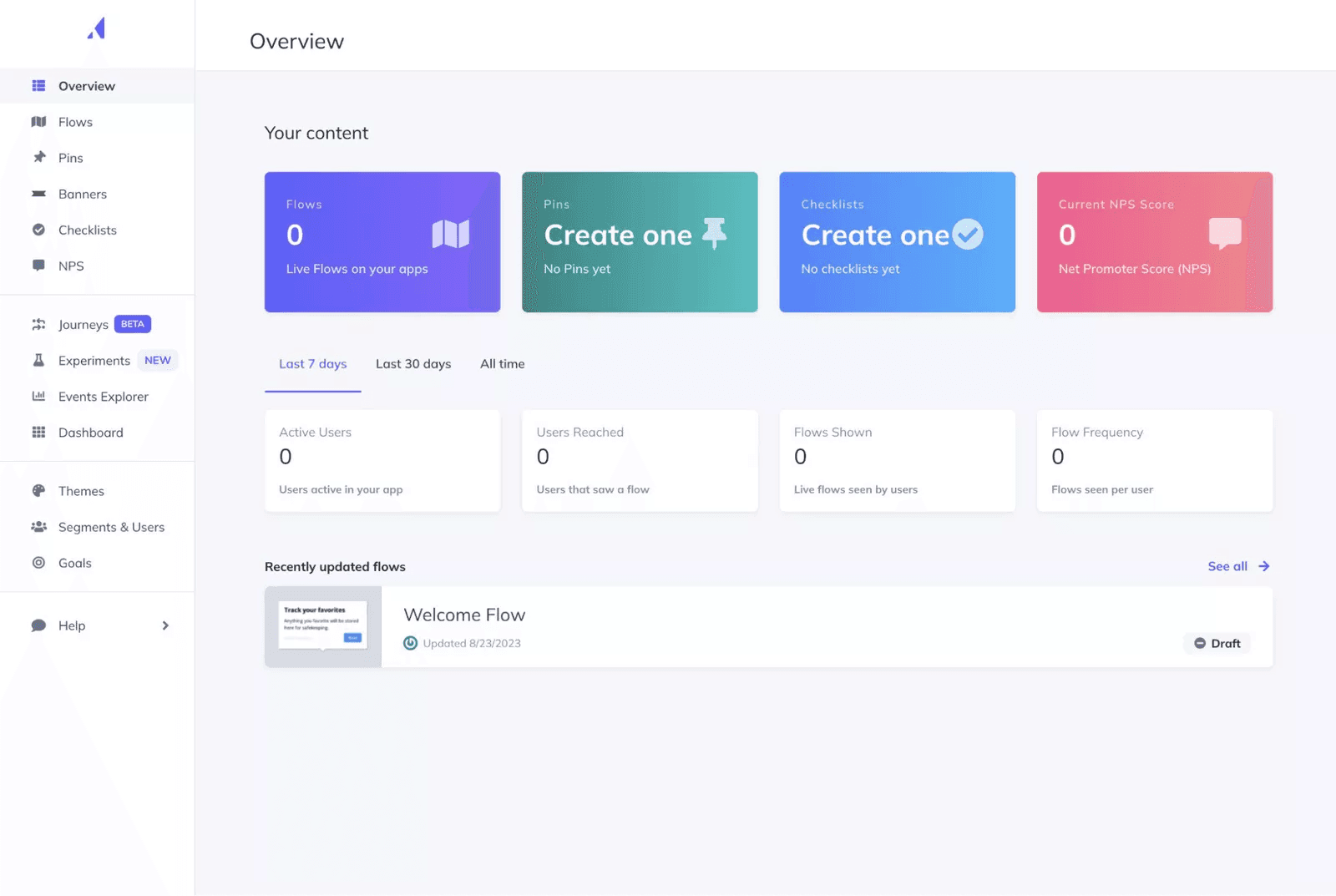
Appcues is a user onboarding software that allows product and growth teams to provide personalized in-app experiences without writing a single line of code. It allows you to guide users to their "aha" moments faster, increase feature adoption, and maintain high engagement.
Appcues Dashboard
The platform includes five key features:
- Create in-app tours, tooltips, and checklists using a Chrome extension. Simply click around your app to place elements where you need them.
- User targeting: Display targeted customer onboarding flows for specific user segments (for example, free vs. paid users). You can target users based on their actions, demographics, or company information.
- Multi-channel messaging: Use in-app modals, automated emails, or mobile push notifications to re-engage users who have abandoned flows.
- Analytics: Track performance by measuring how many users complete checklists and flows using basic dashboards.
- NPS surveys: Integrate Net Promoter Score polls into your app to measure user satisfaction and segment them.
- Appcues pricing begins at $300 per month and increases rapidly as your app scales. Depending on the number of active users on your app, you could pay thousands of dollars per month before you know it.
Here are the pricing details:
- Start Plan: $300 per month for 1,000 monthly active users (MAU). The plan consists of basic flows and limited integrations.
- Growth Plan: $750 per month for 1,000 MAUs. The strategy also includes A/B testing and multi-channel campaigns.
- Enterprise pricing is custom and averages $15,000 or more per year.
According to Vendr data, the median Appcues buyer pays $15,234 per year.
6 Best Appcues Alternatives in 2025
1. Whatfix
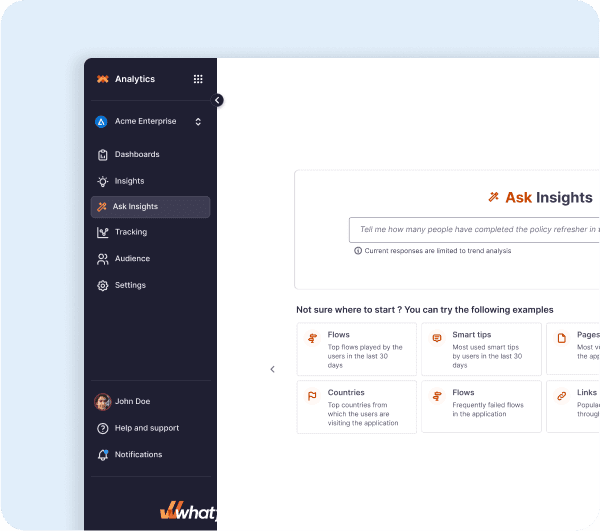
If you’re a large organization needing deep customization and robust analytics, Whatfix is an excellent Appcues alternative.
Why It Stands Out:
- Strong focus on in-app guidance, tooltips, task lists, and self-help widgets
- Seamlessly integrates with enterprise tools like Salesforce, SAP, and Oracle
- Supports multi-language onboarding
- Deep analytics and user segmentation
Best For:
Enterprises with complex onboarding needs and internal employee training.
Pricing:
Custom pricing based on features and usage.
Why It’s a Top Appcues Competitor:
Whatfix outpaces Appcues when it comes to enterprise-scale onboarding, employee enablement, and internal app support.
2. Userpilot
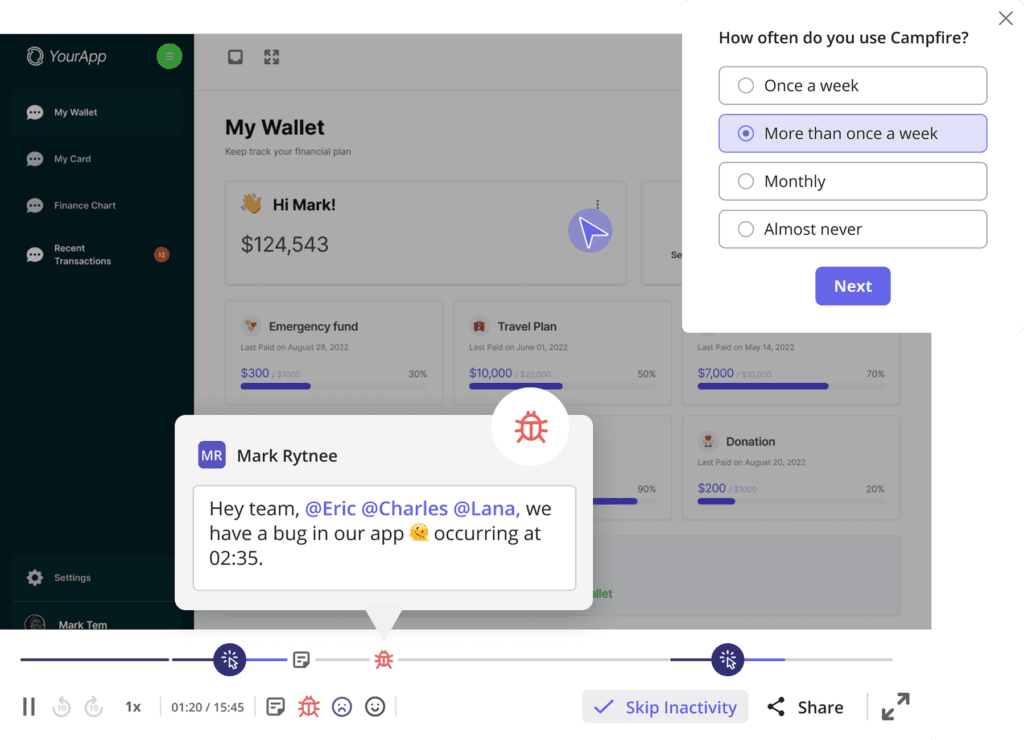
If you're in a product-led team focused on driving feature adoption, Userpilot is a front-runner in the world of Appcues competitors.
Why It Stands Out:
- Contextual onboarding experiences based on user behavior
- Dynamic segmentation and NPS collection
- Real-time event-based triggers
- Chrome extension for live editing—no code required
Best For:
SaaS businesses and PLG startups focusing on activation and retention.
Pricing:
Starts around $249/month; plans vary based on monthly active users (MAUs).
Why It’s a Top Appcues Alternative 2025:
Userpilot offers more control over targeting, event tracking, and in-app experimentation, making it a favorite among growth hackers and marketers.
3. PLG OS
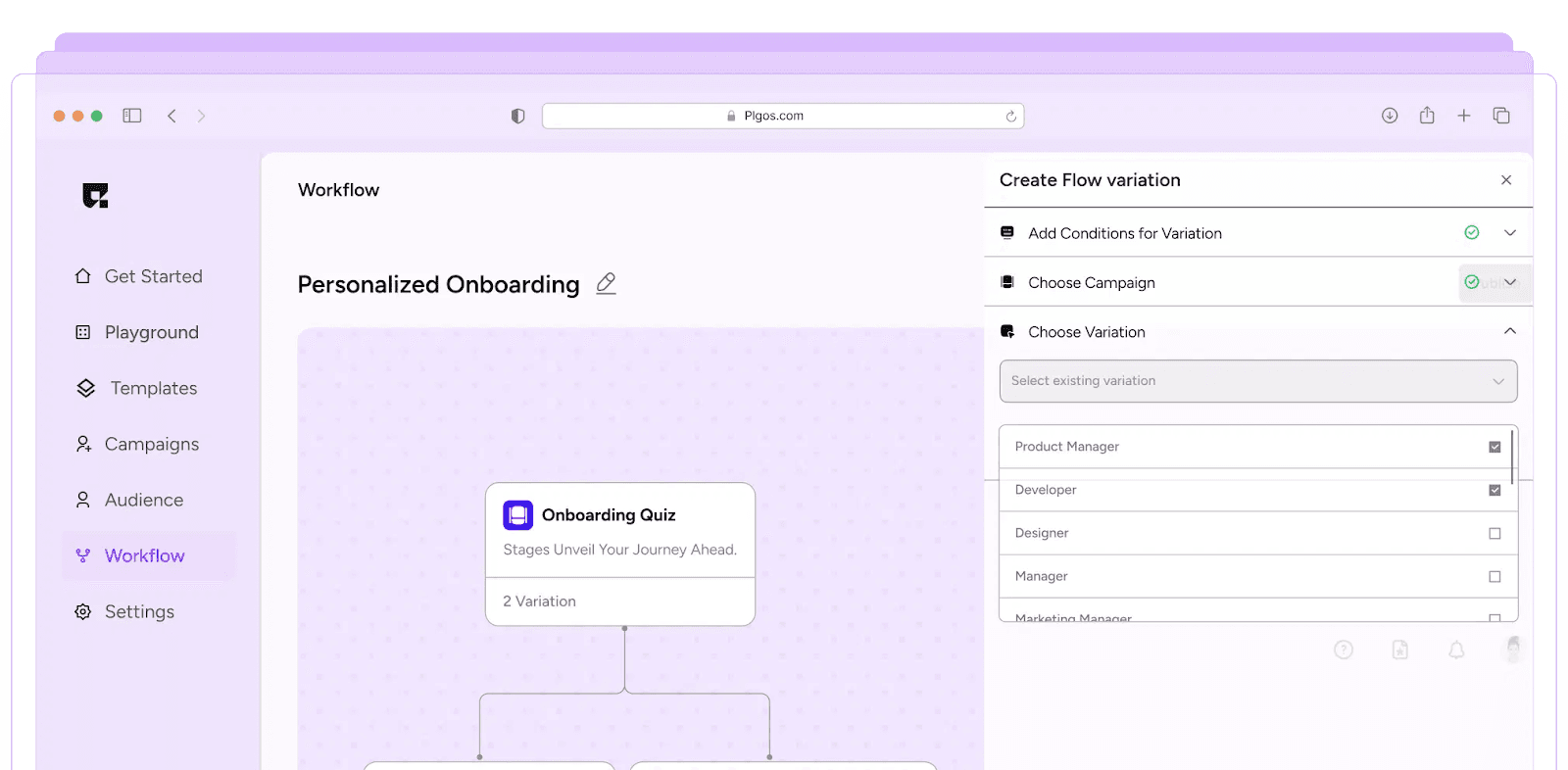
While most onboarding tools focus on the how, PLG OS helps you figure out the what and why. It’s not just a tool—it’s a Product-Led Growth Operating System.
Why It Stands Out:
- Helps you map product metrics to business outcomes
- Guides you in defining activation triggers, aha moments, and success metrics
- Integrates seamlessly with product analytics tools like Mixpanel and Amplitude
- Helps build data-driven onboarding experiments
Best For:
Teams serious about implementing end-to-end PLG strategies and enhancing onboarding with strategic clarity.
Pricing:
Free starter plan, paid plans available with premium support and integrations.
Why It’s a Best Appcues Alternative 2025:
According to Gartner’s most recent DAP market guide, Appcues lacks IF/THEN branching support, reducing its ability to create highly contextual user flows and journeys based on user actions. PLG OS, on the other hand, isn’t just about onboarding UI. It helps your team build the right onboarding based on your PLG funnel. It’s strategy meets execution.
4. Pendo
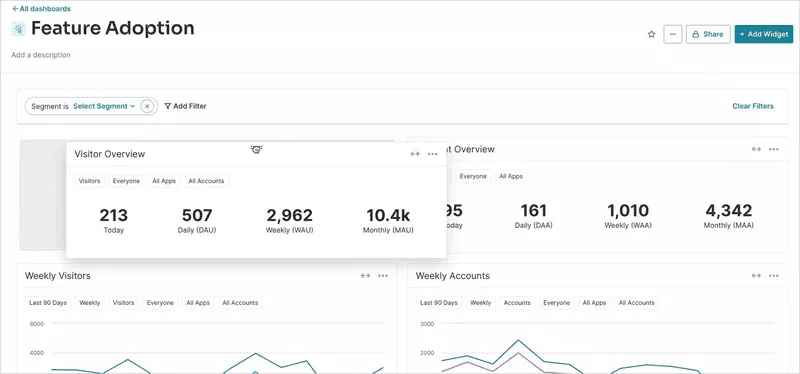
If your onboarding strategy requires robust product analytics + in-app guidance, Pendo is a heavy hitter in the digital adoption space.
Why It Stands Out:
- Deep product usage analytics paired with onboarding flows
- Tracks feature usage and user sentiment (via in-app polls & NPS)
- Offers both customer and employee onboarding
- Supports web and mobile applications
Best For:
Product teams at mid-to-large companies looking to pair onboarding with real-time insights.
Pricing:
Custom pricing tends to be on the premium end of the market.
Why It’s a Top Digital Adoption Platform:
Unlike Appcues, Pendo gives equal weight to analytics and guidance, helping PMs make data-backed onboarding decisions.
5. Chameleon
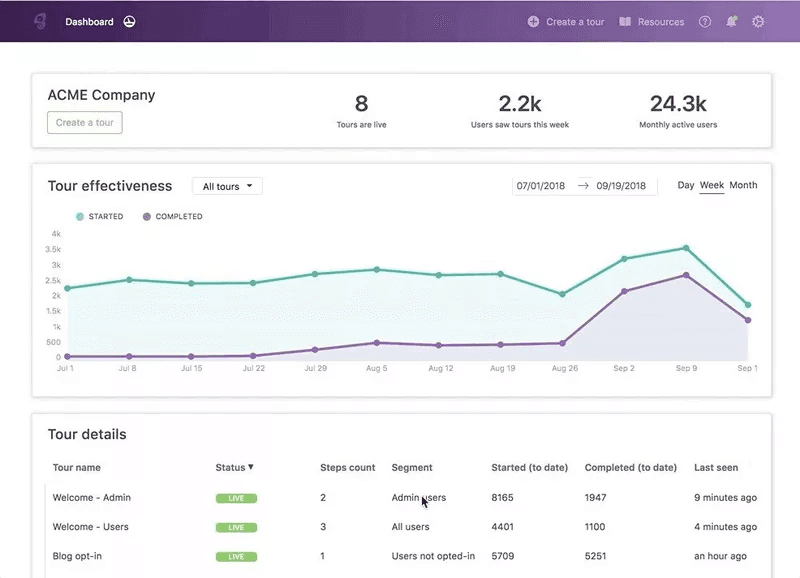
Chameleon is all about building onboarding that feels like part of your product, not an afterthought.
Why It Stands Out:
- Advanced targeting with user segments, custom events, and triggers
- Offers launchers, tours, banners, and checklists
- Deep integration with Segment, Mixpanel, Heap, and more
- In-app A/B testing for flows
Best For:
Startups and scaleups that want fine-tuned control over design and experience.
Pricing:
Starts at $279/month; scales with MAUs and usage.
Why It’s Among the Best Appcues Alternatives:
Chameleon is perfect for teams who want to build branded, beautiful, and smart onboarding flows without bloating their product.
6. Userflow
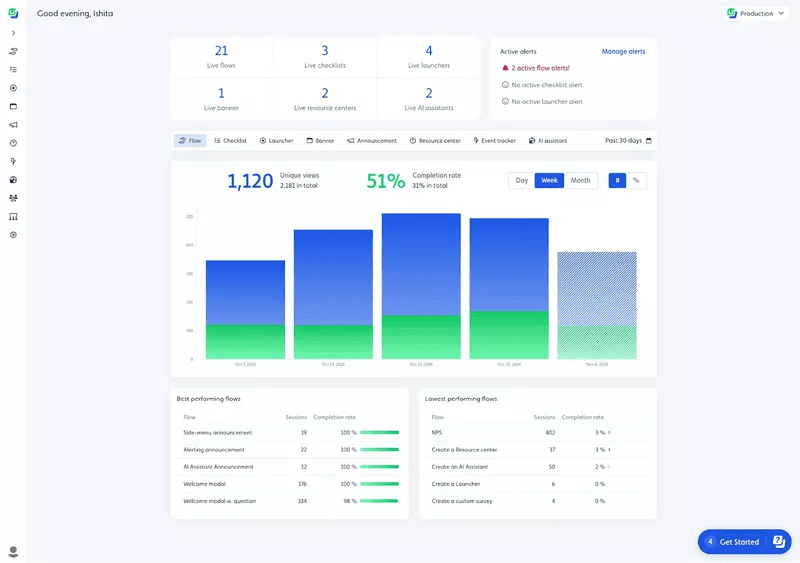
If you want speed, flexibility, and a lightweight overlay tool, Userflow is a slick choice.
Why It Stands Out:
- Fastest onboarding builder—drag and drop simplicity
- Supports custom user flows, checklists, and tooltips
- Powerful event tracking
- Great for both dev teams and marketers
Best For:
Early-stage startups and small SaaS teams needing quick deployment.
Pricing:
Starts at $250/month for up to 3,000 MAUs.
Why It’s a Strong Appcues Competitor:
Userflow is intuitive, fast, and more affordable than Appcues, without compromising on core onboarding features.
6 Best Appcues Alternatives in 2025: Comparison Table
| Tool | Best For | Pricing | Strength |
|---|---|---|---|
| Whatfix | Enterprises | Custom | Internal training & scale |
| Userpilot | Growth Teams | From $249/mo | Feature adoption |
| PLG OS | Strategic PLG Alignment | Free & Paid | PLG roadmap design |
| Pendo | Product Managers | Custom | Analytics + onboarding |
| Chameleon | UX-Driven Startups | From $279/mo | Custom design |
| Userflow | Startups & SMBs | From $250/mo | Speed & simplicity |
Choosing the Right Onboarding Tool in 2025
With so many digital adoption platforms out there, choosing the right one depends on your team’s needs:
- Stage (startup, scale-up, enterprise)
- Goals (activation, retention, self-serve)
- Technical ability (no-code vs code-first)
- Budget (affordability vs premium features)
If you want onboarding to be a strategic growth lever, not just a checklist item, combine executional tools like Userpilot or Chameleon with PLG OS to stay focused on what truly matters: your Product-Led Growth journey.
Final Thoughts
Appcues has earned its stripes, but 2025 calls for smarter, more adaptive tools. With customers demanding contextual experiences, you need more than just tours—you need insight, experimentation, andalignment with your business model.
Tools like PLG OS, Userpilot, and Whatfix don’t just help you onboard they help you scale with purpose. So whether you're just starting your onboarding journey or revamping your PLG stack, this list of Appcues alternatives 2025 gives you the blueprint to build onboarding that doesn't just educate—but activates, retains, and grows.
FAQs
1. What are the top Appcues alternatives in 2025?
Top alternatives include Whatfix, Userpilot, PLG OS, Pendo, Chameleon, and Userflow each tailored for different onboarding needs and business sizes.
2. Which Appcues competitor is best for product-led growth (PLG)?
PLG OS is ideal for strategic PLG planning, while Userpilot executes PLG onboarding flows.
3. Are there affordable alternatives to Appcues for startups?
Yes. Userflow and Chameleon offer cost-effective plans with powerful onboarding features for early-stage startups.
4. Can these tools replace Appcues completely?
Absolutely. Many tools offer broader capabilities, deeper analytics, and better scalability than Appcues, especially for modern onboarding in 2025.
5. Do I need coding knowledge to use these tools?
Most alternatives like Userpilot, PLG OS, and Whatfix are no-code or low-code, making them accessible to product and growth teams without developer support.