How to Reduce Support Ticket Volume for SaaS [12 Best Strategies]

Managing an excessive number of support tickets for your SaaS company? You have company! The bright side is that there is a more intelligent approach to dealing with this typical problem. You can decrease those annoying tickets and keep your customers happy for longer by using the correct techniques.
We have surefire methods to help you reduce support inquiries while increasing satisfaction, from improving your self-service choices to optimizing your onboarding process. Are you prepared to revolutionize the way you handle customer service? How about we jump right into these revolutionary methods!
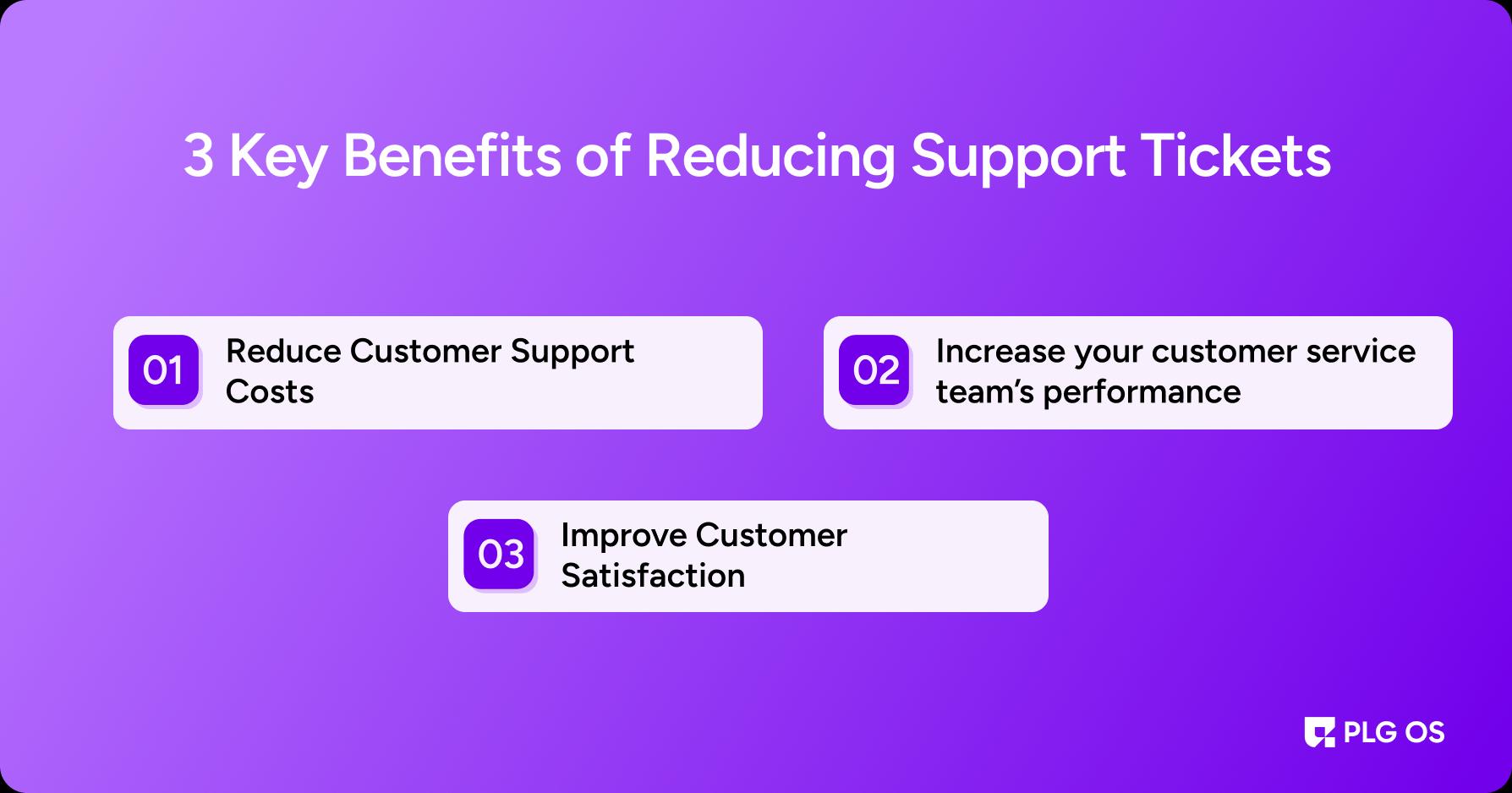
Benefits of Reducing Support Tickets
Without effective ticket management, no SaaS company can sustain growth and profitability over the long run. In fact, studies show that 67% of customers hang up the phone or abandon a support request if they have to wait too long, and 60% of customers have had to contact a company multiple times to resolve a single issue.
However, lowering the number of support tickets isn't just good for growth. For starters, there are a lot of additional benefits, such as a customer service personnel that is both less overwhelmed and more motivated. Additional advantages of reducing your support tickets will be discussed later on.
Reduce Customer Support Costs
Dealing with customer support tickets may be quite expensive. The need to recruit additional support agents is directly proportional to the volume of client questions and tickets. Think of all the money you'll save instead if you concentrate on reducing the volume of tickets!
Increase your customer service team’s performance
Spending important resources like your customer service team on repetitive, easy-to-solve problems is a waste. They will be less productive and eventually burn out as a result of this.
To free up your support crew to tackle more difficult problems and do more productive things, like making self-service resources, automate the resolution of these simpler tickets.
Improve Customer Satisfaction
We are all aware that customers despise waiting. Similarly, they dislike being kept waiting for a resolution when it concerns customer service requests.
Customers are more satisfied and have a better overall experience when you respond fast to their issues and decrease the number of tickets.

1. Develop a Thorough Frequently Asked Questions (FAQ) Section.
Commence the reduction of support inquiries by developing a thorough Frequently Asked Questions (FAQ) section. This will assist you in addressing customer inquiries prior to their seeking assistance. An FAQ section is beneficial for addressing prevalent challenges encountered during the registration process.
To maximize the effectiveness of your Frequently Asked Questions (FAQ) section:
- Arrange the information in a coherent manner to facilitate effortless navigation for customers.
- Employ precise and succinct language to eliminate ambiguity.
- Regularly update it to reflect the onboarding of new customers and the evolution of their requirements.
- Enhance its search engine optimization to facilitate swift accessibility for customers.
Example: Netflix
Netflix provides a detailed FAQ section addressing common issues such as billing errors, streaming problems, and account management, helping users resolve problems independently.
2. Enhance Website Design to Promote User-Friendliness
Customers should not be required to reach out to support for assistance in navigating your website. Enhancing the user-friendliness of your website has the potential to decrease the volume of support inquiries. Commence by ensuring that your website is user-friendly, featuring clearly defined labels and intuitive navigation menus. Subsequently, enhance the optimization of your website for mobile devices in order to accommodate the increasing number of mobile users. It is advisable to implement a user testing procedure to identify potential usability challenges and facilitate enhancements.
Example: Airbnb
Airbnb redesigned its website with clear navigation, simplified search filters, and an intuitive booking process to reduce user confusion and lower support queries related to booking and cancellations.
3. Engage in Proactive Communication with Clients
Rather than awaiting inquiries from consumers, mitigate the volume of support tickets by engaging in proactive communication with them. To ensure that consumers remain informed and engaged, it is advisable to disseminate:
- Consistent updates
- Notifications
- Assistance and Recommendations
Utilize email, social media platforms, or in-application notifications to engage with consumers in an effective manner. Tailor your communication to enhance its relevance and engagement. You may also offer proactive assistance by initiating contact with customers prior to their experiencing any difficulties, such as:
- Distributing notifications regarding impending deadlines.
- Providing support for newly introduced functionalities.
Example: Slack
Slack proactively informs users about system updates, new features, and best practices via in-app messages and emails, reducing confusion and unnecessary support tickets.
4. Establish a Comprehensive Knowledge Repository
An additional efficacious method for diminishing the volume of support requests is to establish a comprehensive knowledge base. This repository of articles, tutorials, and various resources is designed to empower customers to resolve issues autonomously, thereby reducing the need to contact support.
Make it easier to find and access the knowledge base by setting up a clear framework and a strong search feature. Use clear and simple wording to make the information easy to understand and avoid confusion. Regularly update your information to reflect any changes in your:
- Products
- Services
- Policies
Example: Microsoft Office
Microsoft Office provides a vast knowledge base with guides on using its software suite, enabling users to resolve problems such as installation errors and feature usage without contacting support.
5. Utilize Chatbots and Artificial Intelligence Assistants
The implementation of chatbots and AI assistants can significantly diminish the volume of support tickets by addressing routine inquiries and delivering fundamental assistance. This technology enables human agents to allocate their attention to more intricate matters.
Select a chatbot or AI assistant that possesses the following characteristics:
- Aptly tailored to meet your requirements.
- Is capable of delivering precise and beneficial responses.
Instruct your chatbot or AI assistant to adeptly manage a diverse array of inquiries and deliver tailored assistance. Ultimately, it is essential to consistently assess and enhance its performance to guarantee a favorable consumer experience.
Example: HDFC Bank
HDFC Bank uses an AI chatbot named ‘Eva’ to answer customer queries about account balance, loan eligibility, and credit card details, reducing support workload.
6. Tailor the Customer Experience to Individual Preferences
Personalization may also contribute to a reduction in the number of support inquiries. Utilize customer data to customize interactions and recommendations, thereby fostering a sense of value and comprehension among customers. Developing a more tailored and gratifying experience can effectively cater to customers' distinct requirements and preferences, thereby alleviating frustration and enhancing loyalty. It is advisable to employ customer segmentation in order to effectively target distinct groups of consumers with customized messaging.
Example: Netflix
Netflix customizes content recommendations based on users’ watch history, reducing queries related to content discovery and improving overall satisfaction.
7. Consistently Maintain and Update Your Website
A website that is outmoded or inadequately functioning can cause frustration among users, resulting in a significant increase in support inquiries. To mitigate this issue, it is essential to consistently maintain and upgrade your website. Maintain it current and devoid of:
- Errors
- Bugs
- Security vulnerabilities
Enhance search engine optimization to augment visibility and elevate user experience. Utilize website analytics to monitor performance and discern opportunities for enhancement. Consistently evaluate your website across various devices and browsers to ascertain compatibility.
Example: Google
Google continually updates its services like Gmail and Google Drive to fix bugs and introduce new features, reducing the number of technical support queries.
8. Deliver Explicit and Informative Error Notifications
In the event that users experience errors on your website or application, you can mitigate the volume of support queries by offering clear and informative error messages. Refrain from utilizing generic error messages that fail to provide any constructive information. Instead, please provide detailed instructions or recommendations for troubleshooting. Utilize straightforward language and refrain from employing specialized terminology. It is advisable to incorporate visual indicators or icons to assist users in navigating the error message.
Example: PayPal
PayPal provides detailed error messages explaining why a transaction might have failed and suggests steps to resolve the issue, preventing unnecessary support tickets.
9. Establish an Effective System for Ticket Routing and Assignment
Today, more and more customers prefer to solve their own problems, with around 40% choosing self-service over waiting for support. When consumers seek assistance, it is imperative to ensure that they receive the necessary support in a timely manner. To achieve this, it is imperative to implement efficient processes for ticket routing and assignment. Use a ticketing system to:
- Categorize
- Assign Track tickets effectively
- Effective Ticket Routing for Enhanced Support Efficiency
Ensure that tickets are assigned to the relevant team members in accordance with their areas of expertise and current availability. Implement automation to optimize the ticket routing process and minimize manual intervention. Consistently evaluate and enhance your ticket dispatching procedure to pinpoint opportunities for refinement.
Example: Zendesk
Zendesk’s ticketing system ensures customer queries are automatically assigned to the appropriate support team based on the query type, improving resolution efficiency.
10. Allocate Resources for Continuous Professional Development of Support Personnel
A knowledgeable support team is capable of promptly and accurately resolving customer inquiries, thereby diminishing the probability of ticket escalation. Allocate resources towards continuous training to ensure that your support team remains informed about:
- Product features
- Troubleshooting techniques
- Customer service best practices
Best Practices for Customer Service
Facilitate professional development and advancement opportunities, including:
- Workshops
- Conferences
- Digital seminars
Encourage your support personnel to disseminate knowledge and share exemplary practices. To encourage and acknowledge exemplary performance, it is advisable to provide incentives or rewards for outstanding customer service.
Example: Google Cloud
Google Cloud provides ongoing training and certification programs for its support teams to keep them updated with the latest cloud technologies.
11. Collect Feedback and Administer Surveys
One cannot rectify issues within the support process without first acknowledging their existence. To ascertain opportunities for enhancement, gather customer feedback via:
- Surveys
- Social media
- Alternative channels
Examine the feedback to discern prevalent challenges and emerging patterns. Utilize feedback to inform data-driven decision-making processes and enhance the overall consumer experience. It is advisable to utilize customer satisfaction surveys as a means to assess the efficacy of your support initiatives.
Example: Uber
Uber frequently collects rider and driver feedback through in-app surveys, helping identify areas of improvement and reducing recurring support issues.
12. Engage in Ongoing Monitoring and Analysis of Support Ticket Trends
To discern patterns and trends, please monitor:
- Volume of support complaints
- Categories of Concerns
- Response Times
- Optimization of Support Through Data-Driven Approaches
Utilize analytical tools to create visual representations of data and discern opportunities for enhancement. Consistently evaluate and scrutinize your support ticket data to facilitate informed decision-making and enhance your support processes. It is advisable to employ benchmarking methodologies to evaluate your support performance in relation to established industry standards.
Example: Dropbox
Dropbox tracks support ticket trends to identify common file-sharing issues and improves its help documentation accordingly.
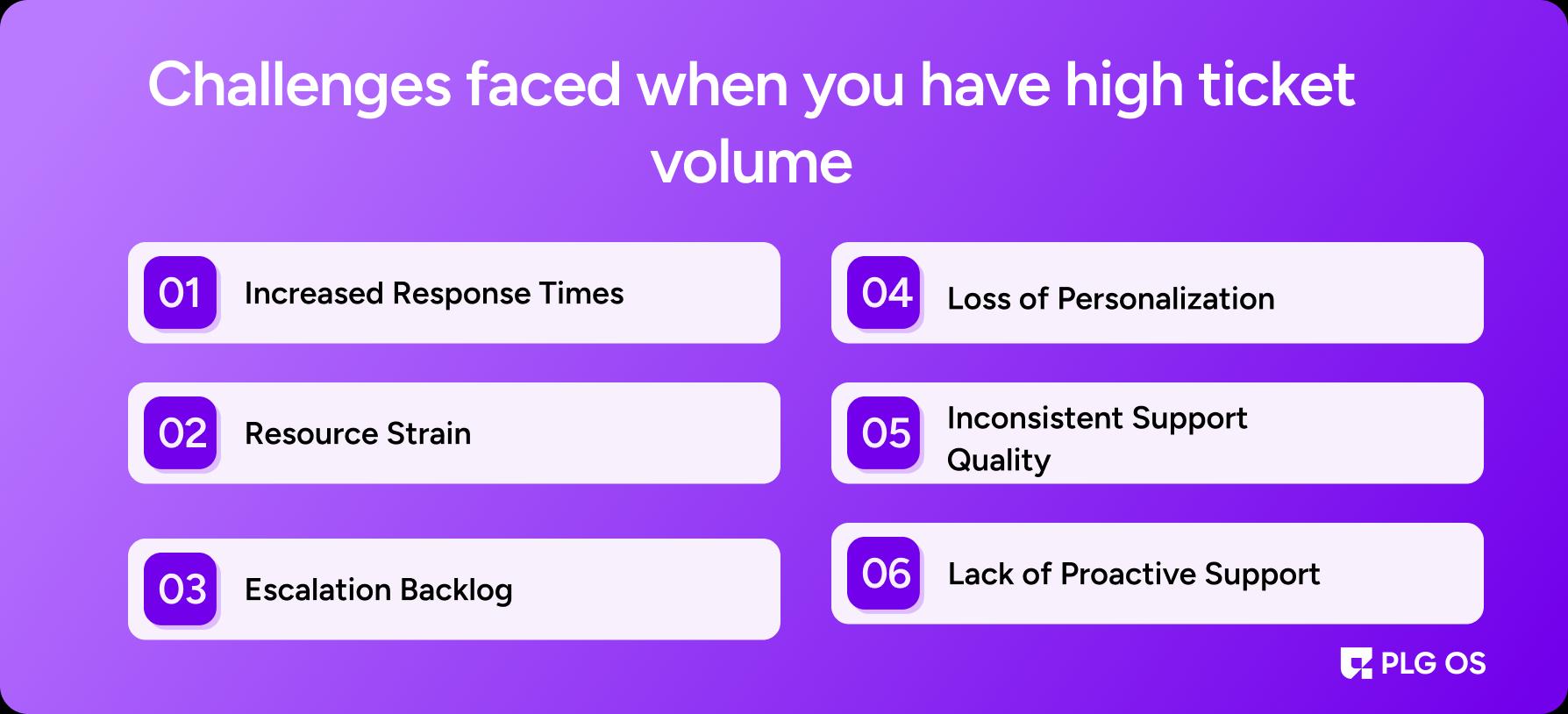
Challenges faced when you have high ticket volume
Managing a high volume of support tickets is one of the biggest challenges SaaS businesses face. As your user base grows, so does the demand for support, leading to several issues that can strain resources and affect customer satisfaction.
1. Increased Response Times:
When the ticket volume surges, response times inevitably increase. Customers often face frustrating delays, leading to dissatisfaction and a potential loss of trust in your service. In today’s fast-paced world, long wait times are unacceptable and can lead to negative reviews and churn.
2. Resource Strain:
High ticket volumes can overwhelm your support team, leading to burnout. With more tickets to resolve, employees may feel stressed and overworked, impacting their performance. The need for quick resolutions often leads to a decrease in the quality of customer service, as team members rush through tickets without providing thorough, personalized responses.
3. Escalation Backlog:
As more issues are reported, some tickets may require escalation to specialized teams or higher-level support agents. A high volume can create a backlog in escalated tickets, resulting in longer wait times for customers who need more complex solutions. This situation can lead to frustrated customers who feel their problems are not being handled efficiently.
4. Loss of Personalization:
When there are hundreds or thousands of tickets to handle, it becomes difficult to personalize responses. Generic replies might be sent to customers, leaving them feeling undervalued. Personal touch is key to customer satisfaction, and when overwhelmed, your team may struggle to provide the attention each customer deserves.
5. Inconsistent Support Quality:
With a high ticket load, maintaining consistency across support responses becomes a challenge. Different agents might provide varying levels of service, leaving customers with inconsistent experiences. This can erode trust and make it difficult to build a loyal customer base.
6. Lack of Proactive Support:
In the rush to handle incoming requests, businesses often lose sight of proactive support. Instead of preventing problems before they arise, teams are stuck in reactive mode. Without proactive measures, more customers may face similar issues, increasing the volume even further.
One proactive measure is to put help where the questions start. Our comparison of the best in-app support tools covers in-app chat, help centers and AI agents you can embed on the screens where users get stuck.
Conclusion
Effectively managing an influx of tickets may appear to be a formidable challenge; however, it simultaneously presents an opportunity to demonstrate to both your consumers and your team that you are genuinely invested in their needs.
By optimizing processes, employing tools that alleviate burdens, and providing support to your agents to prevent exhaustion, you can confront the challenge directly. Ultimately, each ticket represents an opportunity to cultivate more robust relationships and demonstrate to your consumers that they are well cared for. Attend to the needs of your team, and they will, in turn, attend to the needs of your consumers; it is as straightforward as that.
FAQs
1. How can self-service options help reduce support ticket volume?
Self-service options like knowledge bases, FAQs, and instructional videos empower customers to find solutions on their own. By providing easy access to information, you can address common questions and problems, reducing the need for customers to submit support tickets.
2. What role does automation play in minimizing support requests?
Automation tools like chatbots and automated ticket triaging can quickly handle simple queries and direct customers to relevant resources. This reduces the number of tickets that need human intervention, allowing support teams to focus on more complex issues.
3. How can better onboarding reduce support ticket volume?
A thorough onboarding process helps customers understand how to use your product effectively, addressing common issues early on. By providing clear instructions, guides, and tutorials, customers are less likely to encounter problems that would result in support tickets.
4. Is it possible to prevent recurring issues that lead to high ticket volume?
Yes! Regularly analyzing support tickets for recurring problems allows you to identify common pain points and fix them in your product or service. Proactively addressing these issues can significantly reduce the number of support requests over time.
5. How does improving customer communication reduce support ticket volume?
Clear, consistent communication through email, in-app messages, and social media channels can help manage expectations and reduce confusion. When customers have access to timely updates and easy-to-understand product information, they are less likely to submit unnecessary support tickets.