How to build a strong Customer Health Score
In the ever-evolving landscape of SaaS, customer retention is a game changer. Among the many metrics available to track customer relationships, the Customer Health Score (CHS) stands out as a vital tool for success. This powerful metric not only helps identify at-risk accounts but also aids in forecasting renewals and shaping proactive customer success strategies. Let's dive into what CHS is all about and how it can drive meaningful improvements for your SaaS business.
What is Customer Health Score?
Imagine a wellness check-up, but instead of patients, we're talking about your customers. The Customer Health Score is a comprehensive metric that indicates how likely a customer is to grow, maintain, or churn based on various engagement indicators. This score acts as an early warning system, alerting you to potential issues while also highlighting opportunities for growth.
Why Customer Health Score Matters in SaaS
Predictive Power
One of the standout features of CHS is its predictive capability. Unlike reactive metrics that merely report on past performance, a well-structured CHS gives you a glimpse into the future of your customer relationships. By catching potential issues early, you can act before they escalate into churn or, conversely, seize the moment when customers show positive engagement patterns.
Resource Optimization
With a clear understanding of which accounts need attention and why, customer success teams can prioritise their efforts effectively. This targeted approach leads to more efficient resource allocation, maximising the impact on both your company and your customers.
Revenue Impact
Healthy customers are not just a nice-to-have; they directly influence your bottom line.
Subscription Renewal:
Renew their subscriptions
Upgrades:
Upgrade to higher tiers
Recommendations:
Recommend your product to others
Feedback:
Provide valuable feedback and testimonials
Components of Customer Health Score
A robust Customer Health Score typically pulls from a variety of data points across key areas:
Product Usage Metrics
Login Activity:
Login frequency and patterns
Feature Usage:
Feature adoption rates
Engagement:
User engagement levels
Time Investment:
Time spent in the product
Core Features:
Core feature utilisation
Business Outcomes
Goal Achievement:
Achievement of defined goals
ROI:
ROI realisation
Value Time:
Time to value
Problem Resolution:
Problem resolution rates
Milestone Completion:
Success milestone completion
Customer Engagement
Support Interaction:
Support ticket frequency and resolution
Communication:
Response to communications
Community:
Community participation
Training:
Training program completion
Feature Requests:
Feature request engagement
Account Stability
Contract Details:
Contract length and value
Payment Status:
Payment history
Growth:
Account growth
Advocacy:
Advocacy activities
Executive Support:
Executive sponsorship
Building Your Customer Health Score Model
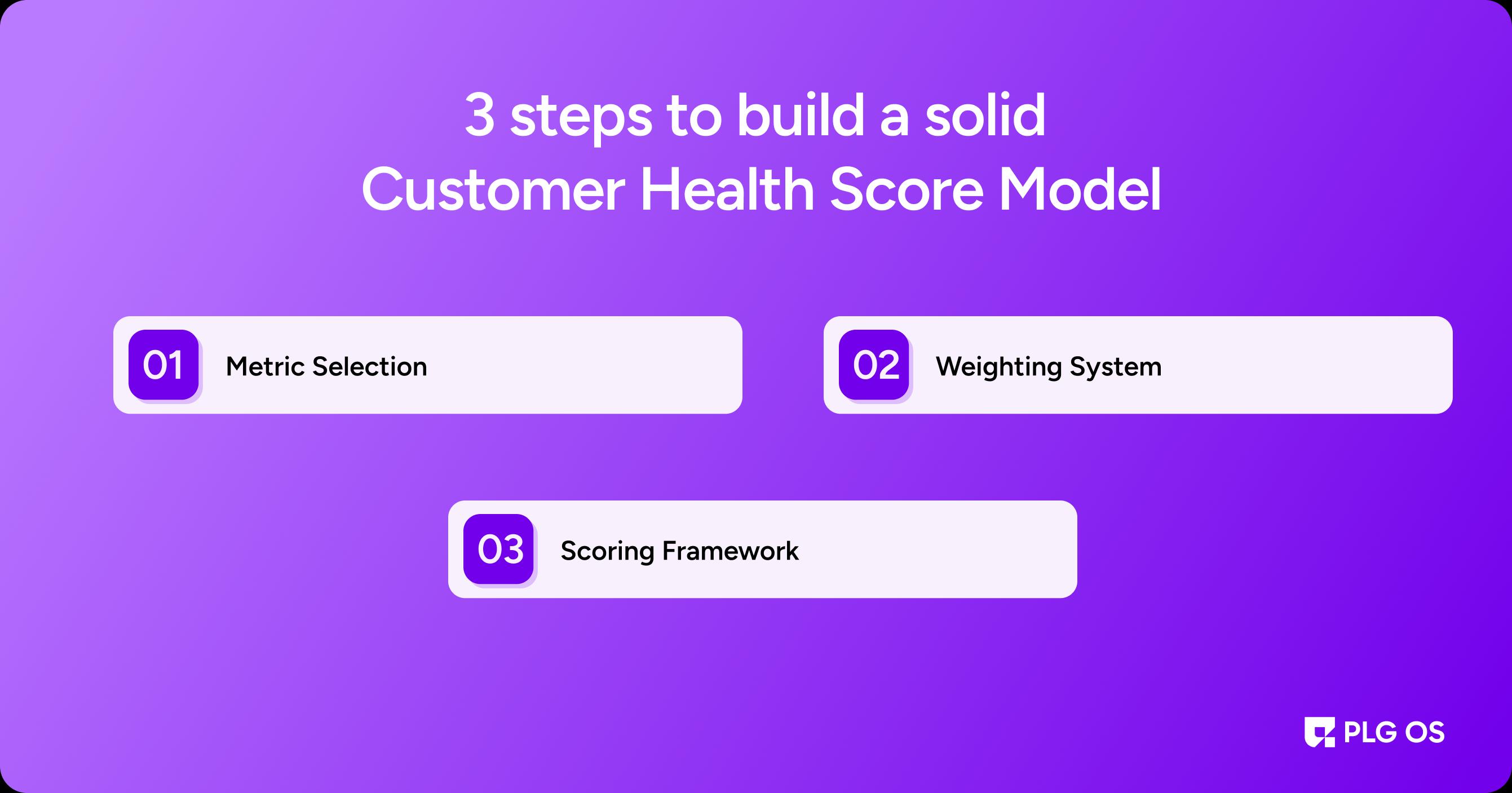
Creating a meaningful Customer Health Score model involves a few strategic steps:
Step 1: Metric Selection
Retention Correlation:
What behaviours correlate with long-term retention?
Churn Indicators:
What actions precede customer churn?
Growth Patterns:
Which engagement patterns signal growth potential?
Step 2: Weighting System
Critical Factors:
Critical success factors should carry more weight
Industry Priorities:
Consider industry-specific priorities and different customer segments
Data Validation:
Validate weights through historical data analysis
Step 3: Scoring Framework
Develop a clear scoring system that provides actionable insights. It should be easy to understand, allow for segmentation, and facilitate quick decision-making.
Implementing Customer Health Scoring
Data Collection and Integration
Product Analytics:
Product analytics
Support Systems:
Customer support systems
Communication:
Communication platforms
Financial Data:
Financial systems
CRM Integration:
CRM data
Automation and Tools
Real-time Processing:
Real-time data processing
Score Calculation:
Automated score calculations
Alert Systems:
Alert mechanisms
Reporting:
Reporting dashboards
Analysis:
Trend analysis
Team Training and Alignment
Ensure that all customer-facing teams understand how the score is calculated and what different scores mean. They should also be aware of the required actions for various scenarios and the escalation procedures.
Using Customer Health Scores Effectively
Proactive Intervention
Early Warning:
Creating early warning systems for at-risk accounts
Growth Opportunities:
Identifying expansion opportunities
Engagement Planning:
Developing customized engagement plans
Resource Management:
Making informed resource allocation decisions
Customer Communication
Communication Strategy:
Tailored communication strategies
Success Planning:
Personalised success plans
Training:
Custom training recommendations
Strategic Reviews:
Strategic review discussions
Optimising Customer Health Scores
Regular Review and Refinement
Accuracy Validation:
Validating predictive accuracy
Metric Updates:
Updating metrics and weightings
New Data Integration:
Incorporating new data points
Market Adaptation:
Adjusting for changing market conditions
Segmentation and Customization
Recognize that customer health might look different across various dimensions such as customer segments, industry verticals, and geographical regions.
Common Challenges and Solutions
Data Quality Issues - Challenge:
Incomplete or inaccurate data affecting score reliability
Data Quality Issues - Solution:
Implement robust data collection processes and regular audits
Metric Overload - Challenge:
Including too many metrics makes the score complex and hard to act on
Metric Overload - Solution:
Focus on key indicators that truly predict customer success
Score Interpretation - Challenge:
Difficulty in translating scores into action plans
Score Interpretation - Solution:
Develop clear playbooks for different score ranges and trends
Future Trends in Customer Health Scoring
AI and Machine Learning
Predictions:
More accurate predictions
Automation:
Automated intervention triggers
Personalization:
Personalised success strategies
Enhanced Integration
Real-time Updates:
Real-time score updates
Data Synthesis:
Cross-platform data synthesis
Predictive Models:
Predictive modelling
Best Practices for Success
Clear Documentation
Maintain detailed documentation of your scoring methodology, metric definitions, and update procedures. Clear action playbooks and success criteria are crucial.
Regular Communication
Ensure consistent communication of health scores across customer success teams, departments, and leadership. When appropriate, share this information with customers during strategic planning.
Conclusion
Customer Health Scores provide SaaS companies with a powerful tool to strengthen customer relationships, predict churn, and drive growth. When used effectively, CHS enables proactive strategies that not only improve customer outcomes but also maximise revenue potential through timely engagement and targeted support. Tracking this metric allows SaaS teams to be responsive, anticipate needs, and foster long-term customer loyalty, ultimately leading to a more resilient, customer-centred business.
PLG OS simplifies Customer Health Scoring by automating data collection and real-time score calculations from diverse customer interactions. With in-product analytics, usage insights, and automated alerts, PLG OS empowers your customer success teams to identify at-risk accounts early, prioritise engagement efforts, and uncover upsell opportunities. By seamlessly integrating health scores into actionable workflows, PLG OS enables your team to make data-driven decisions that reduce churn, enhance customer satisfaction, and create sustainable growth.