Agentic AI Vs. AI Agents: The Future of Autonomous Intelligence
Many businesses are looking to capitalize on agentic AI; however, not all will benefit from this. To avoid wasting money on a solution that won't meet your needs, it's crucial to know how agentic AI technologies differ from AI agents.
AI is changing quickly, but not all of it is the same. Some systems do what they're told like good servants, while others think, plan, and act on their own. That's the difference between AI Agents and Agentic AI: Agentic AI makes choices, while AI agents carry out jobs. Imagine an AI that not only responds to queries, but also anticipates issues, strategizes solutions, and operates autonomously.
That's Agentic AI, and it's changing businesses, AI, and even our everyday lives. What makes them different? Which one will happen? Why should you care? Let's check it out.
What is an AI agent?
An AI agent is a piece of software that can understand its surroundings, handle data, and act in certain ways to reach certain goals. From Siri's ability to send reminders to deep learning models' ability to handle more complicated tasks, these agents can be as basic or complex as the user desires.
The combined power of several AI agents can increase their capabilities in an exponential way. A group of AI agents, sometimes called an agentic AI system, may work together to accomplish more complicated tasks and workflows than any one agent could on its own. One AI agent may perform language processing, another may search knowledge bases, and a third could handle ticket routing in customer care. This way, problems can be efficiently resolved for customers.
AI agents have the ability to work both alone and in a group. All of them act in accordance with their predetermined programs and the information they are fed. However, tasks that would be too difficult for a single agent to manage can be tackled by combining their efforts.
What is agentic AI?
Agentic AI is a type of artificial intelligence that can make decisions on its own, act based on goals, learn and change, and use advanced reasoning. In 2024, the global market value of agentic AI was $5.1 billion, and it's expected to grow to over $47 billion by 2030.
Agentic AI uses numerous agents to manage complicated workflows autonomously, learning and adjusting in real-time based on feedback and experience, unlike AI agents that use a single agent to concentrate on a particular task.
Using AI that isn't agentic, an IT support system might only categorize tickets and respond according to predetermined templates. Agentic AI-powered systems, on the other hand, can understand what users are saying in plain English, gather relevant data, figure out the best thing to do, and then do it for example, by changing permissions or resetting passwords without any help from a person.
Four main features set agentic AI apart from traditional AI:
Making decisions autonomously:
Agentic AI can do more than just follow rules; it can assess context, choose an action, and carry it out without continual human supervision.
Actions driven by goals:
agentic AI plans and executes multi-step tasks to achieve particular objectives, rather than classical AI's focus on pattern recognition.
Learning and adapting:
A key feature of agentic AI is its ability to learn and adapt. Unlike static algorithms, agentic AI takes into account interactions and results to enhance its performance and make quick adjustments as needed.
Advanced reasoning:
Agentic AI can coordinate across several databases and tools, link to multiple systems, and manage intricate processes on its own.
When compared to agentic AI, which offers more adaptability, actionability, and scalability across various applications, traditional AI models excel only in data analysis and content generation. Automating jobs and streamlining processes with less human participation is possible with its appropriate implementation.
Agentic AI vs AI Agents: Differences
| Feature | AI Agents | Agentic AI |
|---|---|---|
| Autonomy | Limited to predefined tasks and rules | Highly autonomous, takes initiative |
| Decision-Making | Follows preset rules or learned patterns | Sets its own goals and adapts to new situations |
| Learning | Learns from data but within a structured framework | Self-learns and evolves dynamically |
| Problem-Solving | Executes known solutions | Develops novel solutions based on context |
| Human Oversight | Requires regular monitoring and intervention | Can function independently with minimal supervision |
| Flexibility | Works well in structured, predictable environments | Adapts to changing, complex environments |
| Use Cases | Chatbots, recommendation systems, automation tools | Autonomous research, strategic decision-making, self-improving AI |
Understanding the fundamental distinction between agentic AI and AI agents is critical for businesses and developers seeking to create effective AI solutions.
Here's a detailed comparison between agentic AI and AI agents, highlighting their distinct features and capabilities.
1. Autonomy Level
Agentic AI has more autonomy than AI agents, which work within predetermined boundaries. Agentic AI can make autonomous decisions and acts without continual human supervision, allowing it to effectively navigate complicated situations.
In contrast, AI agents often adhere to predefined rules and scripts, which limits their capacity to adapt autonomously.
2. Goal orientation
Another significant distinction between agentic AI and AI agents is that agentic AI prioritizes long-term goals, whereas AI agents prioritize task completion. This means that agentic AI can establish and pursue bigger goals, modifying its techniques as needed to attain them.
On the other hand, AI agents excel at performing specialized jobs or activities, such as customer service or data processing, but lack a long-term vision.
3. Learning Capabilities
When comparing agentic AI to AI agents, agentic AI systems outperform traditional AI agents in terms of learning and adaptability.
Agentic AI uses advanced approaches such as adaptive artificial intelligence to continuously enhance its decision-making processes based on prior experiences and real-time data.
In contrast, many AI agents have weak learning capabilities and frequently require reprogramming to accommodate new tasks or environments.
4. Complexity
Agentic AI systems are more complicated and intelligent than traditional AI agents. They use a variety of advanced technologies, including machine learning algorithms and massive language models, allowing them to do complex tasks requiring reasoning and problem solving in dynamic contexts.
In contrast, AI chatbots are often created for simpler, well-defined activities that do not necessitate substantial cognitive ability.
5. The decision-making process
In terms of AI decision-making, agentic AI differs from AI agents in that it takes a more nuanced approach, assessing various aspects and potential outcomes before making a decision.
This contrasts with the generally uncomplicated decision-making process of AI bots, which often adhere to a set of predetermined rules without regard for broader consequences.
6. Interaction With the Environment
Agentic AI systems may actively sense their surroundings and adjust their behavior in response, displaying a high level of situational awareness.
Traditional AI agents, on the other hand, work in a controlled environment, with interactions limited to the inputs and outputs prescribed by their programming.
Generative AI Trends
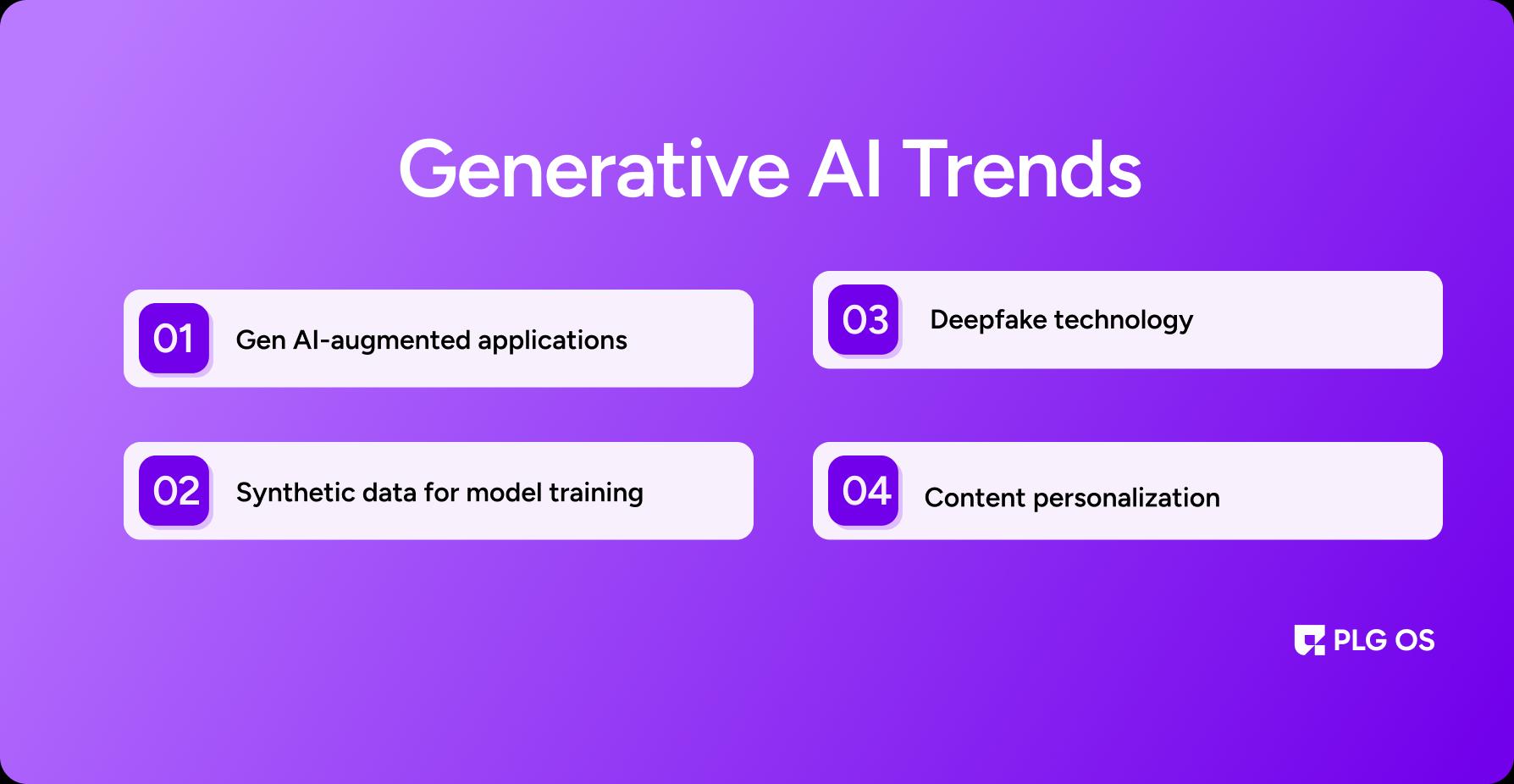
1. Gen AI-augmented applications: There is a growing trend of integrating Gen AI-augmented applications into various software and platforms. This integration contributes to a more personalized user experience while also providing intelligent functionalities.
2. Synthetic data for model training: AI-generated synthetic data will be used to train models when real-world data is unavailable or prohibitively expensive. The use of synthetic data can improve AI training in areas such as robots, self-driving cars, and banking.
3. Deepfake technology: While moderately entertaining, Gen AI has created a hyper-realistic image or movie using AI that appears real. It has and continues to raise ethical concerns about misinformation.
4. Content personalization: It is a prevalent trend in retail. Marketing teams are tailoring content and campaigns to individual tastes using Gen AI data analytics.
Agentic AI Trends
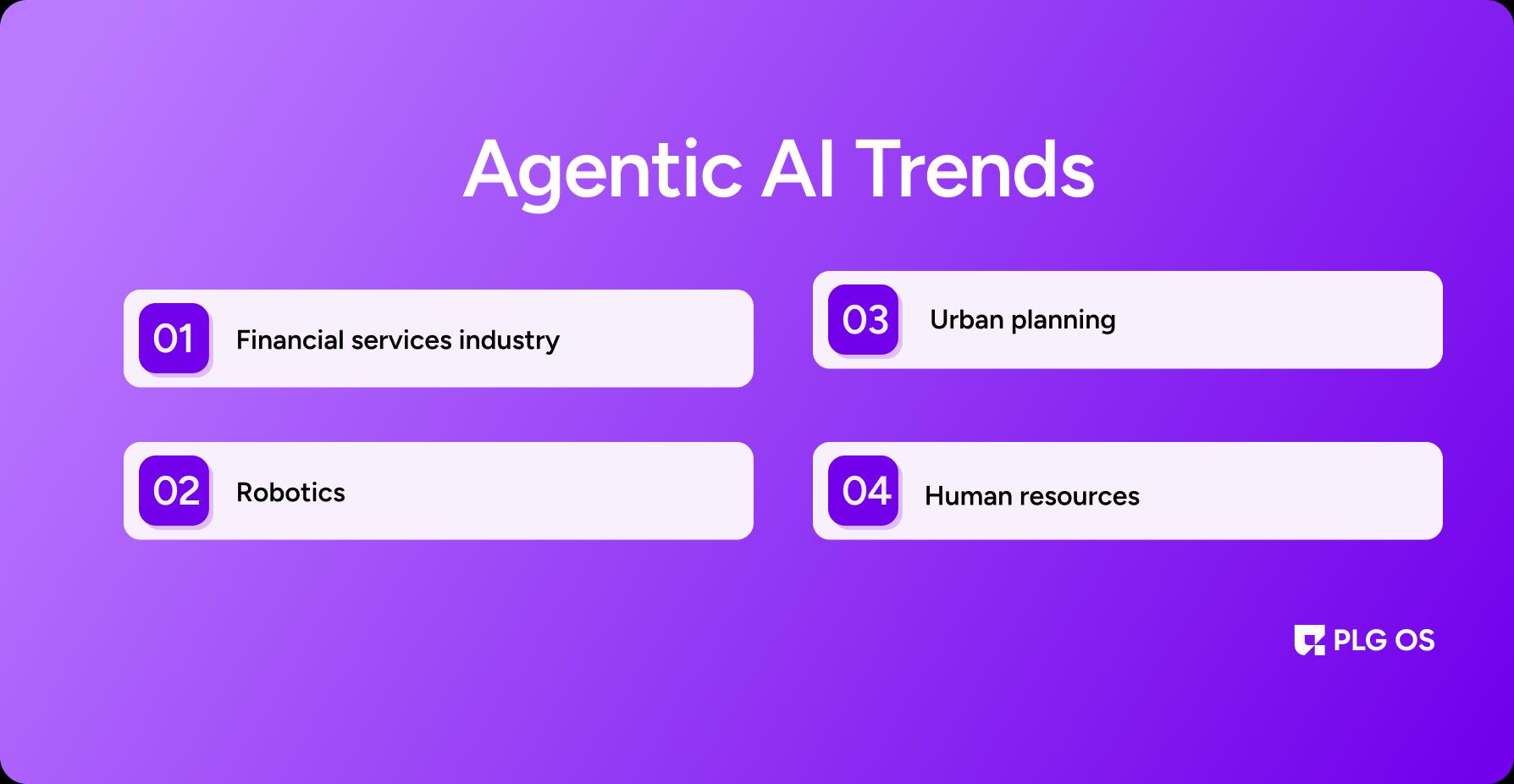
1. Financial services industry: Agentic AI has the potential to transform trading techniques by assessing market data and executing transactions more quickly. It's broad reach is a huge advantage because it can be programmed to search the entire internet. Agents can retrieve updates and obtain real-time information.
2. Robotics: Amazon warehouses have begun to deploy robots in fulfillment centers to improve warehouse automation and manufacturing operations. Agentic AI can manage complex tasks and work independently on specialized tasks.
3. Urban planning: Agentic AI systems in urban planning may examine a wide range of datasets, including real-time traffic data and video sensors, to assist planners in making more educated decisions. The intuitive nature of agentic AI has the ability to save teams hours of work creating presentation slides or tables.
4. Human resources: When agentic AI is applied for human resources, firms can go beyond the capabilities of general AI and provide autonomous decision-making and dynamic employee support. AI agents may automate repetitive tasks and give individualized replies to employees, allowing HR professionals to focus on more strategic concerns.
Conclusion
The autonomy, goal orientation, learning capabilities, and complexity of AI agents differ from those of agentic AI.
Whereas AI agents tend to be task-specific and operate within predefined constraints, agentic AI systems possess a great deal of autonomy, making decisions on their own and adjusting to new situations. Responsible development and deployment techniques that address ethical considerations must be prioritized as we investigate the potential societal impact of agentic AI vs AI agents.
If you want to implement AI agents or think this revolutionary system can help your business, you can book a call with us to understand our AI automation tools better.
FAQs
1. What is the main difference between AI Agents and Agentic AI?
AI Agents follow predefined rules and assist with tasks, while Agentic AI is autonomous, makes decisions, and adapts to new situations.
2. Can AI Agents become Agentic AI over time?
Not necessarily. AI Agents are designed for specific tasks, while Agentic AI requires advanced self-learning and decision-making capabilities.
3. Is Agentic AI safe?
It depends on safeguards. Proper oversight, ethical guidelines, and transparency are crucial to ensure responsible AI behavior.
4. Where is Agentic AI used?
It’s emerging in research, healthcare, cybersecurity, and autonomous systems where independent decision-making is valuable.
5. Will AI Agents become obsolete?
No. AI Agents will continue handling repetitive tasks, while Agentic AI will take on more complex, strategic roles.