SaaS vs Agentic AI: Which Will Lead the Future of Business?
The business world is at an inflection point. Artificial intelligence is no longer a futuristic concept, it’s here, revolutionizing industries at an unprecedented pace. But within this AI-driven transformation, two forces stand out: SaaS (Software as a Service) and Agentic AI.
The future of business is being shaped by two powerhouses: SaaS (Software as a Service) and Agentic AI (AI that acts independently, learns dynamically, and makes decisions on its own). SaaS has been the backbone of modern business for years, powering everything from CRMs to collaboration tools. But now, Agentic AI is crashing the party, promising to revolutionize industries by thinking, adapting, and acting, without waiting for human commands.
So, what does the future hold? Will SaaS remain dominant, or will Agentic AI redefine the rules of business? And more importantly, how will the intersection of these two powerhouses shape the next decade?
Let’s dive in.
SaaS: The Bedrock of Modern Businesses
SaaS transformed how businesses use software. Gone are the days when companies needed to purchase expensive licenses, install bulky programs, and deal with tedious updates. In 2024, the market value of agentic AIwas $5.1 billion. Instead, SaaS solutions provide instant, cloud-based access to software, allowing businesses to operate efficiently with minimal IT overhead.
Why Has SaaS Dominated?
1. Scalability & Accessibility - Whether a startup or an enterprise, SaaS allows businesses to scale without heavy investment in infrastructure. Accessing powerful tools from anywhere makes operations seamless.
2. Cost-Effectiveness – Subscription-based pricing removes the need for hefty upfront costs, making it easier for businesses to adopt new technologies.
3. Continuous Innovation – SaaS providers roll out regular updates, ensuring users can always access the latest features and security enhancements.
4. Integration-Friendly – Modern SaaS platforms are built to integrate with various other tools, making them essential in complex digital ecosystems.
From CRM systems like Salesforce to collaboration tools like Slack and project management platforms like Asana, SaaS has embedded itself deeply into daily business operations.
But while SaaS has changed the game, its limitations are becoming more apparent in a world demanding autonomous, intelligent decision-making.
Agentic AI: The Next Business Revolution
Agentic AI is a step beyond traditional AI applications. Instead of relying on humans to feed it data and make final decisions, it acts independently, learns dynamically, and optimizes operations on its own.
Imagine an AI system that analyses customer data and initiates personalized engagement campaigns without manual input. Or an AI-driven logistics platform that automatically reroutes supply chains based on weather predictions and geopolitical changes.
What Makes Agentic AI Different?
1. Autonomy – Unlike SaaS, which provides tools for human use, Agentic AI can operate independently, making its own decisions.
2. Context Awareness – It understands and adapts to environments in real-time, rather than just processing predefined tasks.
3. Self-Learning Capabilities – Agentic AI improves over time, adjusting strategies based on new data without manual reprogramming.
4. Proactive Problem-Solving – Instead of just offering insights, it takes action to solve problems before they even arise.
From autonomous customer service bots to AI-driven investment portfolios, Agentic AI is moving from a mere support role to a decision-maker.
SaaS vs. Agentic AI: Who Leads the Future?
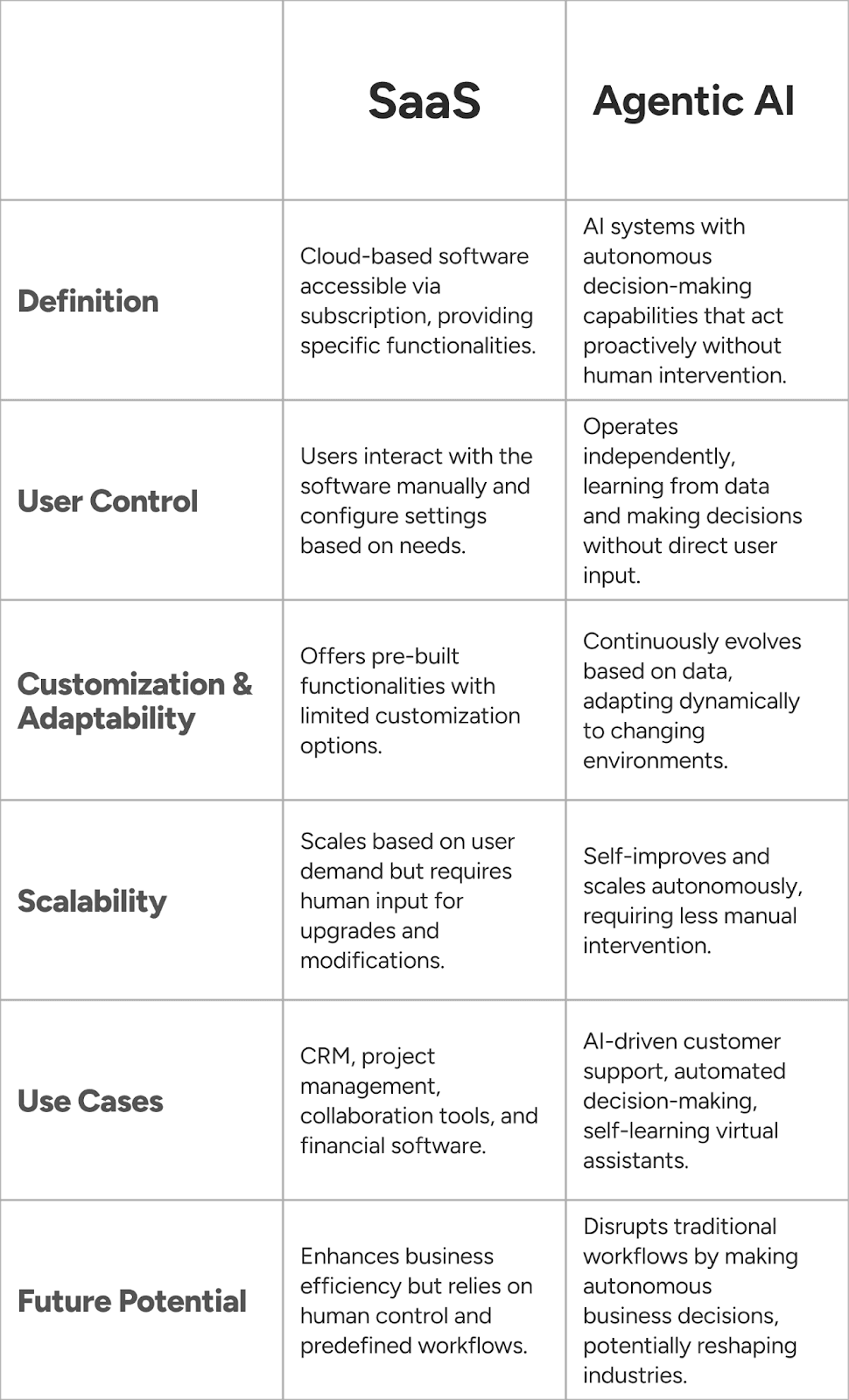
While SaaS has been the dominant force in business technology, Agentic AI presents a new paradigm shift. The question isn’t whether Agentic AI will change business, it’s how much of SaaS it will replace.
Where SaaS Still Holds the Advantage
1. Trust & Control – Businesses still prefer having control over decision-making, rather than letting AI run autonomously. SaaS provides structured solutions where humans remain in charge.
2. Compliance & Regulation – Many industries have strict compliance requirements that demand human oversight, making SaaS a safer choice.
3. User Adaptability – SaaS platforms are designed to be user-friendly and integrated into workflows, making them easier to adopt.
4. Customization – Companies want software that caters to their specific needs. SaaS allows businesses to configure solutions rather than rely on AI-driven decisions.
Where Agentic AI is Set to Disrupt
1. Efficiency Beyond Human Limits – Agentic AI can operate at speeds and depths impossible for humans, making it ideal for optimizing processes in real-time.
2. Cost Reduction in Decision-Making – AI-driven decision-making eliminates the need for large teams to analyze and act on data, reducing operational costs.
3. Dynamic Adaptability – Unlike SaaS, which requires updates and human intervention, Agentic AI continuously evolves on its own.
4. Unprecedented Automation – From finance to healthcare, Agentic AI is taking over tasks that once required human expertise, streamlining industries at a fundamental level.
The Future: The Convergence of SaaS and Agentic AI
The most likely scenario isn’t an outright replacement but a fusion of these technologies. SaaS will evolve by embedding Agentic AI capabilities, shifting from passive software to active, decision-making platforms.
What This Fusion Looks Like
1. AI-Augmented SaaS Platforms
- Instead of just providing dashboards, SaaS tools will proactively recommend and execute actions based on real-time data.
- Example: A CRM that tracks leads and autonomously personalizescustomer engagement strategies.
2. Self-Optimizing Business Applications
- Software that learns from user behavior and adapts its interface, workflows, and automation to maximize productivity.
- Example: Project management tools that dynamically adjust priorities based on team performance and deadlines.
3. Autonomous SaaS Agents
- Businesses will no longer just access software, they’ll have AI-powered agents within these platforms that perform tasks independently.
- Example: An AI-driven ERP that optimizes supply chain logistics without human intervention.
Overcoming SaaS Challenges with Agentic AI
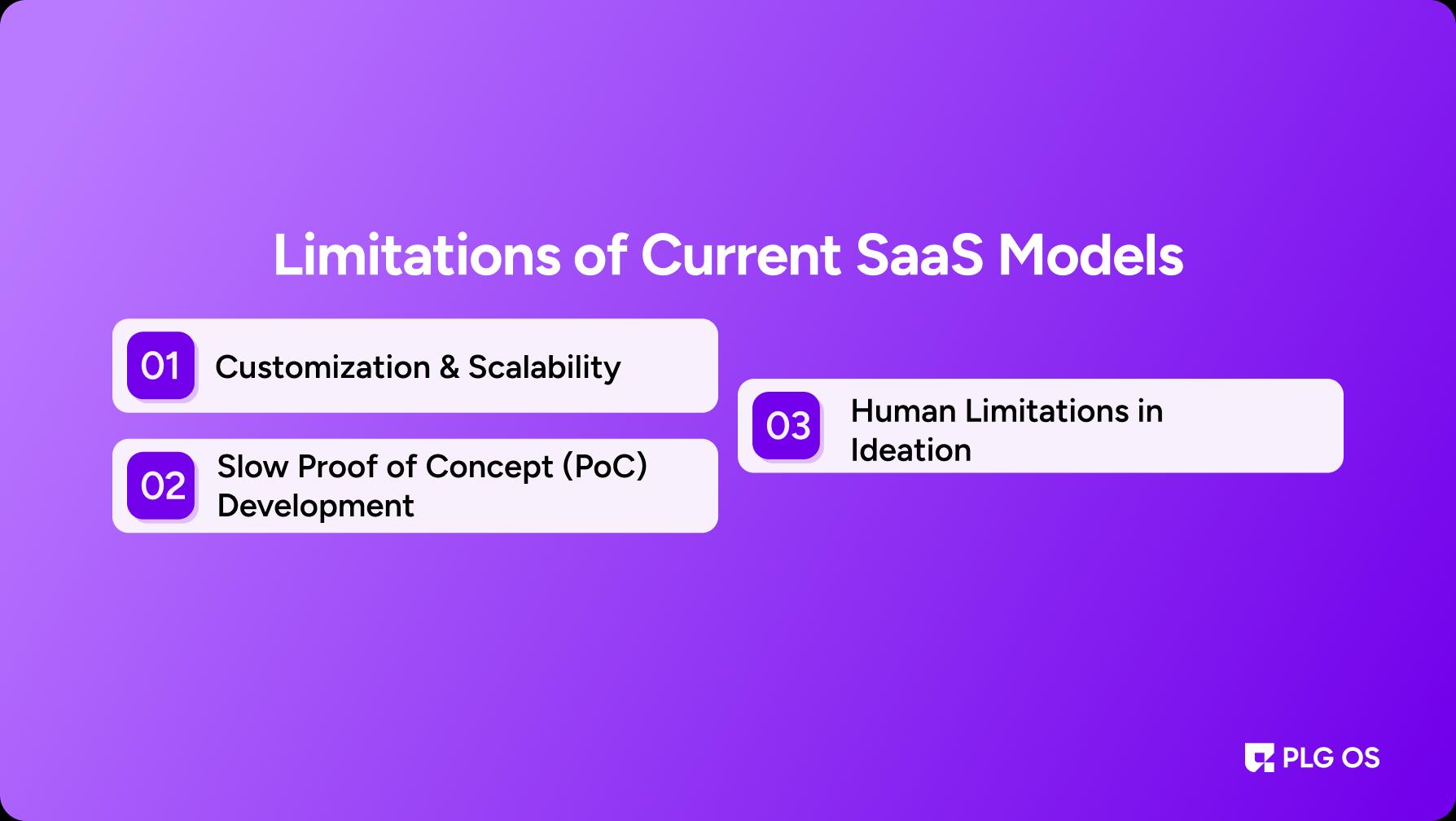
Limitations of Current SaaS Models
1. Customization & Scalability
SaaS platforms offer standardized solutions but struggle with customization. Tailoring them for diverse use cases demands extensive engineering effort, increasing costs and development time.
Scaling SaaS from small to large user bases brings performance bottlenecks, infrastructure challenges, and resource management issues. Updates meant to enhance functionality often introduce instability, requiring frequent maintenance.
2. Slow Proof of Concept (PoC) Development
SaaS PoCs take months to build, delaying idea validation and giving competitors an advantage. The process involves extensive manual research, resource procurement, and integration testing before a concept is fully realized.
3. Human Limitations in Ideation
SaaS innovation depends on human creativity, but manual research is time-consuming and prone to biases. Market opportunities are often explored reactively rather than proactively, making businesses slow to adapt to trends.
How Agentic AI Solves These Challenges
1. Automated Ideation
Agentic AI acts as an intelligent strategist, autonomously generating and validating ideas. It simulates brainstorming sessions, analyzes trends, and refines concepts in real time.
Example:
An AI-powered strategist can develop and validate three PoCs in weeks instead of months.
Technical Insight:
LLMs like GPT-4 use reinforcement learning to understand industry challenges and generate business-specific solutions.
2. Natural Language Interfaces (NLIs)
AI-powered NLIs simplify user interactions, eliminating technical barriers. Users can retrieve insights using plain language queries rather than complex coding.
Example:
Asking “How much revenue have we lost due to downtime this year?” prompts the AI to generate SQL queries and deliver results instantly.
Technical Insight:
Transformer-based models convert natural language into database queries, reducing reliance on developers.
3. Optimized Data Retrieval
Agentic AI automates data extraction and visualization, providing deep insights into operations, customer behavior, and financial metrics.
Technical Insight:
AI models like Azure OpenAI GPT embed structured and unstructured data, enabling seamless retrieval and analysis.
4. Efficiency in Software Development
Agentic AI reduces manual workload in software development by auto-generating macros, SQL queries, and test cases.
Example:
AI tools like GitHub Copilot analyze millions of repositories to predict and generate boilerplate code, accelerating development.
For enterprises, AI-driven tools like SearchUnify Virtual Assistant (SUVA) automate workflows, while the Agentic Self-Service Hub enhances user engagement through conversational AI, making processes more intuitive and efficient.
Challenges in the Transition
As promising as Agentic AI-powered SaaS sounds, businesses must navigate several hurdles before full adoption.
Ethical & Compliance Risks
- Can businesses trust AI to make unbiased, ethical decisions?
- How do industries with strict regulations manage AI-driven decision-making?
Workforce Displacement
- With AI taking over complex tasks, how do companies reskill employees?
- What roles will humans play in an AI-driven business world?
Security & AI Vulnerabilities
- How do businesses prevent AI from making catastrophic mistakes?
- Can AI be manipulated or hacked into making harmful decisions?
Final Thoughts: A New Era of Business is Here
If SaaS is the foundation, Agentic AI is the rocket fuel.
SaaS isn’t going anywhere. It will continue to provide essential business tools. But on its own, it’s not enough. Companies that embrace AI-driven SaaS solutions will have an undeniable competitive edge. Those that resist? They’ll struggle to keep up.
The future belongs to businesses that let software do more than just assist—they let it think, act, and lead.
So, the real question isn’t “SaaS or Agentic AI?” It’s: Are you ready for a world where software works smarter than ever before? Book a call to learn how Agentic AI can help your SaaS business.
FAQs
1. Will Agentic AI completely replace SaaS?
Not entirely. SaaS will continue to provide the foundation for business operations, while Agentic AI will enhance it by making autonomous decisions and optimizing workflows.
2. What makes Agentic AI different from traditional AI in SaaS?
Traditional AI in SaaS relies on human input to function, while Agentic AI acts independently, learns dynamically, and makes decisions without constant supervision.
3. Is Agentic AI safe for businesses to adopt?
While it offers massive potential, businesses must address challenges like compliance, bias, and security risks before fully relying on autonomous AI decision-making.
4. How will SaaS evolve with AI integration?
SaaS platforms will become more autonomous, shifting from passive tools to proactive systems that analyze data and take action without human intervention.
5. Should businesses invest in Agentic AI now?
Yes, early adoption can provide a competitive edge. However, companies should start with AI-augmented SaaS solutions before fully transitioning to autonomous AI-driven operations.