Product-Led Growth: Why is it taking off in 2024
In 2024, Product-Led Growth (PLG) is more than a buzzword—it's the strategy reshaping SaaS growth. As companies look to streamline operations and focus on efficient growth, PLG has emerged as the go-to approach. With users expecting more value upfront and businesses seeking to reduce costly sales efforts, PLG places the product itself at the center of acquisition and retention. By allowing customers to experience the product's value firsthand, PLG fosters organic growth, higher user engagement, and stronger customer loyalty. Here's why PLG is leading the way in 2024 and how it drives lasting success for SaaS businesses.
What is Product-Led Growth (PLG)?
Product-Led Growth is a strategy where the product itself is the main driver of customer acquisition, retention, and expansion. In a PLG model, customers experience value directly from using the product, often through free trials or freemium versions, and this experience naturally leads to conversions and upgrades. PLG puts the focus on creating an amazing product experience so that users don't need to be "sold" on the product; they see its value firsthand.
For example, if you've ever signed up for a free trial of a software tool and found yourself wanting to pay for the full version because of how useful it was, that's Product-Led Growth in action. In a PLG model, the product "sells" itself.
Why Product-Led Growth Matters for SaaS
Lower Customer Acquisition Costs (CAC):
When users can try the product without going through a salesperson, it reduces the need for expensive sales teams. This can significantly lower CAC and make growth more scalable.
Faster Growth:
In a PLG model, customers can quickly see the product's value, leading to faster adoption and more organic growth.
Better Retention:
Because users have experienced the product before paying, they are more likely to stick around, knowing exactly what they're getting.
Creates Advocates:
Happy users often become advocates, recommending the product to others. This word-of-mouth growth is incredibly valuable and helps build a loyal customer base.
By focusing on the product experience, SaaS companies can build trust with users, reduce reliance on traditional sales, and create long-term customer relationships.
Key Elements of Product-Led Growth
Successful PLG doesn't happen by accident. It requires intentional design and a strong understanding of what users need. Here are the core elements of a Product-Led Growth strategy:
1. A Great Product Experience
The product must be easy to use and deliver value quickly. Users should feel that they are getting something valuable right from the start. The product experience should be so smooth that users can start seeing the benefits without a lot of guidance.
2. Freemium or Free Trial Model
Many PLG companies offer a freemium version or free trial. This allows users to try the product with minimal commitment, increasing the likelihood that they'll see value and decide to pay for the full version.
3. Clear Value Proposition
Users should understand the product's main benefits quickly. This means clear messaging, an intuitive interface, and a straightforward onboarding process.
4. Data-Driven User Insights
Tracking user behavior within the product helps teams understand what features users find valuable and where they might face challenges. This data guides continuous improvements to ensure the product meets customer needs.
5. Continuous Product Improvement
A Product-Led Growth strategy requires a commitment to ongoing product enhancements. By responding to user feedback, fixing bugs, and introducing valuable features, companies can keep users engaged and satisfied.
Examples of Product-Led Growth in Action
Canva:
Canva offers a free design platform where users can access templates and basic features to create social media graphics, presentations, and more. By allowing users to try these core features for free, Canva attracts a wide range of individuals, businesses, and educators. When users want access to advanced features or premium templates, they're encouraged to upgrade to paid plans. Canva's intuitive design and easy accessibility make it a great example of PLG, as users quickly see the product's value and adopt it naturally.
Notion:
Notion combines note-taking, project management, and collaboration tools in one platform. Notion's free plan offers powerful features, enabling individuals and small teams to organize tasks and projects without a financial commitment. As teams grow and require more advanced features, Notion provides paid plans with additional storage and collaboration options. Notion's flexibility and ease of use make it simple for users to adopt, turning them into advocates who recommend the platform to others.
Miro:
Miro is an online collaborative whiteboard tool used by teams for brainstorming and project planning. By offering a free version with essential features, Miro allows teams to experience its value during brainstorming sessions. Teams often find themselves needing more features, such as advanced integrations and templates, which are available in the paid plans. Miro's focus on enhancing teamwork and productivity keeps users engaged and encourages upgrades over time.
These companies succeed with PLG because they allow users to experience real value without paying upfront. This approach builds trust and encourages users to invest more as they grow.
Steps to Implement Product-Led Growth
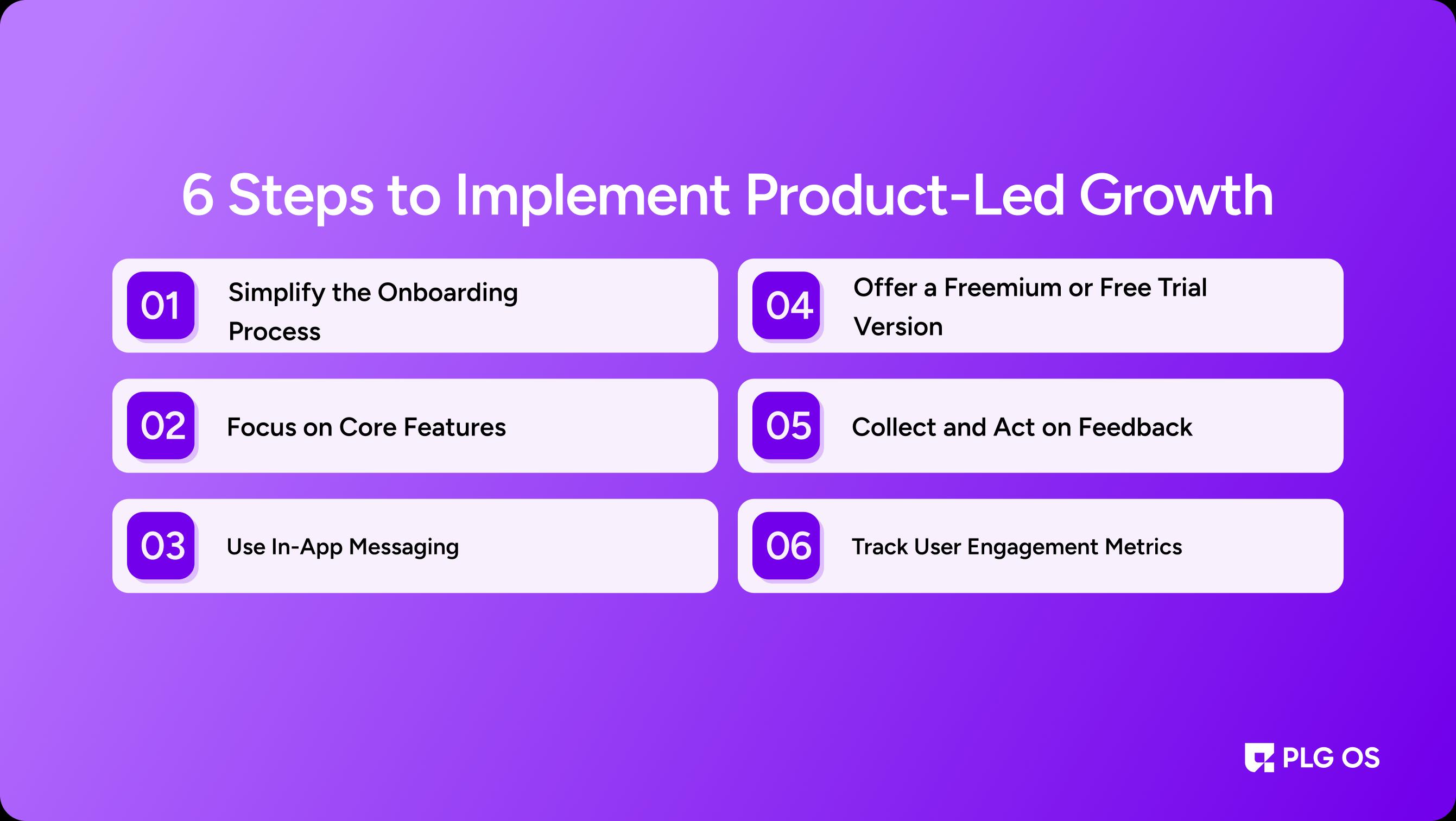
1. Simplify the Onboarding Process
The faster users see the value in your product, the better. Focus on making onboarding easy and engaging. This could include step-by-step guides, tooltips, and interactive tutorials that highlight key features.
2. Focus on Core Features
Identify the features that provide the most value and make sure they're easy to access and use. Avoid overwhelming new users with too many options. A focused experience can make the product feel intuitive and help users understand its value.
3. Use In-App Messaging
In-app messaging is a great way to guide users through your product and keep them engaged. You can use pop-up messages, hints, and notifications to direct users toward features they might find valuable.
4. Offer a Freemium or Free Trial Version
Let users try the product before committing. A freemium version or free trial gives users a taste of the product's value and increases the chances of converting them to paying customers.
5. Collect and Act on Feedback
Regularly gather feedback from users to understand what's working and what isn't. Use surveys, feedback forms, and direct messages to get insights. Make changes based on this feedback to improve the user experience continually.
6. Track User Engagement Metrics
Tracking key metrics like user engagement, feature adoption, and time to value helps you understand if your PLG strategy is working. Adjust your strategy based on these insights to ensure users are getting the most out of your product.
Important Metrics for Product-Led Growth
Activation Rate:
Measures how many users complete the onboarding process and start using core features.
Time to Value (TTV):
How quickly users experience the product's value. A shorter TTV often leads to better retention.
Feature Adoption Rate:
Shows which features users engage with most. High adoption means users are finding value in those features.
Customer Retention Rate:
Retention indicates if users see long-term value and stick with the product.
Net Promoter Score (NPS):
Measures user satisfaction and the likelihood they'll recommend your product to others.
Challenges in Adopting Product-Led Growth
Balancing Free and Paid Features:
Offering too much for free can reduce the incentive to upgrade, but offering too little can drive users away. Finding the right balance is key.
Achieving Quick Value:
Users need to see the product's value quickly, or they may lose interest. Focusing on a clear value proposition and simplifying the onboarding process can help.
Iterating Based on Feedback:
Collecting feedback is vital, but implementing changes requires resources and a clear plan. Make sure feedback loops are integrated into the development process.
Conclusion
Product-Led Growth puts users at the center of the SaaS business model. By focusing on creating a product that delivers immediate value, SaaS companies can build loyal user bases, reduce acquisition costs, and grow organically. The key to PLG success is understanding what users need, simplifying the product experience, and continuously improving based on feedback. A strong PLG strategy not only attracts new users but also turns them into loyal advocates who drive further growth.
PLG OS is a powerful tool for SaaS companies aiming to implement a Product-Led Growth strategy. PLG OS offers personalized onboarding, in-app guidance, and user insights, helping companies create smooth experiences that drive user engagement and retention. With PLG OS, SaaS teams can track user behavior, identify key features, and adjust the product to meet user needs continuously. By using PLG OS, companies can take their PLG strategy to the next level, ensuring a seamless journey from onboarding to advocacy.