10 Must-Try Gamification Platforms for SaaS in 2025
The quick answer
Quick answer: gamification for SaaS means adding game mechanics such as streaks, points, badges, challenges and leaderboards to your product so users come back and finish the actions that matter. The ten platforms below fall into three groups: tools that put gamification inside your product (PLG OS, Trophy, StriveCloud, Open Loyalty, Funifier and Bunchball Nitro), tools for marketing campaigns, training and WordPress sites (Optimove Gamify, Kahoot! 360 and BadgeOS), and sales-team gamification (Spinify). This October 2026 update replaces three platforms that are no longer available as described (GrowthHackers Experiments, Playlyfe Catalyst and Classcraft for Business) and corrects the rest. Prices are as of September 2026.
Gamification platforms vs gamified onboarding tools
This page is about gamification platforms you build into a SaaS product or run for your teams: engines, APIs and components for streaks, points, badges and leaderboards that keep people engaged for months after signup. Gamifying onboarding is a narrower job, getting someone through their first days, and it pulls in a different set of tools, including learning platforms used to onboard new employees and product-onboarding tools such as Product Fruits and Pendo. For that job, see our list of the 27 best gamification onboarding platforms.
In 2025, it’s not enough to build a great SaaS product; you have to make it irresistible. That’s where gamification platforms come in. From nudging users to complete onboarding to boosting feature adoption and reducing churn, the right gamification tools can turn your product into a growth engine. And no, we’re not talking about cheesy badges slapped onto your UI we mean smart, strategic game mechanics designed to drive real engagement.
But here’s the real question:
Which gamification platforms are actually worth your time (and budget) in 2025?
Let’s dive into the top 10 platforms to embed gamification in apps and websites in 2025, with tools ranging from plug-and-play simplicity to powerhouse platforms like PLG OS that turn gamification into a product-led growth engine.
SaaS Gamification Features to Embed in 2025
Gamification in 2025 isn’t just about badges and leaderboards. It’s about crafting smart, behaviour-driven engagement loops that align with your product’s core value. Mordor Intelligence values the gamification market at $29.11 billion in 2025 and expects it to reach $112.32 billion by 2031, a compound annual growth rate of 25.24%, indicating widespread adoption across various sectors.
Here are the top SaaS gamification features worth embedding this year:
- Progress Bars & Milestones: Visually guide users through onboarding, tutorials, or multi-step processes. Progress = motivation.
- Achievement Badges: Reward actions like completing a profile, inviting friends, or unlocking advanced features.
- Streaks & Daily Challenges: Build habit-forming usage patterns with recurring, lightweight goals.
- Personalized Scorecards: Show users how they’re doing—and what’s next—based on their unique behaviour.
- Referral Rewards: Turn users into promoters with tiered referral incentives, unlockables, or access to exclusive perks.
- Interactive Onboarding Quests: Make first-time user experiences more intuitive and enjoyable with guided, gamified flows.
- Leaderboards & Social Proof: Create a sense of community (and healthy competition) with real-time rankings.
In 2025, the best gamification software goes beyond surface-level fun. It’s about embedding motivation directly into the product experience. Choose features that not only delight users but also drive real product outcomes like retention, feature adoption, and expansion.
1. PLG OS
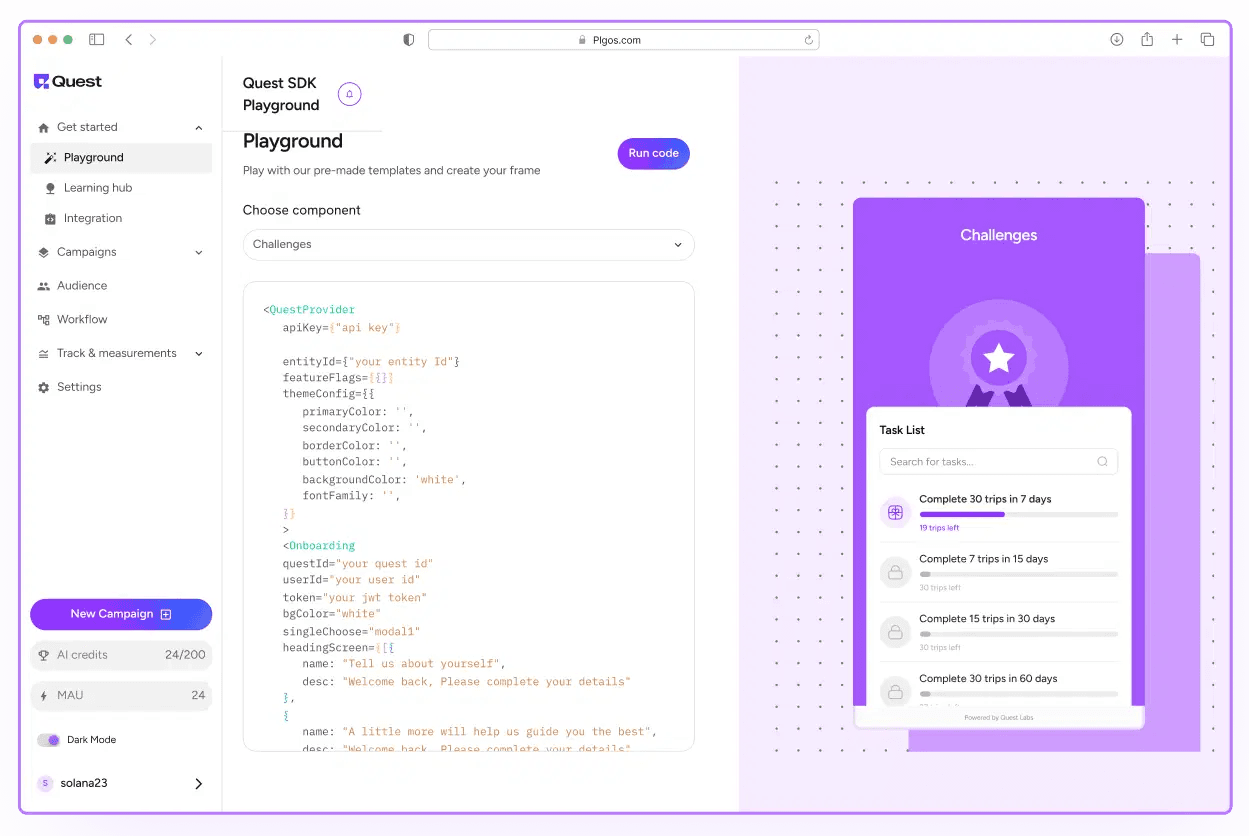
If your SaaS is built around product-led growth (PLG), PLG OS is not just a gamification platform; it’s an operating system for growth.
Why it stands out:
- Gamification components: Streaks, Badges, Leaderboard, Challenges, Gamified Quiz, Spin the Wheel, Scratch the Card and a Quest List, for web and mobile apps.
- No-code control: after a one-time SDK install, you change each component’s text and settings from the PLG OS dashboard.
- Targeting built for PLG metrics like activation, expansion, and retention: segment audiences by custom events and attributes on the Growth plan.
- Each component’s data is added to the user’s profile in PLG OS and can be sent to your CRM or other tools.
PLG OS is built for SaaS companies serious about converting product usage into revenue—and gamification is just the start.
Perfect for:
Product managers and growth teams who want data-driven gamification to boost retention, NPS, and free-to-paid conversions.
Pricing (as of September 2026): free tier for 100 monthly tracked users and one component; Starter $49/month and Growth $149/month on monthly billing.
2. Optimove Gamify (formerly Adact)
Several products use the name Gamify. The one that matches this entry today is Optimove Gamify, which Optimove added when it acquired Adact in March 2025.
It’s a no-code gamified marketing platform with three modules (Minigames, Loyalty and Promotions) and dozens of ready-made formats, from quizzes and raffles to leaderboards and spin-the-wheel.
What we love:
- No-code builder: marketers launch games and campaigns across web, app and in-platform journeys without developers.
- Real-time analytics to experiment, tweak and see which gamification elements are converting.
- Built for acquisition, engagement, retention and loyalty campaigns.
It suits B2C marketing teams already running their CRM marketing in Optimove more than a startup testing the waters; pricing is quoted based on active campaigns, user volume and the depth of the experiences. Loyalty teams are leaning this way: in Open Loyalty’s 2025 loyalty trends research, 45% of loyalty professionals named gamification the most influential trend for the next 2–3 years, ahead of automation (40%) and partner-based marketing (33%).
3. BadgeOS
For content-driven SaaS products or membership sites on WordPress, BadgeOS turns ordinary actions into micro-achievements.
What makes it unique:
- Users earn badges, points, and ranks for completing content, tutorials, or tasks.
- A LearnDash add-on, so members earn achievements, points and ranks from courses, lessons, topics and quizzes.
- AGPL-3.0 core code on GitHub for custom gamification logic, though the repository hasn’t had a commit since 2022.
BadgeOS is now a premium plugin: its free listing on WordPress.org was closed on June 27, 2023 for a security issue. Licences start at $69 a year for a single site (as of September 2026).
If you're thinking of gamifying your onboarding flow, certification process, or educational content on a WordPress site, BadgeOS is still an option, but check that the add-ons you need are maintained before you commit.
4. Kahoot! 360
Kahoot! is no longer just for schools.
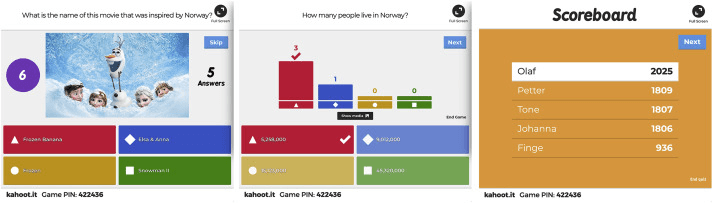
Kahoot! 360, which Kahoot now sells as a workforce engagement platform, lets companies run gamified quizzes, polls and interactive presentations for employee onboarding, training, webinars, and user education. (We previously listed a “360 Engage” plan; Kahoot’s current plans run from Pro Start to Pro Ultra.) For onboarding inside your own product, see these mobile app onboarding strategies instead.
What it offers:
- Live quizzes, polls and interactive presentations.
- Integration with Microsoft Teams, Zoom, Google Slides, PowerPoint and RingCentral for live sessions.
- Connections to learning platforms such as Cornerstone, Docebo and TalentLMS.
For SaaS teams that rely on customer education or community engagement, Kahoot! 360 is one of the best gamification tools to drive interactive learning. There is a free Kahoot! 360 Express plan with limits, and Pro Start costs $19 a month billed annually ($228 a year) as of September 2026. Retail is the biggest single buyer of gamification: Precedence Research puts its share of gamification market revenue at 28.5% in 2025, highlighting its significant role in driving customer engagement.
5. Funifier
Funifier is for companies who are ready to go deep with gamification think AI-assisted strategy design, 90+ game techniques and multi-language support.
Key capabilities:
- An AI Assistant and AI-driven strategy design to suggest game mechanics for your program.
- Connect your app once, then change strategies without touching code.
- Built for enterprise programs, with B2C pricing by volume and B2B pricing by seats.
While it comes with a steeper learning curve and quote-based pricing (plus optional gamification workshops from $3,950 as of September 2026), Funifier is one of the best gamification software platforms for serious SaaS operations.
6. StriveCloud
This spot used to go to GrowthHackers Experiments. That was an experiment-management tool for growth teams rather than in-app gamification, and its successor, Growth Software, is no longer online. If you want to embed gamification in apps as part of your growth strategy, look at StriveCloud, a gamification and engagement engine for B2C apps.
Think: turning habit loops into in-app incentives.
Highlights:
- Streaks, quests, leaderboards, raffles and rewards, with virtual currency and a loyalty shop.
- No-code widgets (embedded as iframes) plus an API and SDKs to tie rewards to events in your core flows.
- Campaign templates and A/B tests on the Pro plan; notifications, emails and webhooks on Scale.
If you believe gamification should be tied to your growth strategy—and not just surface-level UI tweaks—this platform deserves a spot on your radar. It is priced for apps with real traffic: Starter is €999 a month for up to 25,000 monthly active users (as of September 2026).
7. Bunchball Nitro by BI WORLDWIDE
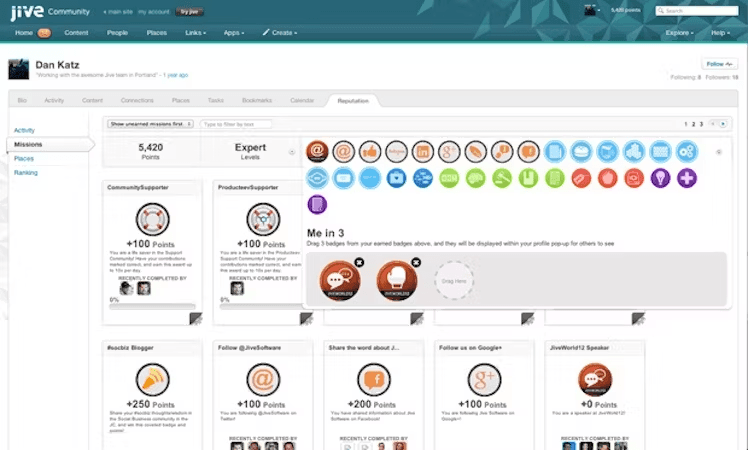
One of the OGs in gamification, Bunchball was acquired by BI WORLDWIDE in 2018, and Bunchball Nitro is now BI WORLDWIDE’s enterprise engagement software, alongside an embeddable dashboard with an AI-driven mission recommendation engine.
What it offers:
- Plug game mechanics into a website, training tool, CRM, online community or other enterprise system.
- APIs you can call from any language that supports HTTPS.
- An embeddable gamification dashboard with AI-driven mission recommendations.
It's more suited for customer loyalty, employee engagement, or partner ecosystems, but SaaS teams can use its APIs to create powerful internal or external gamified experiences. Pricing is quoted.
8. Open Loyalty
This spot used to go to Playlyfe Catalyst, which turned out to be a sales-productivity app rather than a developer framework; Playlyfe’s website no longer hosts either product. If you’ve got developer resources and want custom game mechanics tightly embedded into your product, Open Loyalty is the API-first tool to explore.
Developer-focused features:
- A REST API for points, tiers, challenges, badges, leaderboards, rewards, spin the wheel and scratch-and-win.
- Engineers connect it once; marketers then run campaigns without writing code.
- Data stored in Europe, APAC or North America, from an ISO/IEC 27001 certified company.
If your team needs complete control over how you gamify user flows, especially on top of a rewards or loyalty program, Open Loyalty offers that flexibility. Pricing is quoted: a platform fee plus an allowance based on the number of monthly active members.
9. Trophy
Small nudges, big gains. That’s the Trophy philosophy: it calls itself the gamification layer for consumer apps.
What’s unique:
- API-first and built for micro-engagements: you build the UI or use its open-source UI kit.
- Add achievements, streaks, points and leaderboards through its API.
- A no-code editor for its push notifications.
Great for consumer SaaS, finance apps, productivity tools, or any UX where subtle gamification drives big conversion lifts. Trophy charges only for active users: it’s free up to 1,000 monthly active users, and Starter is $25 a month with 1,000 MAUs included (as of September 2026).
10. Spinify
Not every SaaS gamification tool is customer-facing.
This spot used to go to Classcraft for Business. Classcraft was acquired by HMH in 2023, its original platform closed on June 30, 2024, and we could not find a business edition. For gamifying internal teams, especially sales, Spinify turns CRM activity into leaderboards, competitions and recognition.
Key benefits:
- Designed for remote and in-office teams, with leaderboards on TV, web and mobile.
- Competitions and recognition fed by live CRM activity, with integrations such as Salesforce and HubSpot.
- 250+ ready-made templates and unlimited TV displays on every plan.
If your company runs a sales or customer-success team, this one’s worth considering. It is priced per user per month and billed monthly, with a free trial.
Choosing the Right Gamification Tool in 2025
Let’s make one thing clear: not every gamification platform is built the same.
Here’s a quick checklist to guide your decision:
| Platform | What it is | Best for | No-code? | Pricing (as of September 2026) |
|---|---|---|---|---|
| PLG OS | In-app gamification components on one SDK | SaaS products adding gamification next to onboarding and feedback | Yes, after a one-time SDK install | Free tier; Starter $49/mo, Growth $149/mo (monthly billing) |
| Optimove Gamify | No-code gamified marketing: minigames, loyalty, promotions | B2C marketing teams on Optimove | Yes | Quote only |
| BadgeOS | WordPress plugin for badges, points and ranks | WordPress membership and LMS sites | Plugin settings and add-ons | From $69/yr (single site) |
| Kahoot! 360 | Live quizzes, polls and interactive presentations | Training, webinars and events | Yes | Free Express plan; Pro Start $19/mo billed annually |
| Funifier | Enterprise gamification platform with AI-assisted design | Large employee or consumer programs | Yes, once your app is connected | Quote only |
| StriveCloud | Gamification engine for B2C apps | Consumer apps with real traffic | No-code widgets plus API and SDKs | Starter €999/mo (up to 25K MAU) |
| Bunchball Nitro | Enterprise gamification engine and APIs from BI WORLDWIDE | Large employee, partner or loyalty programs | API plus BI WORLDWIDE services | Quote only |
| Open Loyalty | API-first loyalty and gamification engine | Gamification on top of a rewards program | Campaigns without code; setup through the API | Quote only (by monthly active members) |
| Trophy | Gamification API: achievements, streaks, points, leaderboards | Consumer apps with engineering capacity | No (API-first; no-code push notifications) | Free up to 1,000 MAUs; Starter $25/mo |
| Spinify | Sales gamification: leaderboards, competitions, recognition | Sales and customer-success teams | Yes (250+ templates) | Per user per month, billed monthly; free trial |
Whichever platform you pick, the rules behind the mechanics decide whether they motivate or annoy. Before launch, write down how your leaderboard resets and who competes with whom (our leaderboard fairness and reset specification covers windows, cohorts and resets), what happens when a streak breaks (the streak freeze and recovery product policy), and how rewards survive retries and double-clicks (the reward eligibility and duplicate-claim test matrix).
Trends Shaping Gamification in 2025
Before you go, here are 3 major trends shaping gamification strategies in 2025
1. Data-Driven Gamification
Tools like PLG OS and StriveCloud tie rewards to in-app events and audience segments to personalize game loops for every user. It’s not about flashy design anymore—it’s about impact.
2. Micro Gamification over Mega Mechanics
Forget elaborate games. The best gamification software in 2025 focuses on streaks, nudges, scorecards, and check-ins that drive engagement without distraction.
3. Gamification as Product DNA
It’s no longer a marketing layer. Gamification platforms are being embedded deep inside SaaS products—from user onboarding to feature adoption, referrals, and renewals.
Final Word
If you're building or scaling a SaaS product in 2025, here's your playbook:
- Choose your platform based on your product stage and user behavior.
- Start with PLG OS if you're aiming for retention, revenue, and product-led momentum.
- For consumer apps with developers, try Trophy or StriveCloud.
- Want complete control through an API? Explore Open Loyalty or Funifier.
- Don’t ignore the power of internal gamification with Spinify for sales teams or Bunchball Nitro for enterprise programs.
The top gamification platforms of 2025 aren’t just tools—they’re engagement engines built for outcomes.
Embed gamification in apps and websites not because it's cool, but because it's smart. Your users deserve a reason to stay, return, and advocate. Measure the effect with the customer retention metrics you already track.
FAQs
1. What is gamification in SaaS?
Gamification in SaaS means adding game mechanics such as streaks, points, badges, challenges and leaderboards to a software product, so users come back more often and complete the actions that make the product valuable to them. It works best when each mechanic rewards a real product outcome, such as finishing setup or using a feature every week, rather than activity for its own sake.
2. What are gamification tools for SaaS?
They're platforms that embed game mechanics, like points, badges, and leaderboards, into your product to drive user behaviour, increase retention, and boost engagement. They come as ready-made in-app components, APIs your developers call, or standalone tools for marketing campaigns, training sessions and sales teams.
3. How do I embed gamification in my app?
Pick a tool with low-code integration (like PLG OS), define core user behaviors to incentivize, design simple gamified flows, and launch with tracking baked in. If you have engineers and want full control of the UI, an API such as Trophy or Open Loyalty is the alternative. Onboarding tools such as Userpilot offer gamified progress checklists, but not points or leaderboards.
4. Which is the best gamification software for onboarding?
PLG OS offers streak, challenge, quest list and leaderboard components that you edit from a no-code dashboard after a one-time SDK install, so they suit product onboarding in a SaaS app. For a wider comparison focused on onboarding, including learning platforms used to onboard employees, see our list of the 27 best gamification onboarding platforms.
5. Can gamification improve retention in SaaS?
It can, when the mechanic rewards the behavior that keeps people using the product. Duolingo, for example, reports that learners with at least one Friend Streak are 22% more likely to complete their daily lesson. Test each mechanic against a control group, because a streak or leaderboard that feels unfair can push your most active users away.