6 Best Mobile Onboarding Tools to Boost User Activation

Your App Deserves More Than Just a “Skip” Button. First impressions? They’re everything in the mobile world. In fact, 25% of users abandon an app after just one use. Yes, you read that right. And what stands between your app becoming a daily essential or just another download? Onboarding. That’s where mobile onboarding tools step in. If you’re looking to boost user activation, retain your users, and skyrocket app success, then this guide to the best onboarding tools is exactly what you need.
Let’s explore mobile app onboarding, why it’s non-negotiable, and the 6 tools that are changing the game.
What is mobile app onboarding?
App onboarding is the process of training new users on how to utilize your product. It employs tutorials, walkthroughs, and in-app advice to help users reach their first milestone quickly and understand the value of your app.
The user onboarding process never stops. Depending on your onboarding plan, you may need to offer value via self-service assistance, feature adoption tooltips, and high-touch customer success services. Onboarding checklists can improve feature adoption by up to 20%.
Benefits of Mobile Onboarding Tools
A smooth user onboarding experience is key to driving early user activation and long-term product adoption. With the help of user onboarding tools, businesses can create custom onboarding and personalised user onboarding flows that guide users through a clear, user-friendly onboarding journey.
- Boosts user activation by guiding users through key features and actions
- Reduces churn by preventing confusion and first-time user drop-offs
- Shortens time-to-value (TTV) so users quickly experience the app’s core benefits
- Improves user retention by creating a smooth and engaging first impression
- Increases feature adoption through interactive walkthroughs and tooltips
- Enables personalization based on user roles, preferences, or behaviors
- Enhances customer satisfaction with a more intuitive and helpful experience
- Encourages positive reviews by ensuring early success and satisfaction
- Delivers actionable insights to product teams about friction points and user behavior
- Drives long-term growth by aligning onboarding with product-led growth strategies. 88% of users say they are more likely to use an app regularly if it has a good onboarding experience
Web App Onboarding vs Mobile App Onboarding
| Aspect | Web App Onboarding | Mobile App Onboarding |
|---|---|---|
| User Entry Point | Often starts after clicking “Free Trial” or signing up on a website | Begins after downloading the app from the app store |
| Design Flexibility | Greater flexibility with layout and design across various screen sizes | More layout constraints due to mobile OS guidelines and smaller screens |
| User Feedback & Analytics | Leverages browser features (cookies, pop-ups, forms) for data and feedback | Limited by mobile OS permissions; harder to gather extensive feedback |
| User Expectations | Users expect robust, feature-rich experiences | Users expect simplicity, speed, and convenience |
| User Behavior | Shorter attention span, higher bounce rate, can easily switch tabs or exit | Tools like Appcues, Chameleon, and Userpilot are well-suited |
| Onboarding Objective | Grab attention quickly, show value, highlight advanced features, and build credibility | Retain loyalty, reduce friction, and provide immediate gratification |
The 6 Best Mobile Onboarding Tools
1. Userpilot
Best for: Product teams that want to guide users quickly without coding.
Userpilot allows you to build in-app onboarding experiences with zero code. You can design interactive product tours, onboarding checklists, tooltips, and even NPS surveys.
Key Features
- Personalized onboarding based on user segments
- Behavior-based checklists
- Built-in analytics
- A/B testing of flows
Why choose Userpilot
It’s built with product-led growth in mind. If you’re following a framework like PLG OS, Userpilot complements it perfectly by helping you execute onboarding tactics that support user activation goals.
Userpilot fits right in with other app onboarding tools, offering a complete toolkit to enhance your new user experience.
2. Appcues
Best for: Creating branded and visually impressive onboarding flows.
Appcues is known for helping teams create beautiful onboarding experiences without relying on developers. Its easy-to-use builder lets you add in-app messages, tooltips, and walkthroughs that feel like a seamless part of your product.
Key Features
- Drag-and-drop onboarding flow creator
- Advanced targeting and user segmentation
- Supports both mobile and web
- Integration with analytics tools
Why choose Appcues
Appcues is one of the most popular mobile onboarding tools for a reason. It helps turn new users into active users with experiences that are both beautiful and functional.
3. PLG OS
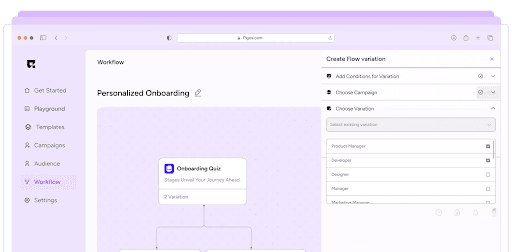
Best for: Strategy-focused teams looking to improve onboarding from the ground up.
Unlike typical onboarding tools, PLG OS is a framework and operating system for product-led growth. It helps your team create onboarding strategies that are data-driven, structured, and aligned with user activation goals.
Key Features
- Onboarding and activation strategy boards
- Time-to-value planning tools
- Frameworks for reducing churn
- Team collaboration workflows
Why choose PLG OS
PLG OS gives your team the clarity to build better onboarding from the inside out. Instead of just designing experiences, you design outcomes. It’s perfect when paired with other mobile app onboarding tools, helping you connect your onboarding efforts to long-term growth.
4. Whatfix
Best for: Enterprise onboarding with complex flows and internal tools.
If you’re building enterprise or internal apps, onboarding can get tricky. Whatfix offers powerful walkthroughs, contextual help, and onboarding automation that simplifies the learning curve for new users.
Key Features
- In-app walkthroughs and interactive help
- Onboarding based on roles or behaviors
- Mobile, web, and desktop support
- Knowledge base integration
Why choose Whatfix
It’s one of the most robust onboarding tools for apps with complex logic or multiple user types. If you need scale, personalization, and reliability, Whatfix is a strong contender.
5. Chameleon
Best for: Subtle and contextual onboarding for modern product teams.
Chameleon creates onboarding experiences that don’t feel pushy or intrusive. With lightweight popups, tooltips, and product tours, it lets you nudge users at the right moment without overwhelming them.
Key Features
- Smart tooltips and onboarding modals
- User segmentation
- Integration with analytics tools
- Supports mobile and web
Why choose Whatfix
For teams that want users to feel in control, Chameleon offers a user-first approach. It’s one of the best onboarding tools if you value subtle, guided user education over scripted flows.
6. Pendo
Best for: Product teams that want onboarding combined with insights.
Pendo merges product analytics and in-app guidance into one platform. You can see how users interact with your app and use that data to improve onboarding flows.
Key Features
- Behavior-based onboarding flows
- Heatmaps and usage analytics
- Mobile and web onboarding
- In-app feedback and NPS tools
Why choose Pendo
With Pendo, you don’t just guide users—you understand them. It’s a data-rich user onboarding software that helps you connect engagement and retention directly to the onboarding experience.
How PLG OS Helps You Build Better Onboarding
While tools help you execute, PLG OS helps you plan. It brings your team together around shared goals like activation, engagement, and retention.
With PLG OS, you get:
- Strategic templates for onboarding
- Clear workflows for reducing friction
- Tools to measure and improve time-to-value
- Activation boards that align product and marketing teams
You can pair PLG OS with tools like Appcues, Userpilot, or Pendo to bring your onboarding strategy to life. The combination of planning and execution is what drives results.
Visit www.plgos.com to start designing onboarding flows that convert.
Summary: Best Mobile Onboarding Tools at a Glance
| Tool | Ideal For |
|---|---|
| Userpilot | No-code product teams |
| Appcues | Design-focused teams |
| PLG OS | Strategy and product-led growth planners |
| Whatfix | Enterprise onboarding |
| Chameleon | Lightweight and contextual onboarding |
| Pendo | Analytics + onboarding in one |
Final Thoughts: Make Your First Impression Count
User onboarding is no longer optional. Whether you’re building a consumer-facing app or an enterprise platform, mobile onboarding tools can mean the difference between a loyal user and a lost opportunity.
The best onboarding tools not only educate users but activate them. They help you deliver value early, reduce churn, and increase customer lifetime value.
So whether you’re using tooltips, checklists, interactive tours, or all of the above, make sure they’re built with strategy and backed by insights. Use PLG OS to build a strong foundation, and tools like Appcues or Pendo to execute with impact.
Because in the world of apps, a great start leads to a lasting relationship.
FAQs
1. What is mobile app onboarding?
Mobile app onboarding is the process of guiding new users through your app’s key features and helping them get value quickly.
2. Why is onboarding important for mobile apps?
It boosts user activation, reduces churn, and ensures users don’t drop off due to confusion or poor first impressions.
3. How long should mobile onboarding be?
Keep it short and focused—ideally under 60 seconds or 3–5 screens. Show value fast without overwhelming the user.
4. Can onboarding be personalized?
Yes. Great onboarding adapts based on user type, behavior, or preferences to make the experience more relevant.
5. What if a developer is building the onboarding instead?
Then the relevant comparison is libraries rather than platforms — our mobile in-app tour library comparison covers the six worth considering per framework, and the offline and interruption recovery plan covers what happens when the flow is interrupted mid-step.
6. What's the difference between web and mobile onboarding?
Web onboarding is more flexible and data-rich, while mobile onboarding focuses on simplicity, speed, and user retention.