Is PLG the New Trend? 7+ Best PLG Tools in 2025
Slack, Zoom, and Canva: What do these unicorns have in common? Their product fueled their growth. Your product does more than just support your growth strategy; it is your growth strategy.
Product-led growth (PLG) changes the way businesses scale by making the product the primary driver of customer acquisition and retention.
Unlike traditional strategies that rely heavily on sales and marketing, PLG prioritizes providing a seamless and intuitive product experience. This approach enables users to discover value on their own, increasing loyalty, accelerating adoption, and driving organic word-of-mouth growth.
In this blog, we'll look at the best PLG tools for creating a frictionless user experience, driving adoption, and realizing your product's full potential.
What is Product-Led Growth?
One strategy for expanding a business is known as product-led growth (PLG), and it centers on making the product itself the main engine of expansion. Without having to go through a maze of ads, marketing strategies, and plans users can experience the product right away with a product-led growth strategy.
This is typically accomplished by PLG companies through the use of a freemium pricing model or a free trial to attract potential customers.
Why is Product-Led Growth Important?
On the surface, product-led growth strategy appears to be no different from any other model that suggests a "try before you buy" option for the consumer. If you look into it more, you'll see that PLG is a comprehensive methodology that companies can use.
This is why software as a service (SaaS) products should prioritize a product-led growth strategy.
- One thing that makes PLG stand out is the way it helps businesses cut down on acquisition costs, boost retention, shorten sales cycles, and make customers happier.
- Instead of just telling people about the benefits of your product, demonstrate to them how they will benefit from using it.
- To make the buying process more pleasant, a PLG strategy suggests little, incremental commitments from the customer.
- Is it acceptable? Remember that offering a free trial or freemium version is just the beginning if you want to drive growth with product-led. To draw in users, you need marketing, and to help them quickly find value inside the app, you need in-app instructions.
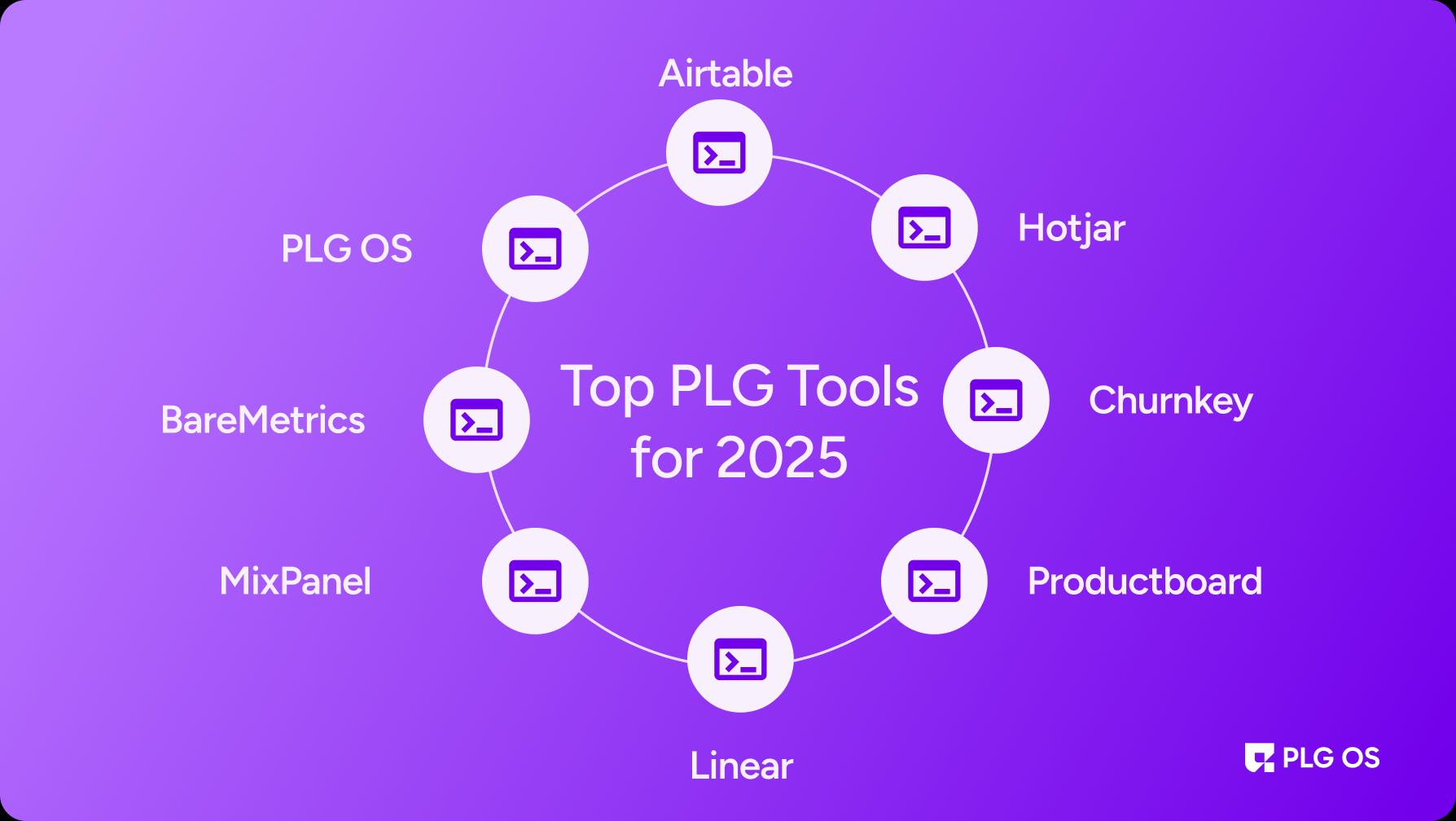
Top 7+ PLG Tools for 2025
1. Airtable
When it comes to product-led growth (PLG), Airtable is a model company. People are drawn in by a freemium product that is both well-designed and offers popular, customisable themes. People start paying to play once they see the value and desire further features.
Key Features:
- The range of products offered by Airtable is quite broad. That is, it's flexible and has many potential applications. Airtable is multipurpose; users can use it for both personal and professional scheduling needs.
- A freemium product lineup is the foundation of Airtable's PLG approach. Even while some users never convert to paying clients, this freemium option attracts users of all kinds.
- Automated workflows that assist move users easily from onboarding to activation are made possible using Airtable's integration with many other PLG tools, such as Zapier and Slack, among others.
Streamlined collaboration, user onboarding, feedback tracking, and product experience optimization are just a few of the ways that Airtable can help firms manage product development.
2. PLG OS
PLG OS revolutionizes user onboarding by providing personalized, interactive, and frictionless experiences. It enables businesses to create tailored onboarding journeys that guide users efficiently, driving engagement and long-term retention.
Key Features:
- Customizable onboarding flows to align with user needs and goals.
- Integrate user experience features quickly across all stages of the user journey, allowing for dynamic user flows with rich data insights and extensive integrations from a single platform.
- Data-driven optimization with analytics to track and enhance onboarding performance.
- Connect with various PLG tools and platforms to streamline workflows and enhance functionality.
- Deploy tailored onboarding processes, gamification elements, and loyalty programs swiftly to engage users effectively.
PLG OS transforms onboarding into a powerful tool for user success by combining personalization, interactivity, and actionable insights. It simplifies adoption, boosts engagement, and helps businesses scale efficiently by providing a seamless and user-centric experience.
3. MixPanel
Teams can monitor user actions and make product enhancements with the help of Mixpanel, a sophisticated product analytics platform. Product managers and analysts of data will find it ideal. In order to keep up with product usage data, we use it every day.
Key Features:
- To gain insight into how users engage with your product, event tracking keeps tabs on particular user actions in real-time, like clicks or sign-ups.
- Grouping users based on shared attributes or behaviors allows for targeted engagement; this is called cohort analysis.
- Using conversion rate analytics across a user's journey, funnels can pinpoint where they are most likely to abandon the process.
- Reports on user retention measure the frequency with which users come back to your product following their initial engagement.
A free plan is available on Mixpanel for up to one million events per month. A paid plan with 10,000 events starts at $24/month.
4. Productboard
To aid teams in prioritizing features, aligning stakeholders, and delivering customer-centric solutions, Productboard provides a comprehensive platform for product management. To make sure that product decisions are in line with business goals and user demands, it provides PLG tools for collecting, organizing, and acting on consumer input, which enables product-led firms.
Key Features:
- It can centralize the gathering of feedback from many sources, such as stakeholders, teams, and customers. In order to help in making educated decisions, its AI-powered functionality transforms comments into practical insights.
- For better stakeholder alignment and plan communication, you can make and share visual product roadmaps.
- To make sure that product changes are reaching the correct people, you can utilize customer segmentation to detect and prioritize input from different user segments.
Businesses can benefit greatly from using Productboard as PLG software since it facilitates Product-Led Growth (PLG) strategies, allows users to build roadmaps driven by users, collects feedback, and ranks product development priorities according to consumer needs.
5. Hotjar
To better understand how customers engage with their products, teams can utilize Hotjar, a customer experience platform. Although it's a good alternative, we ultimately decided to use Posthog for recording sessions and creating heatmaps.
- Use heatmaps to see exactly where people are clicking, scrolling, or hovering.
- You can record user sessions and analyze them in depth with session recordings. This will help you gather both quantitative and qualitative data.
- Asks users for their opinions and gathers data about the product through surveys.
- Use conversion funnels to find out where users are losing interest in critical flows.
- Up to 35 sessions per month can be tracked for free with Hotjar. The monthly fee for a paid plan starts at $32.
6. Linear
Issue tracking, roadmap planning, and sprint management are all made easier with Linear, a project management tool tailored to agile product teams. They promote themselves as the Jira of the modern era.
Key Features:
- Keeping tabs on issues: handle feature requests and bugs
- Future Plans: Makes objectives and schedules for products transparent
- Team collaboration: Assigns tasks and communicates within the platform
- Integrations: Syncs with tools like Featurebase, GitHub and Slack
Linear offers a completely free plan for two teams with unlimited members. Paid plans start $8 per user per month.
7. Churnkey
By providing retention strategies and optimizing the cancellation process, Churnkey helps SaaS companies reduce churn. So far in our two years of business, it has prevented us from losing forty-six clients and eight thousand dollars in revenue!
Key Features:
- Offers discounts or pauses as incentives to avoid cancellations in dynamic cancellation flows.
- Use exit surveys to collect data from people who automatically cancel.
- Comparison of two samples: Conducts experiments to determine the most effective retention strategies for your company's plan
- Analytics dashboard: Conveniently displays churn and retention data
You can try Churnkey risk-free for 14 days. You will then be charged according to the amount of churn you experience. Monthly churn up to $5,000 will cost you $250 with Churnkey.
8. BareMetrics
To help software as a service (SaaS) businesses see key revenue metrics, Baremetrics offers subscription analytics.
Key Features:
- Monitoring of MRR and ARR:- Keeps tabs on recurring revenue, which is crucial for SaaS teams, both monthly and annually
- Segmenting Customers: Classifies clients according to their actions or subscription plans
- Understanding churn: Helps you reduce the cost of acquiring customers by tracking subscription cancellations and downgrades.
- Forecasting: Uses past data to foretell how revenue will rise and fall in the future.
The monthly recurring revenue (MRR) of your business determines the pricing for Baremetrics. At $108/month, it's the most affordable option.
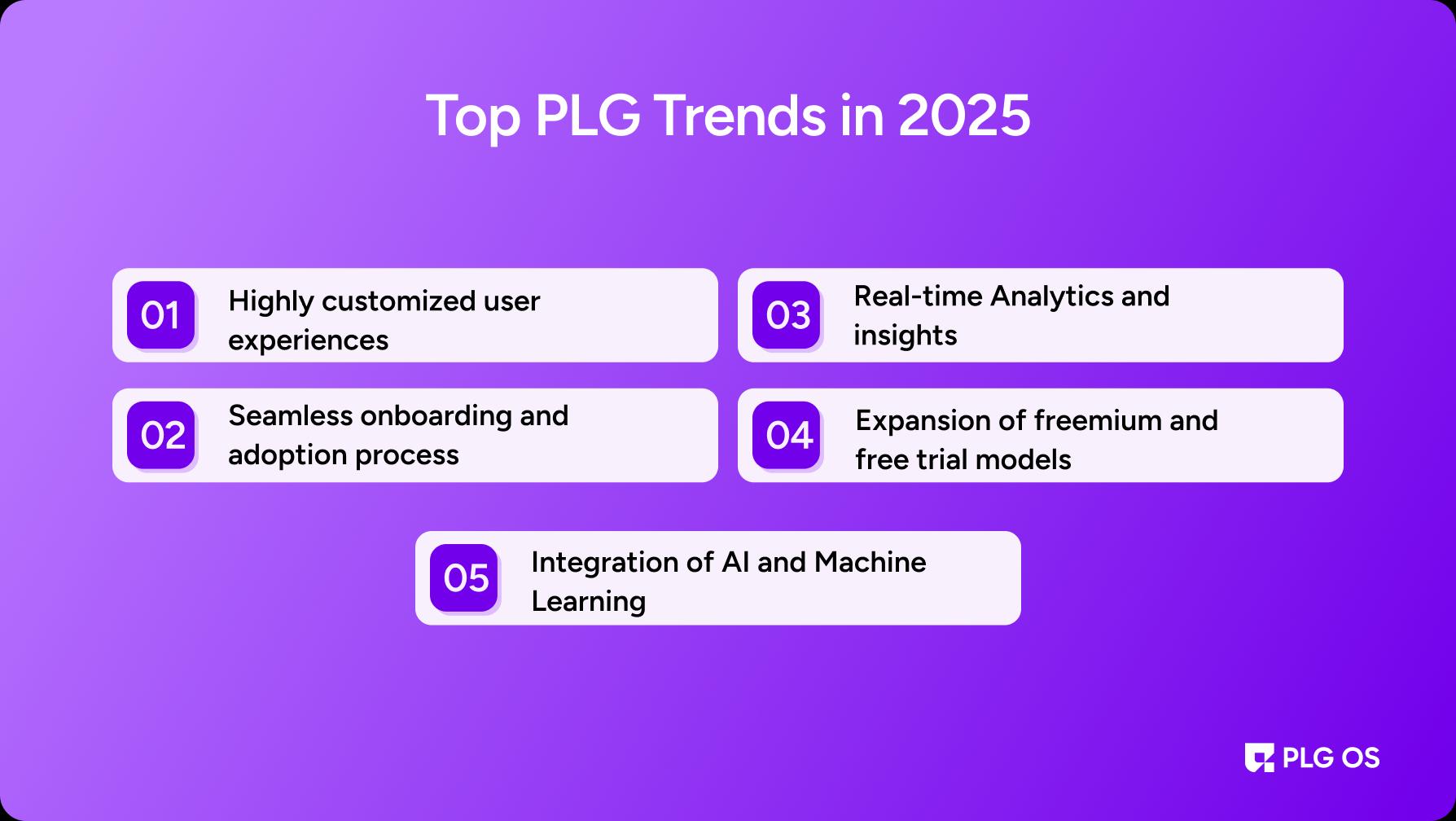
Top PLG Trends in 2025
1. Highly customized user experiences
A great user experience in the year 2025 will still revolve around personalization, but it will take it to a whole new level. With the help of AI and ML, businesses can now process massive volumes of data to provide highly customized experiences that change in real-time. These experiences are more than just content recommendations; they can sense user needs even before they express them. 71% of consumers expect companies to deliver personalized interactions, and 76% get frustrated when this doesn't happen.
Software as a service products may automatically modify user interfaces or feature sets according to the user's preferences or role. By making the product seem tailor-made for each user, personalization boosts engagement, retention, and loyalty.
By letting users choose templates and PLG tools that match their specific goals, the flexible workspace app Notion does an excellent job of customizing user onboarding, which in turn increases user engagement and satisfaction.
2. Seamless onboarding and adoption process
Customers now expect instant gratification from the products they utilize, making seamless onboarding a must. Simplifying the initial user experience with a product with an emphasis on providing immediate gratification is a popular trend. As an alternative to lengthy tutorials, guided tours, in-app messaging, and contextual tips that appear when needed are being used by companies to help new users.
In just a few short minutes after signing up, Trello and Asana demonstrate the power of their project management features through visual and interactive onboarding. Customer retention is higher and product exploration is deeper when the onboarding process is easy.
3. Real-time Analytics and insights that can be used
In the SaaS industry, static dashboards are outdated and insufficient. Analytics that can instantly adjust to the requirements of individual customers are in high demand. Not only do these insights show what has happened, but they also suggest things users can do to make things better. Without having to wait for scheduled reports, users are able to make data-driven decisions thanks to real-time analytics, which also enable product teams to react swiftly to trends.
With the advent of real-time event tracking and anomaly detection, users are able to take immediate action based on crucial metrics, thanks to PLG tools such as Amplitude and Mixpanel.
4. Expansion of freemium and free trial models
The notion of freemium isn't going anywhere; rather, it's changing, even though basic freemium models have demonstrated diminishing returns. Businesses nowadays often have freemium tiers with premium features meant to encourage users to upgrade.
These extras are designed to give free users more value without being overly complicated or demanding. They can be premium integrations, advanced analytics, or exclusive templates.
Example:
Canva's freemium model lets users make beautiful designs, but it cleverly hides premium templates and brand kits behind a paywall, so users are encouraged to upgrade when they need more advanced features.
5. Integration of AI and Machine Learning
Artificial intelligence (AI) in user support is evolving from a robotic to a more intelligent application. Chatbots and virtual assistants driven by AI can now troubleshoot problems in real-time, walk users through product features, and answer complicated queries.
Consider Intercom's AI tools; they can automatically respond to the vast majority of user inquiries and only send the most complicated ones to human agents. This guarantees that users receive timely assistance while simultaneously decreasing response times and support expenses. The AI in SaaS market was valued at $71.55 billion in 2024 and is rapidly growing, expected to reach $775.4 billion by the end of 2031.
Final Words:
One last hurdle for software as a service (SaaS) companies is to implement a product-led growth strategy. Among the many advantages you'll enjoy are increased customer engagement and improved feature adoption. You can make your sales team's lives easier and your product usage data into gold with the PLG tools mentioned above.
As PLG continues to reshape the way businesses engage with users, tools like PLG OS are essential for staying ahead. Ready to boost your PLG strategy with us? Explore how PLG OS can help you create a seamless, personalized experience for your customers today.
FAQs
What are PLG tools?
PLG (Product-Led Growth) tools help businesses drive growth by offering products that deliver value to users through self-service, personalized experiences, and seamless onboarding.
Which PLG tools are the best in 2025
Some of the top PLG tools/ PLG software in 2025 include PLG OS, Mixpanel, Amplitude, Intercom, and Trello, all of which provide personalized user experiences, real-time analytics, and easy onboarding.
How do PLG tools improve onboarding?
PLG tools or PLG software offer customizable onboarding flows, contextual guidance, and in-app messaging to simplify user discovery, ensuring a smooth and engaging product adoption process.
Do PLG tools integrate with existing systems?
Yes, most PLG tools, including PLG OS and Mixpanel, are designed to integrate seamlessly with your existing tech stack, allowing for quick deployment without technical expertise.
Why is personalization important in PLG tools?
Personalization enhances user engagement and retention by delivering tailored experiences that cater to individual preferences, helping users quickly realize the value of the product.