How to Make a Customer Retention Model for Your SaaS?
Customer retention is the biggest challenge for SaaS businesses, yet many focus only on acquiring new users. The truth? An engaged consumer drives revenue, increases word-of-mouth, and ensures continued success.
You can use data from a customer retention model to make predictions about what your consumers want. A solid customer retention plan should help the business keep a steady stream of current clients and attract new ones. Companies must gain three new customers to compensate for the loss of one existing client, according to McKinsey's research on customer acquisition. This highlights the essential importance of generating repeat business.
The IBM Institute for Business Value CEO Guide to Generative AI for Customer Service found that most service professionals (60%) have said customer expectations have increased since before the pandemic.
What is customer retention?
Customer retention means that your business can keep people for a long time and earn their loyalty. It shows how knowledgeable your brand is and draws attention to the high quality of your goods, services, or customer service, which makes people want to stay connected with your brand.
Why is customer retention necessary?
Being aware of how to keep customers helps you figure out how loyal and happy your customers are, how good your customer service is, and if any issues could turn away possible customers. Keeping customers back to pay off in the long run:
Lower cost than getting new customers:
Econsultancy says that 82% of businesses say that keeping customers is much cheaper than getting new ones. However, many companies spend a lot more on getting new customers than taking care of the ones they already have.
Increased AOV:
Most of the time, keeping customers is cheaper than getting new ones, and those customers are also likely to spend more over time. It was found that loyal customers are 23% more likely to buy something from you than other customers.
Increased profits:
Taking care of people and keeping them for a long time will also help your bottom line. Keeping customers for an extra five percent of the time can boost income by 25% to 95%, and current customers bring in 65% of a business's revenue.
Brand ambassadors:
Loyal customers are great because they tend to tell others about how great your business is, which turns them into brand ambassadors. That is worth a lot. Yotpo says that 60% of people who are loyal to a brand talk about it with their family and friends. Because word of mouth spreads so quickly, keeping customers is important for your business.
3 customer retention models
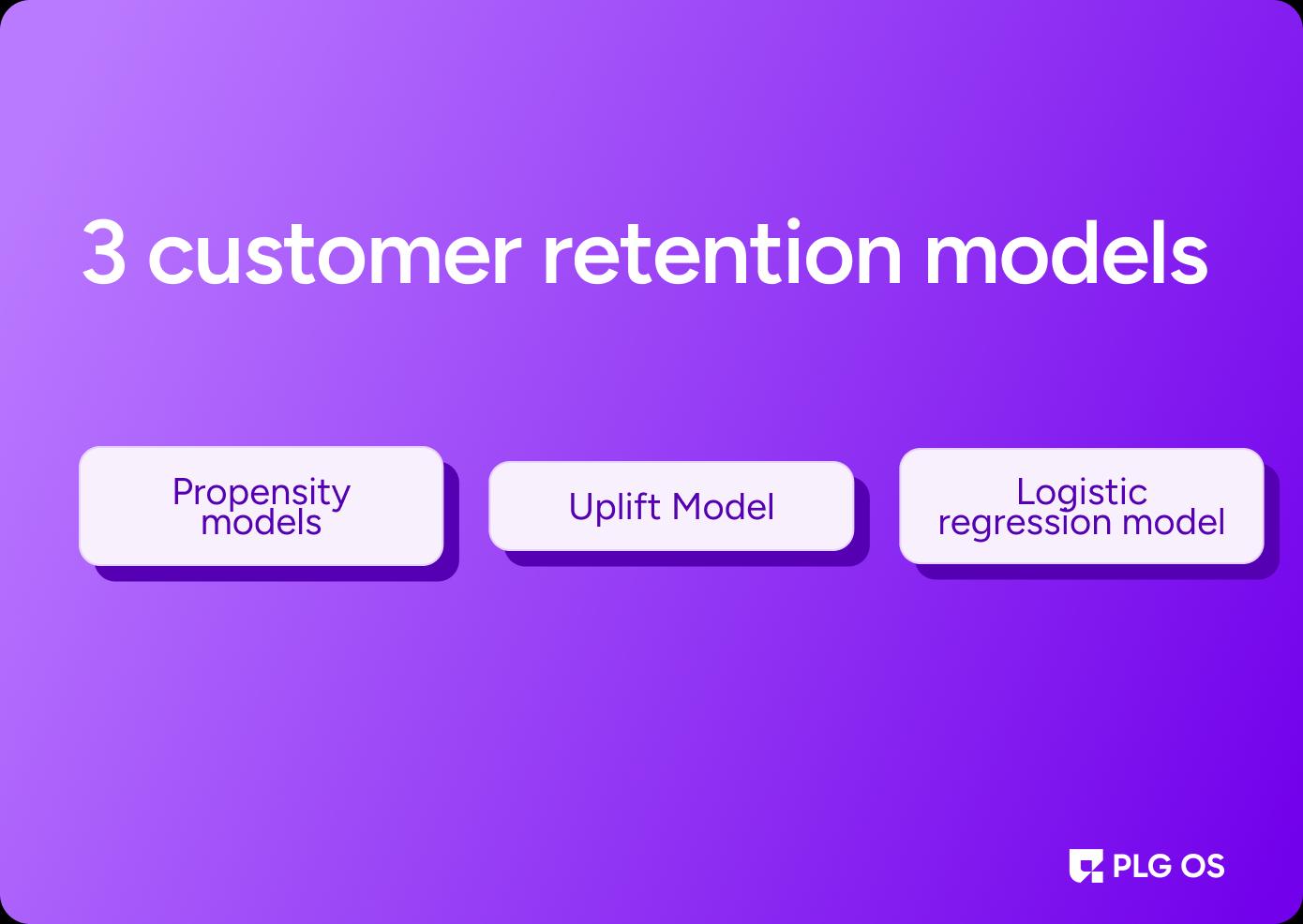
1. Propensity models
This model considers previous actions to determine the probability of an upcoming event.
Propensity models can come in different forms:
- Next purchase model
- Response model
- Next best offer model
Next purchase model
The probability of future purchases, such as account renewals and upgrades, is quantified by this customer retention model.
Additionally, you can utilize this model to forecast the probability of users executing a particular action within your application or utilizing a particular feature. You can target in app messages and offer any required support to encourage the correct action by anticipating when consumers will likely renew their accounts or take specific actions.
Response model
The response model looks at past data to determine if people will react to a stimulus in a certain way.
By analyzing users' behavior with your checklists in the past, you can use this model to predict how likely it is that they will complete a task that is driven by a checklist. Boosting engagement and retention will be a breeze with this data at your disposal.
Next best offer model
Based on the users' past activities, this model predicts what they will do next. You can keep users around for the long haul by ensuring they get what they need from your tool with the next best offer model.
2. Logistic regression model
One type of binary outcome that logistic regression may predict is whether a customer will churn.
It measures the correlation between a dependent variable (retention or churn) and one or more independent predictor variables (e.g., consumer demographics, usage patterns, events, advertisements, promotions), making it an essential tool in retention analysis.
3. Uplift model
Businesses discover how marketing or retention efforts affect consumer actions with the help of uplift models.
While both models are comparable, an uplift model classifies customers into four categories according to their propensity to churn regardless of retention marketing efforts:
Uplift scores, which quantify how a campaign is likely to influence a customer's behaviour, categorize the four kinds of customers. Regarding uplift scores, Sure Things are at the top, while Lost Causes are at the bottom.
Steps to make a customer retention model
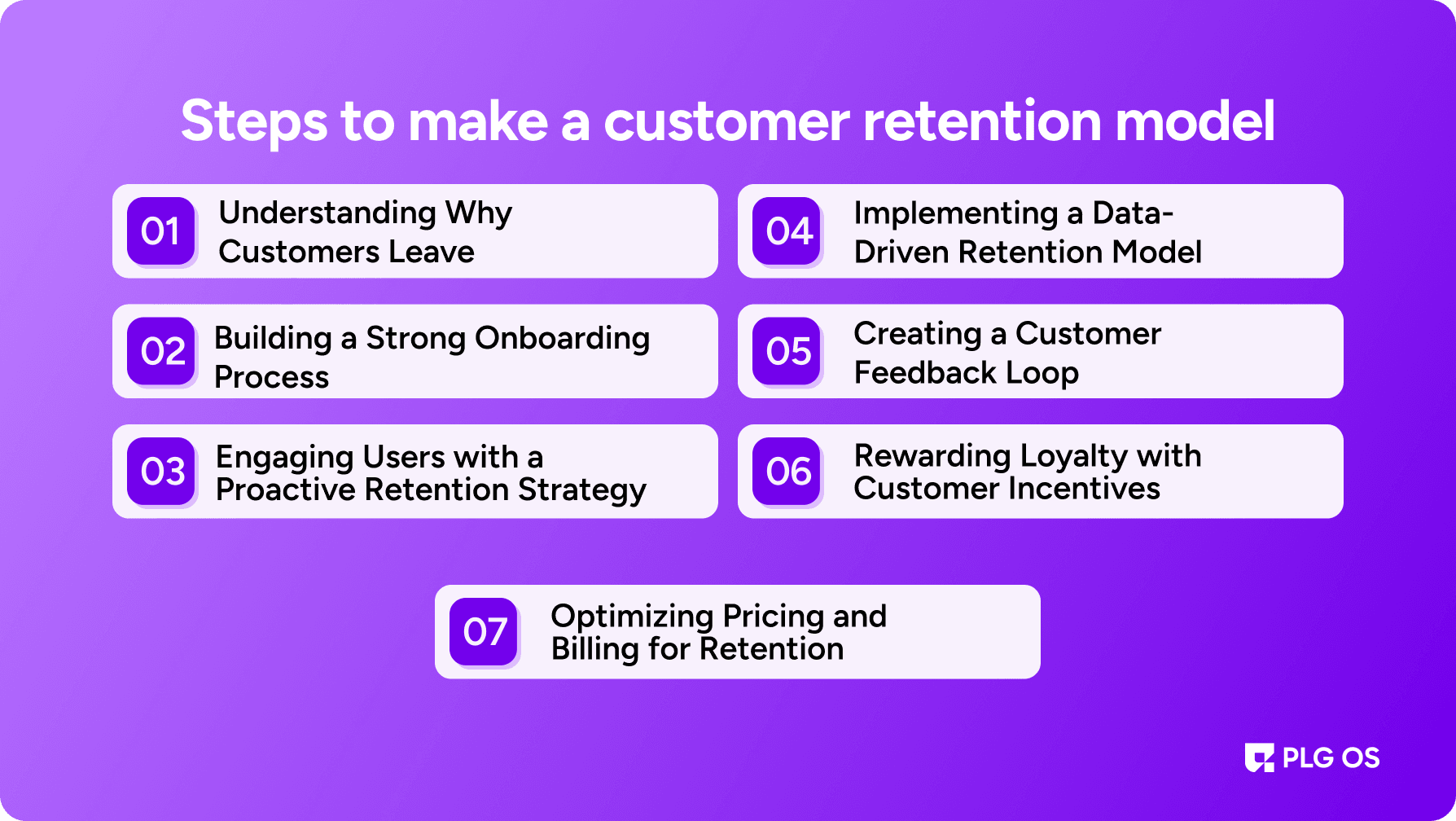
Step 1: Understanding Why Customers Leave
Before we get into the nitty-gritty of building a retention model, let’s address the elephant in the room: Why do customers leave?
Here are some of the common reasons:
Lack of immediate value:
Customers sign up but don’t experience the value quickly.
Poor onboarding experience:
If users struggle with your product, they’ll abandon it.
Lack of engagement:
If users don’t engage regularly, they forget about your product.
Unmet expectations:
If your product overpromises but under delivers, customers will leave.
Better alternatives:
Competitors offer a superior experience.
Pricing concerns:
Users might feel they’re not getting enough value for the price.
Your first job? Identify the gaps by talking to churned customers, analyzing usage data, and tracking behavioral patterns.
Step 2: Building a Strong Onboarding Process
First impressions matter a lot. A seamless onboarding experience is the foundation of retention. Customers who understand and see value in your product within the first few days are more likely to stick around.
Best practices for onboarding:
Provide a smooth signup process:
Minimize friction by reducing unnecessary steps.
Offer an interactive product tour:
Guide users through key features with tooltips or walkthroughs.
Use email sequences:
Dripfeed tips, use cases, and feature highlights to new users.
Enable easy customization:
Let users personalize dashboards, notifications, or settings early.
Gamify the onboarding:
Show progress bars or offer rewards for completing steps. PLG OS can help you customise your onboarding journey.
Key metric to track: Time to value (TTV): The faster users find value in your SaaS, the better.
Step 3: Engaging Users with a Proactive Retention Strategy
Retention isn’t just solving problems; it’s about proactively ensuring customers stay engaged. Here’s how:
1. Personalized Communication
- Use customer data to send targeted emails, messages, or in-app notifications.
- Recommend features based on usage behaviour.
- Send “We Miss You” emails to inactive users.
2. Customer Success Teams
- Assign dedicated customer success managers (CSMs) to high-value accounts.
- Offer regular check-ins and proactive chat support.
3. Community Building
- Create a user forum or Slack group for discussions. Organise live webinars, AMAs, or customer meetups.
4. Continuous Feature Enhancements
- Take customer feedback seriously and iterate.
- Announce updates via newsletters, blogs, and in-app popups.
The key metric to track:Net Promoter Score (NPS): Are your customers happy to recommend your SaaS?
Step 4: Implementing a Data-Driven Retention Model
SaaS businesses thrive on data. Customer insights, analytics, and automation should power your retention model.
Essential Retention Metrics:
Churn Rate:
The percentage of customers leaving your SaaS over a given period.
Customer Lifetime Value (CLV):
The total revenue a customer generates before churning.
Monthly Active Users (MAU) & Daily Active Users (DAU):
A measure of user engagement.
Feature Adoption Rate:
Tracks which features are most and least used.
Customer Health Score:
A predictive score based on user activity, support tickets, and survey responses.
Using Automation to Enhance Retention:
Behaviour-based emails:
Trigger emails based on customer actions (e.g., inactivity for a week).
AI-powered chatbots:
Offer instant support to reduce frustration.
Predictive churn analysis:
Use AI models to detect at-risk customers early.
Step 5: Creating a Customer Feedback Loop
Your customers hold the key to improving retention. Keep an open feedback loop by:
- Conducting exit surveys for churned customers.
- Running NPS surveys to gauge customer sentiment.
- Holding quarterly customer calls to gather insights.
- Encouraging public reviews to build trust and credibility.
Use this feedback to tweak your product, pricing, and user experience.
Key metric to track:Customer Satisfaction Score (CSAT): A direct measure of how satisfied users are with your product.
Step 6: Rewarding Loyalty with Customer Incentives
A loyal customer is worth more than a new customer. Keep them engaged by offering:
Loyalty Programs:
Discounts or extra features for long-term users.
Referral Rewards:
Incentives for referring new customers.
Exclusive Beta Access:
Early access to new features for premium users.
Key metric to track:Customer Retention Rate (CRR): The percentage of customers who stay subscribed.
Step 7: Optimizing Pricing and Billing for Retention
Believe it or not, pricing plays a huge role in customer retention. Here’s how to ensure your pricing doesn’t push customers away:
- Offer tiered pricing to cater to different customer segments.
- Provide annual billing discounts to lock in long-term users.
- Reduce billing friction with auto reminders and easy payment options.
- Allow pausing subscriptions instead of forcing cancellations.
Key metric to track: Revenue Churn: The percentage of lost revenue due to downgrades or cancellations.
Conclusion
Product and marketing teams rely on customer retention models to better analyze consumer behavior and develop tactics to retain consumers' engagement and loyalty. These models let companies concentrate on what really matters to them by forecasting consumer behavior, increasing long-term revenue and customer happiness. Book your calendar today to learn how we can help you retain customers.
FAQs
1. What is a customer retention model in SaaS?
A customer retention model is a framework for keeping users engaged, satisfied, and subscribed to your SaaS product over time.
2. What are the key metrics for SaaS customer retention?
Important retention metrics include Churn Rate, Customer Lifetime Value (LTV), Net Promoter Score (NPS), and Monthly Active Users (MAU).
3. How can I reduce churn in my SaaS?
To reduce churn, focus on better onboarding, proactive engagement, excellent support, personalized experiences, and predictive analytics.
4. What role does pricing play in SaaS retention?
Customers who feel they’re not getting enough value for the price will churn. Offer flexible plans, discounts for loyal users, and feature-based pricing.
5. How long does it take to see improvements in retention?
It depends on implementation, but you can start seeing results within 36 months with consistent effort and data-driven strategies.