Top 5 Chameleon Alternatives and Competitors in 2025

Still Using Chameleon? 2025 Has Bigger Plans for Your Onboarding GameLet’s be honest, user onboarding isn’t just about tooltips and tours anymore. It’s about getting users to feel your product’s value from the very first click. And while Chameleon has been a solid player . in this space, the market’s heating up fast with newer Chameleon alternatives.
If you’re wondering, “Is there something better than Chameleon?” we got you.
This guide breaks down the top 5 Chameleon alternatives and competitors in 2025, what they’re great at, where they shine, and how they stack up in real-world SaaS scenarios. Ready to upgrade your onboarding strategy? Let’s dive in.
Chameleon Overview
Chameleon is a no-code user onboarding platform designed for SaaS teams to build personalized, in-app experiences that drive user engagement and retention. It allows you to create multi-step onboarding flows and target them to specific user segments—all without writing code.
What differentiates Chameleon from many other platforms is its rich set of interactive features, including:
- Celebratory visual effects, like party emojis that appear when users complete a product tour, enhancing the sense of achievement.
- User-controlled experiences, where users can snooze or dismiss in-app messages. You can configure timers to auto-dismiss experiences and ensure that snoozed content reappears only when users match specific segment criteria.
- Smart Delay, a feature that displays tours or microsurveys only after detecting inactivity—making the experience less intrusive and more context-aware.
- Custom triggers using JavaScript, enabling you to define true/false logic to control when and how specific in-app experiences appear.
- HelpBar, Chameleon’s in-app search tool, which allows you to seamlessly integrate your product’s knowledge base, documentation, and support content. It’s quick to implement and available at no cost.
These features make Chameleon a flexible tool for teams looking to deliver tailored onboarding and self-serve user education within their SaaS products.
Why Look for Chameleon Alternatives in 2025?
Chameleon offers solid in-app experiences with features like custom onboarding flows, modals, tooltips, and checklists. However, it also comes with certain limitations that may not fit every team’s goals or budget:
- High pricing tied to Monthly Tracked Users (MTUs)
- Limited mobile and cross-platform support
- Requires moderate technical knowledge to customize deeply
- Lack of deep feedback integration and cross-functional visibility
By 2025 end, the digital adoption platform (DAP) market is expected tosurpass $6.5 billion. For many growing SaaS teams, especially those scaling their PLG motion, this can be restrictive. That’s why more product and growth teams are exploring other product onboarding platforms and in-app guidance software options in 2025.
The Top 5 Chameleon Competitors in 2025
Here are five robust tools that are redefining onboarding and product experiences and giving Chameleon a real run for its money:
- PLG OS
- Appcues
- Pendo
- Userpilot
- WalkMe
And as a bonus, we’ll explore how PLG OS is complementing and enhancing these onboarding tools by orchestrating product-led workflows across user lifecycles.
1. PLG OS
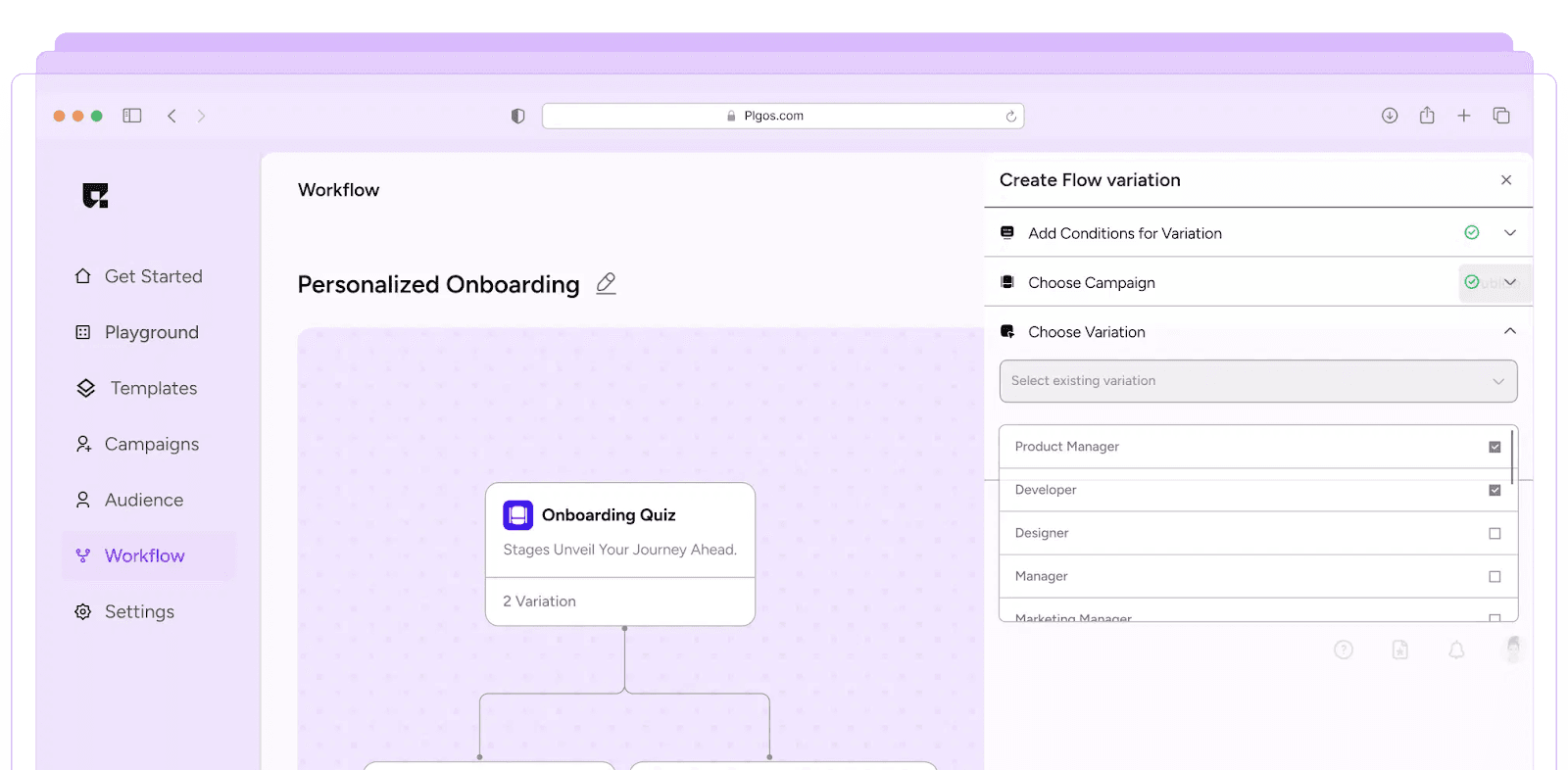
What is PLG OS?
PLG OS is not a direct Chameleon competitor, but rather a complementary tool that helps companies orchestrate their entire product-led growth motion from onboarding to expansion. Product-led companies grow 2–3x faster than sales-led companies.
How it works:
- Centralizes product events, support tickets, feedback, and onboarding flows
- Tracks and visualizes user journeys across touchpoints
- Aligns sales, support, marketing, and product using real-time data
- Acts as a product engagement timeline, helping teams spot friction or drop-off moments
Why it matters in 2025:
While tools like Appcues or Whatfix help create onboarding flows, PLG OS provides the operational backbone ensuring that product usage data drives decisions across departments. It bridges the gap between user experience and company growth.
2. Appcues
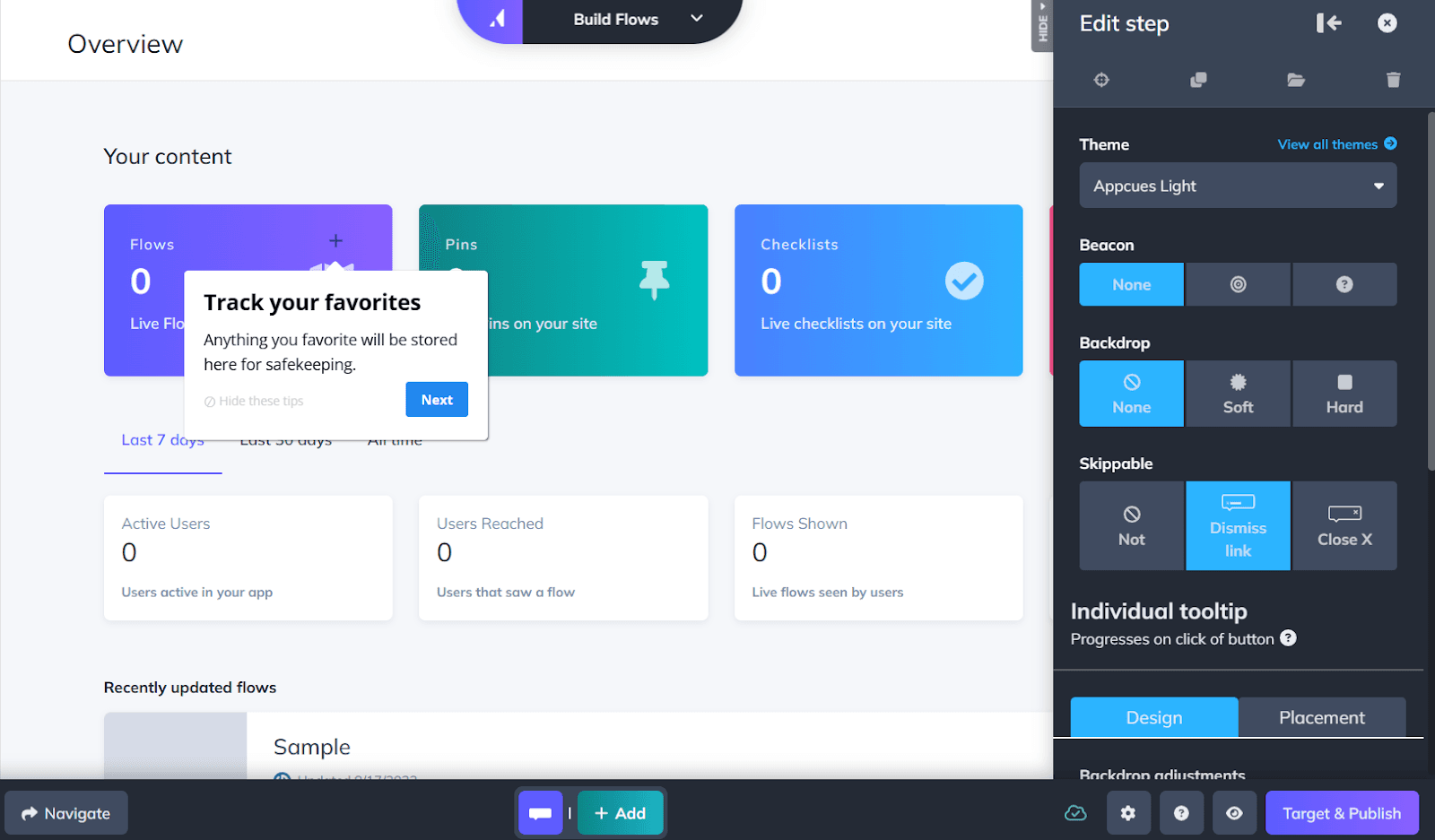
Overview:
Appcues is built for teams that want fast, beautiful onboarding without code. It offers templates, banners, checklists, modals, and more making it a favorite among SaaS product marketers and managers.
Pros:
- No-code setup with intuitive UI
- Pre-built templates and flow variants
- Seamless integration with analytics tools
- Behavior-triggered flows for contextual learning
Cons:
- Limited design flexibility for advanced branding
- Higher cost as usage scales
- Some logic capabilities are simpler than competitors
Best suited for:
SMB and mid-market SaaS companies with agile teams needing to launch fast.
3. Pendo
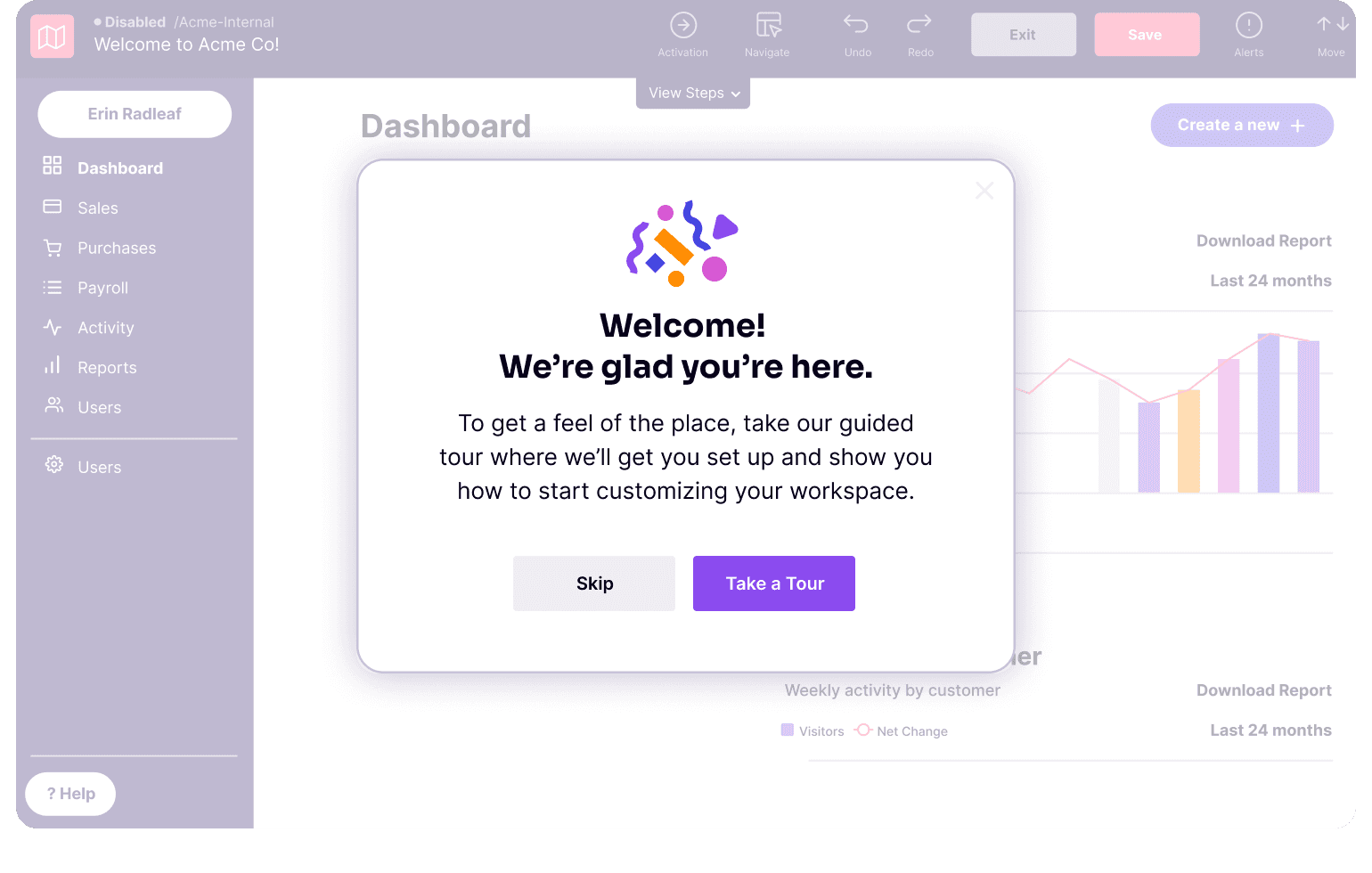
Overview:
Pendo blends product analytics, in-app guides, and customer feedback into one robust tool. It’s ideal for companies focused on both user experience and product optimization. 91% of customers prefer interactive, in-app onboarding over static documentation.
Pros:
- Deep usage analytics and user behavior tracking
- Surveys, NPS, and roadmap feedback tools
- Multi-language and mobile support
- Custom segments and advanced targeting
Cons:
- Can become expensive with premium analytics features
- Some delays in analytics refresh rate
- Slightly steeper learning curve for smaller teams
Best suited for:
Data-driven product teams focused on insight-based onboarding and iterative improvement.
4. Userpilot
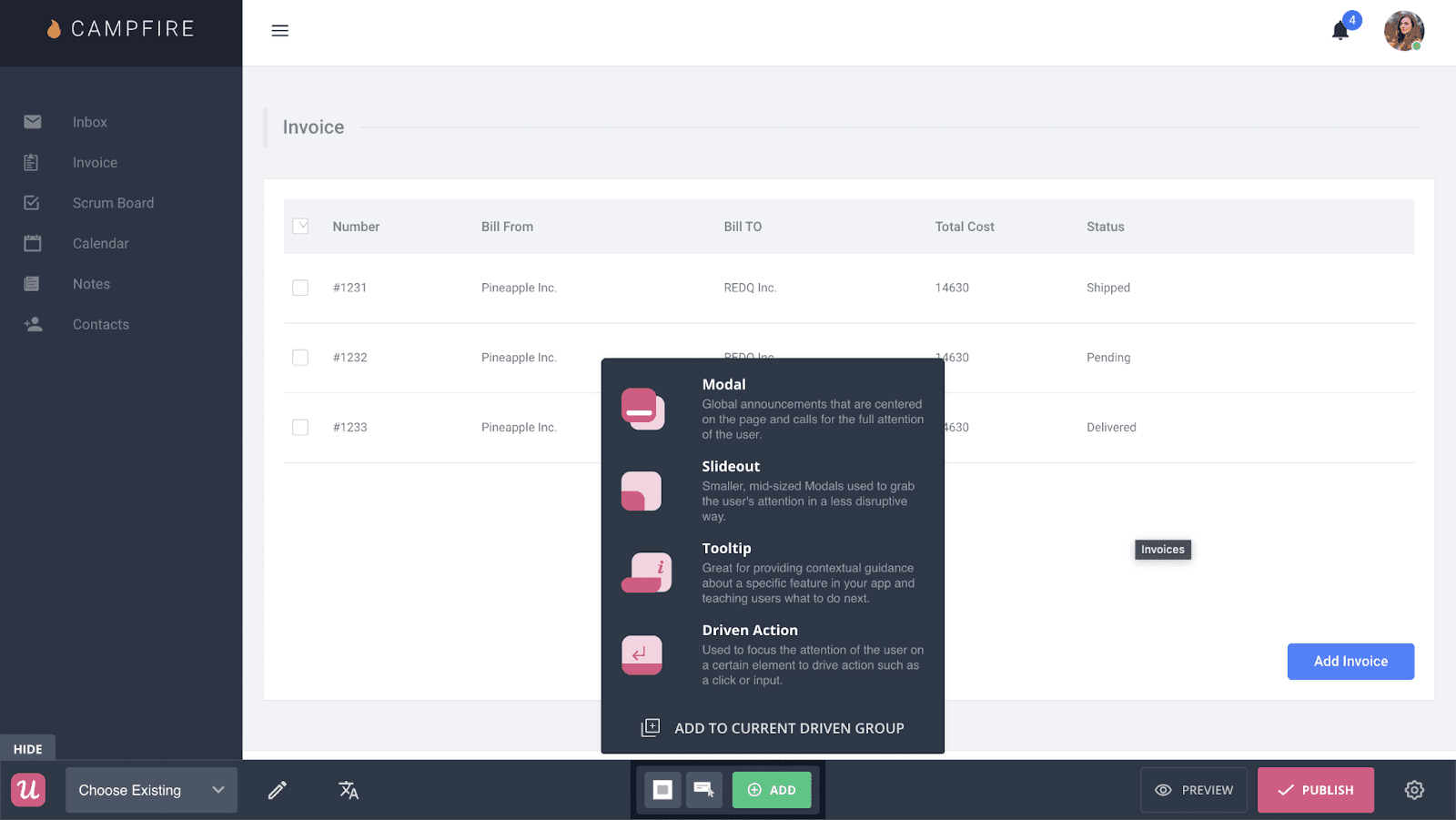
Overview:
Userpilot is a powerful no-code onboarding platform known for its balance between affordability and robust features. It supports localization, session recording, and goal-based onboarding.
Pros:
- Easy to use for non-technical teams
- Behavior-based triggering of UI elements
- Microsurveys, feedback tools, and NPS included
- Cost-effective for startups
Cons:
- Slightly less customizable than Chameleon or Appcues
- Lacks some enterprise-scale automation
- Mobile SDK support is limited
Best suited for:
SaaS startups and mid-sized teams running product-led onboarding and experiments.
5. WalkMe
Overview:
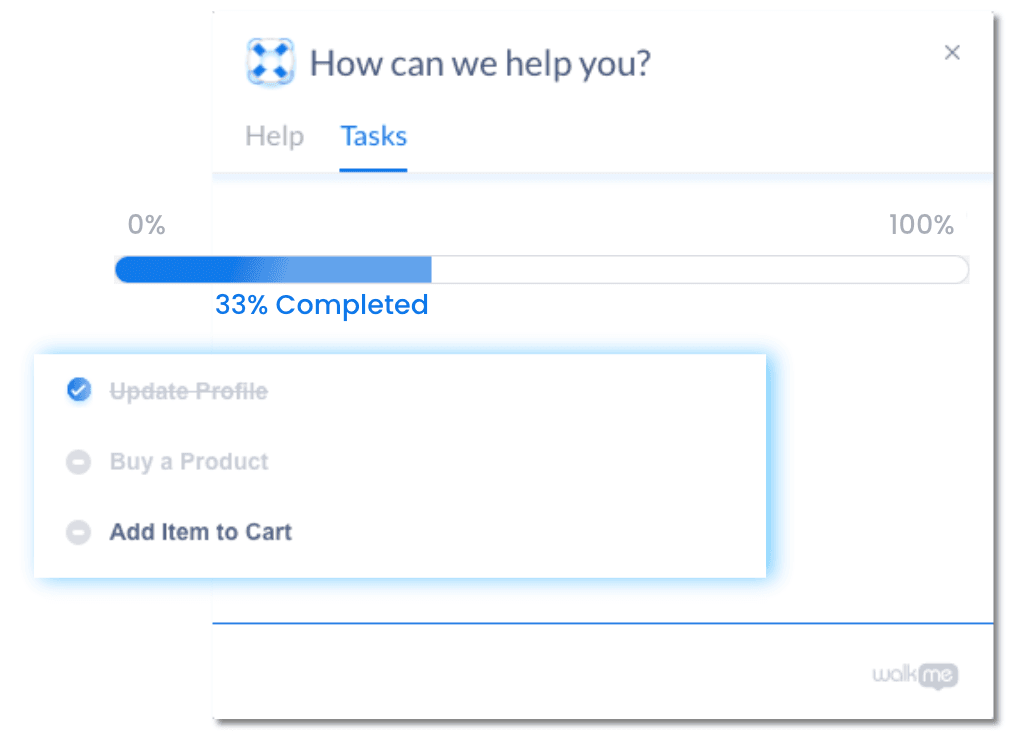
WalkMe is one of the original Digital Adoption Platforms (DAPs), best known for its internal training flows. In 2025, it continues to serve large enterprises with multi-app guidance, task automation, and deep system integrations.
Pros:
- Robust automation features
- Supports internal training and employee onboarding
- Advanced logic and branching capabilities
- Highly scalable and secure
Cons:
- Complex setup and steep learning curve
- Not ideal for startups or small teams
- Premium pricing typically suited for enterprise budgets
Best suited for:
Enterprises with complex internal tools or large external customer bases.
Comparison Table: Chameleon vs Competitors
| Tool | Best For | Key Strengths | Key Drawbacks | Pricing Suitability |
|---|---|---|---|---|
| PLG OS | Cross-functional PLG alignment | Centralized data, journey visualization, real-time ops | Not a direct onboarding tool | Mid to large teams |
| Appcues | Fast onboarding for SMBs | No-code setup, templates, behavioral flows | Limited design flexibility, higher scale cost | SMBs, mid-market |
| Pendo | Data-driven product optimization | Deep analytics, surveys, advanced targeting | Steeper learning curve, premium pricing | Mid to large enterprises |
| Userpilot | Affordable and feature-rich onboarding | No-code, NPS, localization, feedback tools | Limited mobile and enterprise automation | Startups, growing teams |
| WalkMe | Enterprise internal/external training | Task automation, complex logic, scalability | Complex setup, enterprise-only pricing | Large enterprises |
How to Choose the Right Tool
When evaluating Chameleon competitors or doing a no-code onboarding tool comparison, consider these key questions:
1. What’s your onboarding complexity?
Do you need just tooltips and checklists, or full-blown automation and segmentation?
2. Who owns onboarding in your company?
If product marketers or customer success leads are non-technical, tools like Appcues or Userpilot may work best.
3. What’s your data strategy?
If analytics and feedback are central, Pendo or Whatfix could be a better fit.
4. What’s your budget tolerance?
Startups may prefer Userpilot, while large enterprises might invest in WalkMe or Whatfix.
5. Do you need orchestration across teams?
This is where PLG OS becomes invaluable connecting the dots between product data, onboarding journeys, feedback loops, and growth goals.
Conclusion
The in-app guidance software 2025 comparison space is competitive but that’s good news for product teams. You’re no longer limited to one tool or one approach.
Each Chameleon alternative we covered excels in different areas:
- Whatfix for enterprise workflows
- Appcues for usability and fast iteration
- Pendo for analytics and product intelligence
- Userpilot for startups and affordability
- WalkMe for automation and scale
And with PLG OS, you now have a way to orchestrate all these efforts bridging onboarding with retention, expansion, and product-led operations.
If you’re looking to future-proof your product experience, it’s not just about choosing the right tool it’s about choosing the right system. PLG OS is that system.
FAQs on Chameleon Alternatives and Competitors in 2025
1. What is the main difference between PLG OS and tools like Appcues or Pendo?
PLG OS serves as the operational backbone of product-led growth, centralizing data across teams, while tools like Appcues and Pendo focus on creating onboarding experiences and user engagement.
2. Which tool is best for startups with a limited budget?
Userpilot offers a strong balance between features and affordability, making it ideal for startups and mid-sized SaaS companies.
3. Which tool is best suited for enterprises with complex internal systems?
WalkMe is designed for large enterprises and excels in training, automation, and multi-app guidance.
4. Can non-technical teams build onboarding flows with these tools?
Yes, tools like Appcues and Userpilot are no-code platforms that empower non-technical teams to build and deploy onboarding flows.
5. Which tool offers the deepest product usage analytics?
Pendo provides comprehensive analytics and behavioral insights, ideal for data-driven product teams.