What is Funnel Conversion Rate?

Funnel conversion rate is a key metric for any business, especially SaaS companies, that measures the percentage of users who complete a desired action within a sales or marketing funnel. In simple terms, it tracks how well potential customers move from one stage of your funnel to the next until they convert into paying customers.
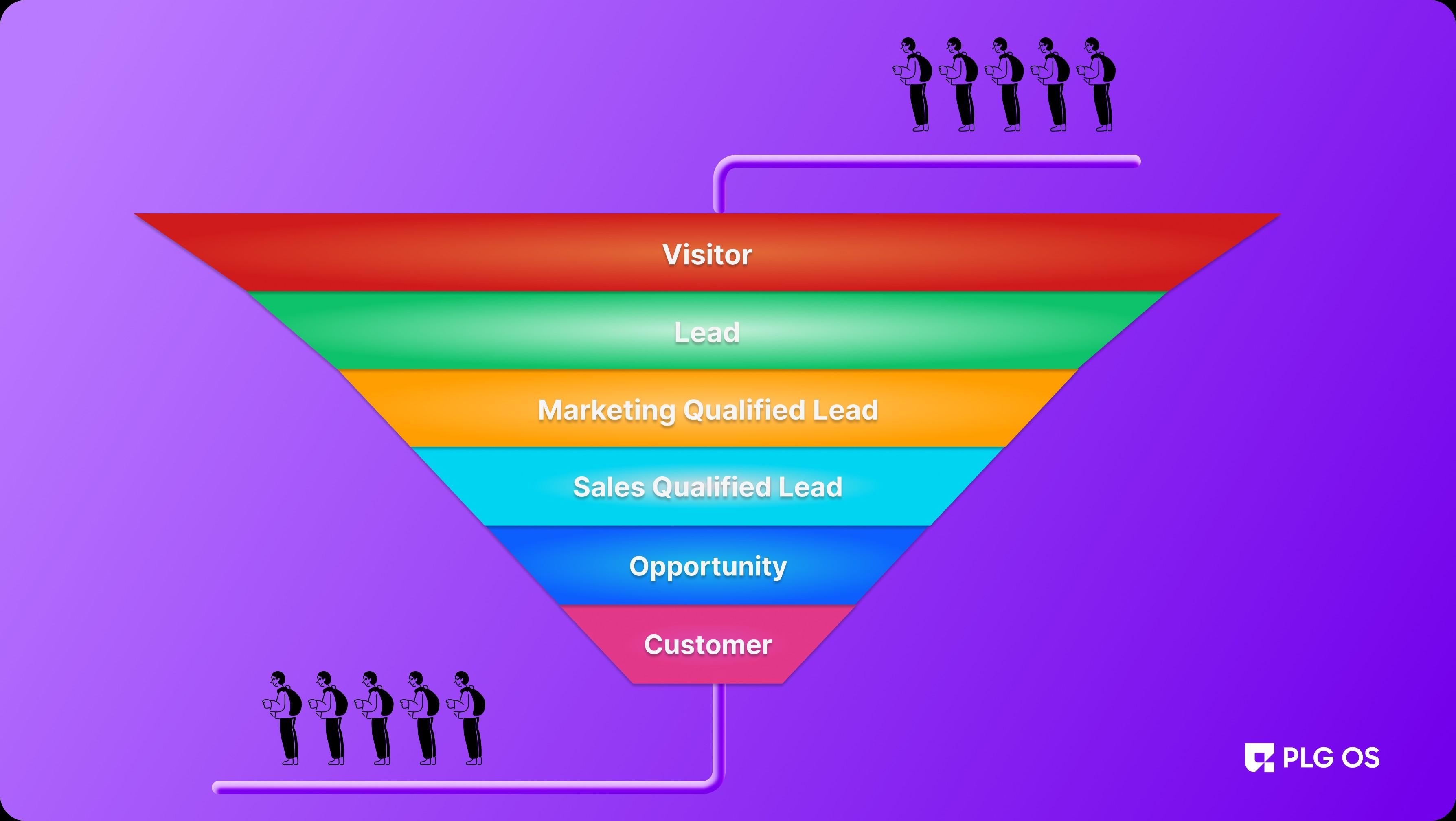
For SaaS companies, a typical funnel might include stages like:
- Visitor (someone who visits your website)
- Lead (someone who expresses interest)
- Marketing Qualified Lead (MQL)
- Sales Qualified Lead (SQL)
- Opportunity (a lead that shows strong purchase intent)
- Customer (a paying user)
The funnel conversion rate can be measured for each stage or for the entire funnel. For example, the overall conversion rate might measure how many website visitors turn into paying customers, while stage-specific conversion rates measure the movement from one step to the next, such as MQL to SQL.
How to Measure Funnel Conversion Rate
Measuring funnel conversion rate involves tracking users through each stage of the funnel. Here's how you can measure it:
1. Define Your Funnel Stages
First, outline each stage of the funnel clearly. This might be from visitor to customer, or it could be more detailed depending on the complexity of your sales process.
2. Set Up Tracking
Use tools like Google Analytics, Mixpanel, or other SaaS analytics platforms to monitor user actions at each stage of the funnel. These tools can track how users interact with your website or product.
3. Collect Data
Accumulate data over a set period. A month’s worth of data is typically a good starting point, but gathering information over longer periods will yield more reliable insights.
4. Calculate Conversion Rates
Use the formula:
Conversion Rate = (Number of Conversions / Number of Users Entering the Stage) x 100.
This calculation gives you the conversion rate for individual stages. For the entire funnel, use the formula:
Overall Conversion Rate = (Number of Customers / Number of Visitors) x 100.
5. Visualize Your Data
Represent your funnel visually using charts or graphs. This can help you quickly identify bottlenecks or stages where users drop off.
Why Measuring Funnel Conversion Rate is Crucial for SaaS Startups
For SaaS startups, tracking funnel conversion rate provides valuable insights that guide business strategy and decision-making. Here are a few reasons why it’s crucial:
1. Identifying Bottlenecks
Tracking conversion rates at each funnel stage helps pinpoint where users are getting stuck or dropping out. For instance, if many leads aren’t converting into MQLs, your marketing efforts may need to be reassessed. This helps you focus on improving specific areas of the customer journey.
2. Guiding Resource Allocation
Not all funnel stages are equal, and some may need more attention than others. By understanding which stages have the lowest conversion rates, you can better allocate resources like marketing spend or sales team efforts.
3. Informs Product Development
If users are dropping off at a specific stage, it could be a sign of a product-market fit issue. For example, if potential customers stop engaging after a trial period, it may suggest your product’s features don’t align with their needs, prompting further development or feature enhancements.
4. Optimizing Marketing Spend
Measuring funnel conversion rates allows you to identify which marketing campaigns or channels are driving the best results. This data helps ensure that your marketing budget is allocated to the highest-performing areas, boosting overall return on investment.
5. Forecasting Growth
With accurate funnel conversion data, you can make more informed predictions about future revenue and growth. By understanding how many visitors convert into customers, you can forecast future performance based on traffic volume.
6. Benchmarking Performance
Conversion rates also give you a way to benchmark your performance against industry standards or competitors. Regularly tracking these rates allows you to assess whether your business is on the right track or if changes are necessary to stay competitive.
7. Impressing Investors
Startups often rely on investors to fuel growth, and funnel conversion rates demonstrate a data-driven approach to scaling. A solid understanding of how your funnel works and where improvements can be made shows potential investors that you have a plan for sustainable growth.
Key Concepts Related to Funnel Conversion Rate
1. Micro-Conversions
These are smaller actions that users take, leading up to the primary conversion goal. For example, in SaaS, micro-conversions could include signing up for a newsletter, watching a product demo, or initiating a free trial.
2. Conversion Rate Optimization (CRO)
This is the process of systematically increasing the percentage of users who perform a desired action in the funnel. CRO involves testing different strategies to improve each funnel stage.
3. Funnel Velocity
This measures how quickly leads move through the funnel. A high velocity means that leads are moving quickly, which often suggests an efficient sales and marketing process.
4. Cohort Analysis
By analyzing groups (cohorts) of users based on when they entered the funnel, you can observe how changes in your product or marketing efforts impact conversion rates over time.
5. Multi-Touch Attribution
This concept acknowledges that users interact with multiple touchpoints before converting. Understanding the value of each touchpoint helps optimize your marketing strategy, as each interaction can influence conversion.
Strategies for Improving Funnel Conversion Rate
Improving your funnel conversion rate requires a mix of testing, optimization, and user-centric strategies. Here are some effective tactics:
1. Optimize Your Value Proposition
Ensure that your product’s value is clearly communicated at each stage. Prospective customers should immediately understand how your SaaS product will solve their problems.
2. Implement Lead Scoring
Lead scoring assigns a value to each lead based on their behavior and characteristics. This helps prioritize which leads should be passed on to the sales team, improving overall conversion rates.
3. Personalize the User Journey
Tailor the user experience based on individual behaviors and preferences. Personalizing email campaigns, landing pages, or onboarding processes can significantly increase conversion rates.
4. A/B Testing
Run tests on various elements of your funnel, such as landing pages, email copy, or calls to action (CTAs), to determine what works best for your audience.
5. Streamline the Onboarding Process
Make it easy for new users to get started with your product. A complicated or lengthy onboarding process can lead to high drop-off rates.
6. Provide Social Proof
Use testimonials, case studies, or customer reviews to build trust with potential customers. This can help push leads further down the funnel.
7. Implement Retargeting
Use retargeting ads to re-engage users who dropped off at various funnel stages. For instance, users who viewed your pricing page but didn’t sign up can be targeted with relevant ads.
Common Pitfalls in Funnel Conversion Rate Analysis
When analyzing funnel conversion rates, it’s easy to make mistakes that could skew your insights:
Ignoring Segmentation:
Different user segments (e.g., enterprise vs. SMB) may have varying conversion rates, so it’s important to analyze these groups separately.
Overlooking Time to Conversion:
Not all users convert at the same pace. Be mindful of differences in user journeys when analyzing conversion rates.
Focusing Solely on Conversion Rate:
High conversion rates don’t necessarily mean high-quality customers. Balance conversion rates with other metrics like customer lifetime value (LTV).
Neglecting Mobile Users:
Ensure your funnel analysis includes mobile users, as their behavior may differ significantly from desktop users.
The Future of Funnel Conversion Rate in SaaS
The SaaS landscape continues to evolve, and so do strategies for optimizing funnel conversion rates. Expect AI-driven optimization, predictive analytics, and personalized funnels that adapt to user behavior in real time.
Conclusion: Funnel Conversion Rate
Funnel conversion rate is more than just a number—it's a crucial KPI for driving growth and making informed decisions. SaaS businesses that continuously improve this metric can create a more efficient sales process, leading to sustainable growth.
PLGOS.com can help improve your funnel conversion rates with tailored onboarding experiences, in-app engagement tools, and real-time analytics. By guiding users through each stage of the funnel, PLGOS can help turn visitors into long-term customers, reducing acquisition costs and accelerating growth.