7 Ways Leaderboards in SaaS can help with User Retention
Ever noticed how people get excited when they see their name on a leaderboard? Whether it’s in a fitness app, a game, or even a classroom, there’s something fun and motivating about climbing the ranks, even with leaderboards in SaaS.
Now, imagine bringing that same energy into your SaaS product. 0
In fact, they’re one of the smartest (and most underused) ways to boost user activity, keep people coming back, and make your product stand out, especially if you’re building with a product-led growth (PLG).
In this blog, we’ll walk through 7 easy and effective ways leaderboards can improve user engagement and why your SaaS might need one sooner than you think.
What is gamification in SaaS?
Gamification is the process of incorporating gaming elements and mechanics into apps to increase user engagement, motivation, and loyalty. The goal is to take games' intrinsic appeal—challenges, rewards, competition, and achievement—and apply it to non-game contexts like work or learning. By 2030, the gamification market is expected to grow by 27.99% and reach a whopping $123.87 billion.
Leaderboards engage users by making the user journey more interactive and rewarding, especially during the onboarding process. For SaaS companies, they help increase user motivation, turning new signups into activated users who explore more of the product or service. When users interact regularly—encouraged by friendly competition or progress tracking—conversion rates improve and loyal customers are built. Even simple app messages tied to leaderboard status can enhance customer support and make users feel seen, valued, and encouraged to keep going.
What Are Leaderboards in SaaS?
Let’s get on the same page.
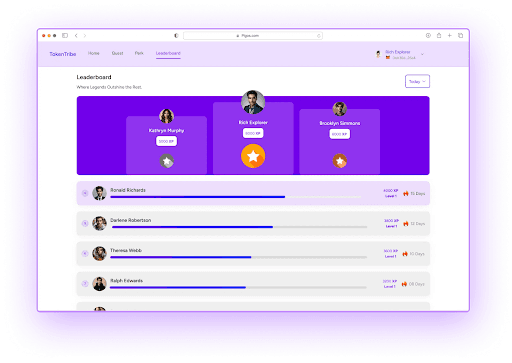
A leaderboard in SaaS is a visual display that ranks users or teams based on specific metrics. Think usage frequency, feature adoption, collaboration levels, referrals, learning progress you name it.
You can implement leaderboards:
- On dashboards
- In emails
- Inside gamified progress bars
- As part of onboarding flows
- Or across team-based accounts
And the best part? They don’t just display data—they inspire action.
Why Leaderboards in SaaS are important?
Because SaaS today is PLG-first, Product-Led Growth is not just a buzzword anymore.
With platforms like PLG OS , you’re encouraged to design products where the product sells itself. Leaderboards fit perfectly into this vision as leaderboard user motivation. They provide immediate feedback, nudge behaviors, and make your users come back because they want to. Organizations that integrate gamified loyalty programs, including leaderboards, achieve a 22% increase in customer retention.
7 Ways Leaderboards in SaaS Can Improve User Activity
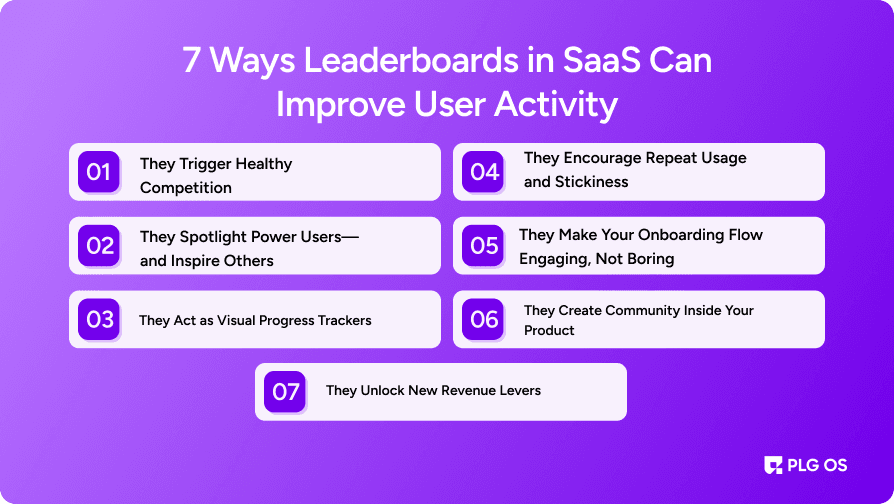
1. They Trigger Healthy Competition
People love to compete even if it’s just with themselves. Introduce a leaderboard that shows user activity, task completion, or daily streaks, and watch how quickly users start pushing themselves to stay on top.
Example:
A sales CRM can have a “Top Closers This Week” leaderboard. Suddenly, your reps log in daily not because they’re told to but because they want to hold their rank.
Why it Works:
- Drives intrinsic motivation
- Keeps users engaged without push notifications
- Turns mundane tasks into daily wins
This is gamification strategy 101 but with real business impact.
2. They Spotlight Power Users—and Inspire Others
Your top users are already doing something right. A leaderboard puts them on a pedestal—not to gloat, but to inspire. Adding gamification—including leaderboards—to training and productivity systems leads to a 40–48% uptick in engagement and motivation
When newer or inactive users see peers succeeding, they’re more likely to copy their behavior.
Think:
- "If Alex reached 500 API calls this week, maybe I can too."
- "Why is this team always leading in adoption? What are they doing?"
SaaS Leaderboard Benefits Here:
- Drives peer learning
- Sets achievable benchmarks
- Helps new users model success
This is especially powerful in B2B SaaS with multiple teams leaderboards create internal case studies without extra documentation.
3. They Act as Visual Progress Trackers
Leaderboards aren’t always about being #1. They can also show:
- How far you’ve come
- Where you rank in the middle
- What you need to do to level up
For many SaaS platforms, especially those with educational or onboarding paths, a progress-based leaderboard can help drive feature adoption.
Example:
In a marketing automation tool, show:
“Most Email Campaigns Completed This Month”
Suddenly, even passive users get curious:
“How many have I done?”
This taps into one of the most subtle yet powerful user engagement techniques: Comparative progress.
4. They Encourage Repeat Usage and Stickiness
Let’s face it: most SaaS users drop off after Day 1.
But what if they had a reason to return? Leaderboards provide that tiny dose of dopamine and FOMO that brings users back for more.
Here’s the kicker:
Every time a user logs in and sees they’ve dropped a few spots, they’re likely to engage with the product to climb back up.
This is a direct path to increase SaaS retention—and it’s surprisingly simple to implement.
Even a weekly leaderboard reset can do wonders:
- Drives recurring logins
- Builds habit loops
- Keeps engagement fresh
5. They Make Your Onboarding Flow Engaging, Not Boring
Onboarding is where SaaS products win or lose the user.
Add a simple “Newbie Leaderboard” that shows how fast new users complete onboarding tasks. Add a “fastest finisher” badge. Offer a little celebration
Suddenly, your onboarding isn’t a chore. It’s a challenge.
Leaderboard Examples in SaaS Onboarding:
- "Top 10 Users to Complete Setup This Week"
- "Fastest First Workflow Execution"
- "Team with Quickest Activation Rate"
The leaderboard format gamifies even the dullest setup and that leads to stronger Day 1 and Day 7 retention metrics.
6. They Create Community Inside Your Product
Leaderboards can spark something powerful:a sense of belonging.
When users see where they stand in a group, they start to see themselves as part of that group. This is huge for collaborative SaaS tools, educational platforms, or community-driven products.
Add these:
- Team-based leaderboards
- Geo-location rankings
- Departmental contests
- Community shout-outs for top users
And you’re no longer just a tool.
You’re a tribe.
And tribes are hard to leave.
This is one of the lesser-talked-about SaaS leaderboard benefits, but in PLG strategy, it’s gold
7. They Unlock New Revenue Levers
Wait, what?
Yes, leaderboards can actually open up monetization opportunities.
Here's how:
- Premium users get visibility on custom leaderboards
- Teams pay to unlock detailed usage insights
- Advanced analytics reveal leaderboard movement over time
- Competitions (with prizes) can be part of paid plans
And guess what happens when your product has high leaderboard engagement ? You have the behavioral data to build even better features.
You know exactly:
- What power users do
- Where others drop off
- Which features drive the most leaderboard jumps
That’s the kind of product insight you usually need interviews for. Now, it’s in your dashboard.
What Makes a Good SaaS Leaderboard?
Now that you’re ready to jump in, don’t just throw together some numbers and hope for magic.
Great leaderboards have these traits:
- Contextual Metrics: Use what matters. Not just "logins" but "meaningful actions."
- Freshness: Weekly resets, monthly awards, real-time updates—keep it dynamic.
- Fairness: Don’t let only legacy users dominate. Level the playing field.
- Visibility: Place it where it counts—in the UI, in emails, in dashboards.
- Rewards: Even if it’s just recognition. Bonus: badges, discounts, unlockables.
PLG OS: Leaderboards as a PLG User
If you’re embracing Product-Led Growth, then platforms like PLG OS are helping you build faster and smarter.
Leaderboards are the PLG embodiment of “show, don’t tell.”
They show the value through peer actions.
They nudge users to adopt new features because everyone else is doing it.
They convert free users to paid, just by sparking curiosity and competition.
And they do all this without extra sales calls, demos, or marketing.
That’s pure PLG energy.
Final Thoughts
Let’s be real—some people still think leaderboards are gimmicks.
That’s outdated thinking.
The right leaderboard:
- Drives behavior
- Increases engagement
- Builds habits
- Unlocks community
- Boosts revenue
This is not decoration it’s design. Smart SaaS design transforms passive users into passionate advocates.
So whether you're a founder, product manager, or marketer, start exploring leaderboard strategies today. The sooner you implement these strategies, the sooner you’ll see users doing what you always wanted them to do: using and loving your product.
FAQs
1. Are leaderboards only useful for gamified SaaS products?
Not at all. Leaderboards work in any SaaS product where user actions can be tracked—whether it’s sales, learning, marketing, or productivity.
2. Can leaderboards really increase SaaS retention?
Yes. By encouraging repeat usage, friendly competition, and progress tracking, leaderboards help users stay engaged longer.
3. What kind of metrics should I use in a leaderboard?
Use metrics that reflect valuable user behavior, like tasks completed, features used, referrals, or team contributions.
4. Will new users feel discouraged by leaderboards?
Not if you design fairly. You can create separate leaderboards for beginners, reset rankings regularly, or show personal progress instead of public ranks.
5. Do I need a lot of data to build a leaderboard?
No. Start simple. Even basic data like logins, checklists completed, or daily usage can be used to build an engaging leaderboard.