6 Best Customer Success Models for Your Saas Engagement
As a growth engine, SaaS companies frequently disregarded customer success. Retaining current clients is as critical as getting new ones, but most businesses overlook the latter's importance.
Everything, however, compounds in SaaS. Monthly customer attrition of 10% would add up to 71.8% annually. To rephrase, if you had 100 clients at the beginning of the year, but only 28 would remain at the conclusion, you would need to bring in 72 more consumers just to break even.
A SaaS customer success strategy is helpful in this situation. Customer success decreases churn and drives retention if marketing and sales drive customer acquisition.
What is a Customer Engagement Model?
From the time a consumer learns about a product through to the point when they become a devoted client (or discontinue using it), a customer engagement model serves as a framework to direct the company's interactions with the customer.
So, What is the point?
To make the customer's experience pleasant and maintain their interest in the goods.
More revenue and better profits for SaaS companies result from an effective customer engagement strategy.
Customer lifetime value is increased through increased customer loyalty and retention brought about by consistent engagement with consumers at every stage of the buying process and by assisting them in getting the most out of your products.
Brand ambassadors are frequently engaged customers. Their word-of-mouth promotion of your SaaS solutions lowers the cost of new client acquisition and helps you reach more people.
You may enhance your product and meet consumer needs more effectively with the help of valuable feedback you get from a well-executed customer engagement plan.
Stages of Customer Engagement
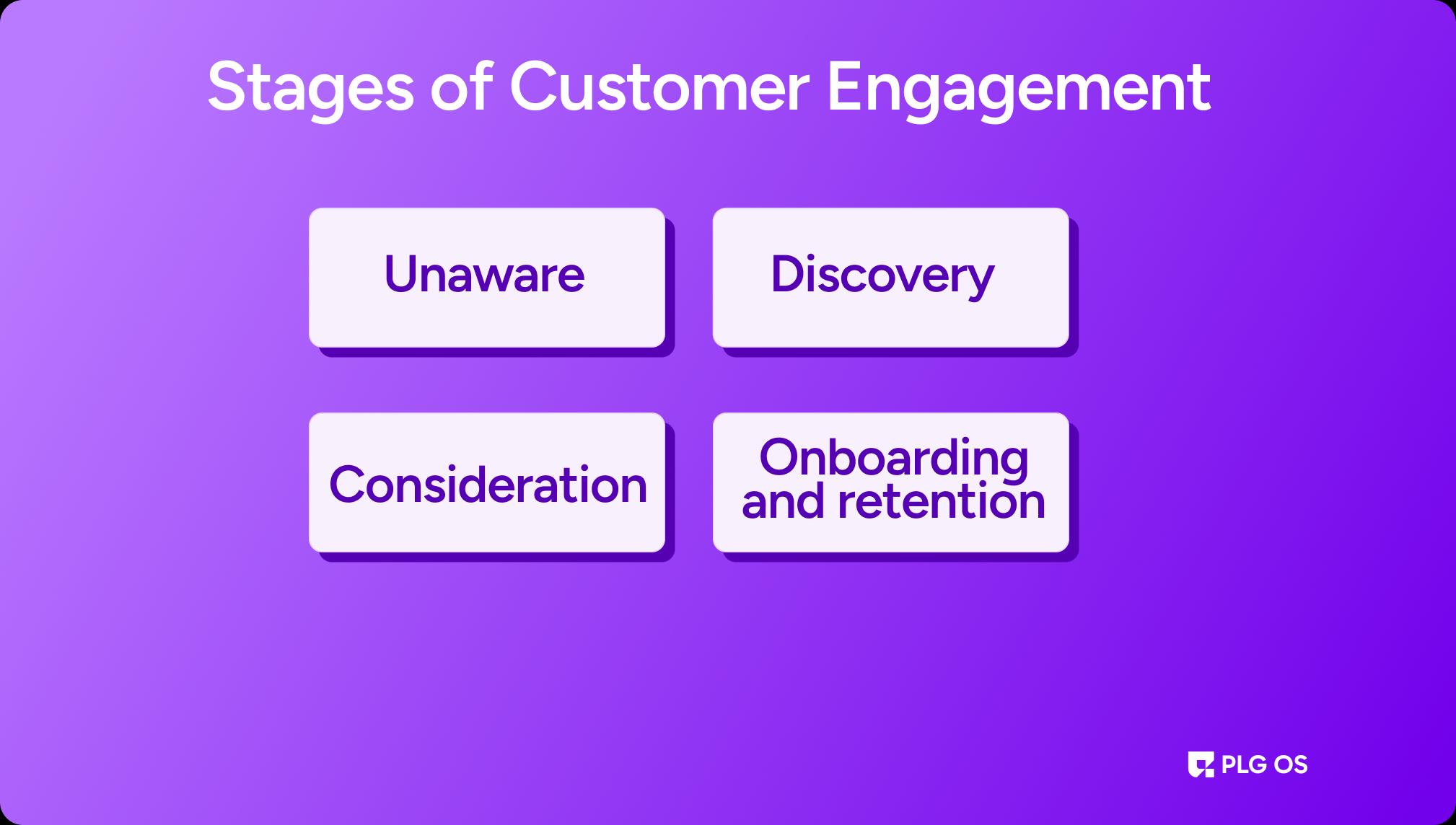
1. Unaware
Nobody knows about your company or the product you sell. Because they are oblivious to your existence, they will never know if what you are offering is precisely what they are seeking.
At this point in the sales funnel, your goal should be to attract new clients by increasing awareness of your brand and leaving a lasting impression of the solution you provide. Customers at this stage aren't ready to engage, so there's no need to tout your features, price, or competitive advantages.
2. Discovery
When people in need of your solution are aware of your brand and its existence, they will seek you out.
When engaging with people in the discovery stage, focus on the value you can provide to their business. Many people erroneously believe that the discovery stage is the best time to expose their feature set to clients. From a commercial perspective, the features may make sense, but when interacting with someone who is merely aware of your product, focus on how you can assist them rather than what you have to offer.
3. Consideration
They will examine the finer points of your offering to think about your pricing, market advantages, and why they should think about working with you if they are happy with the business value.
While they're still in the consideration stage, you can start planning your engagement strategy. This should include things like feature explainers to walk them through all the features your product offers, comparison battle cards to show why your product is better than the competition, and business case studies to showcase how other companies have used your product and been successful.
Additionally, during this engagement stage, incorporate personalization features to demonstrate how your solution aligns well with their sector. This would give you an advantage when they decide.
4. Onboarding and retention
Their consideration leads to a purchase of your solution, and you facilitate their onboarding into your product. Their involvement continues even after they make a purchase; after all, they may always cancel if they aren't happy with the product. Engaging with them during the onboarding process is therefore essential.
When engaging with customers at this point, it's important to provide them with resources that will assist them with setting up the product and making the most of its many features. As a result, they will be more likely to use your solution consistently throughout the product, develop an attachment to it, and remain loyal to you over the long term.
6 Best Customer Success Models for You Saas Engagement
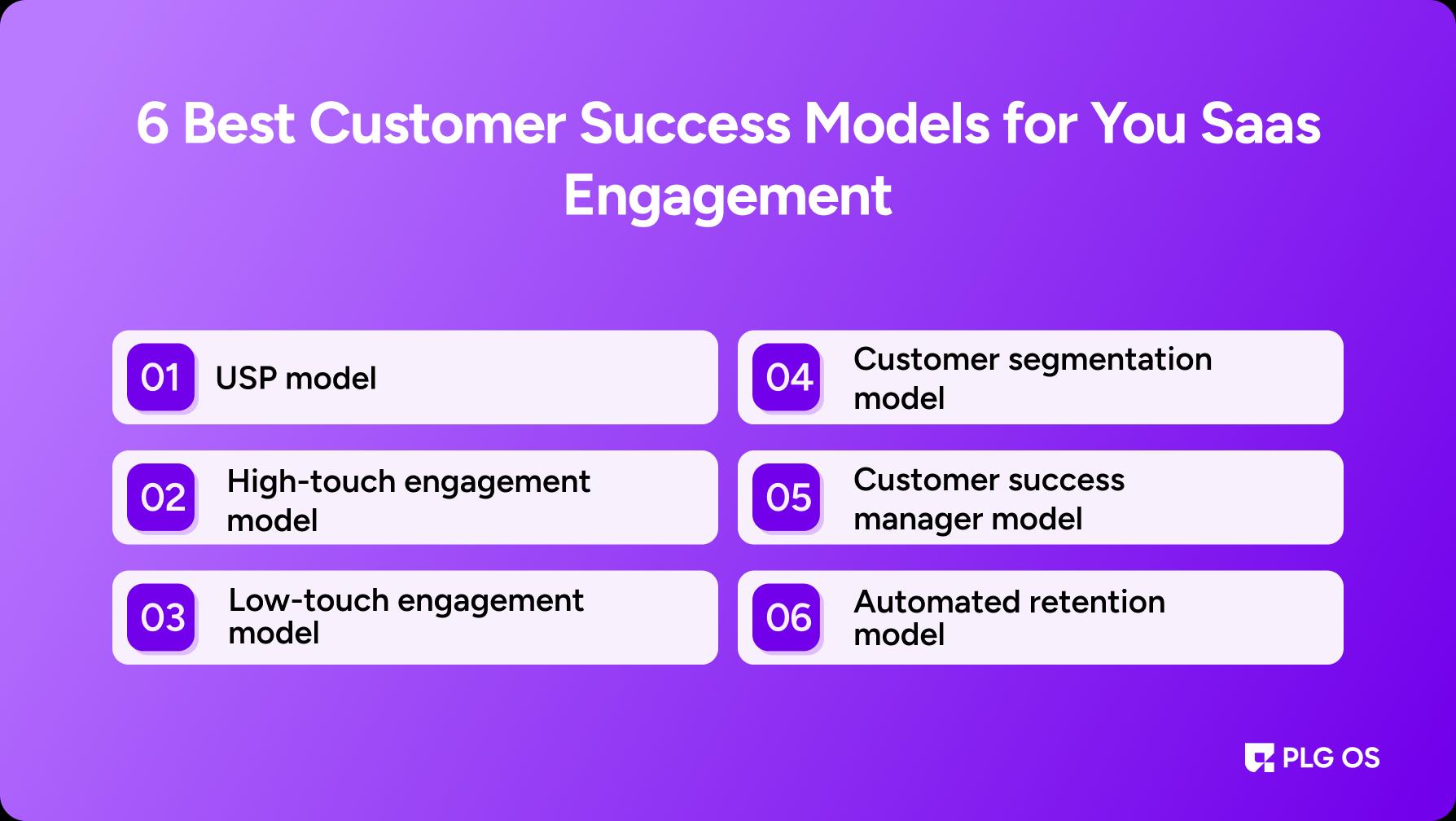
1. USP model
The Unique Selling Point (USP) concept is all about highlighting the things that make your product unique, like its features and benefits that no one else offers. Fully engaged customers spend 23% more over their lifetime than the average customer.
This kind of connection could work for you, particularly in the beginning of the client journey, if your offerings are really distinctive from the competition.
However, remember that it has a narrow emphasis and limited scope. Unless your product is really creative and you're continually releasing new features, highlighting your USPs might not be enough to engage and retain customers in the long run.
Apple
Challenges: In the very competitive smartphone industry, Apple had to figure out how to set itself apart.
Outcome: Apple built a devoted following by highlighting its unique selling points, which include its breakthrough technologies like Face ID and the ease with which its ecosystem works together. With a 23% greater lifetime value than ordinary consumers, Apple has cemented its supremacy in the industry, thanks to customers' willingness to pay a premium for Apple's unique products.
2. High-touch engagement model
Exceptionally tailored exchanges with clients are the backbone of the high-touch engagement paradigm.
Providing first-rate service and assistance to consumers, like through devoted sales and customer success agents, is a certain way to draw in new ones and keep the ones you have. They are available to receive demo calls, onboard new users, and provide assistance as needed.
One way to improve your brand's reputation is to tailor your services to each customer's unique requirements. This will help you understand your customers better and meet their wants.
One drawback is the high resource requirements and difficulty in scaling up this engagement strategy. The supply of qualified salespeople and customer service representatives is finite, regardless of how much capital you have.
Therefore, the strategy works well with corporate solutions for high-value clients or goods that are both difficult and niche.
Salesforce
Challenges: Salesforce had to deal with the difficulty of onboarding and sustaining business clients that had complicated CRM demands and needed individualised care.
Outcome: Salesforce greatly enhanced customer retention by implementing specialized Customer Success Managers (CSMs) to assist clients with onboarding and give personalized support. Because clients felt supported and got better results through tailored involvement, the methodology increased retention rates by 30%.
3. Low-touch engagement model
Alternatively, there is a low-touch client interaction model. Chatbots and in-app flows are examples of self-service systems that rely on automation rather than customized attention to engage clients at scale.
This is a good fit for businesses whose products aren't complex, inexpensive, and don't need a lot of help. A low-touch engagement strategy could work for your product if it has a simple, clear design and an easy-to-understand user interface.
Limiting your chances to get to know your consumers and build close relationships is the biggest downside of this method.
Zoom
Challenges: Zoom had to handle a huge surge in users without overburdening its customer support staff during a time of fast expansion.
Outcome: Users were able to address difficulties on their own once Zoom implemented self-service capabilities such as AI chatbots, knowledge bases, and interactive lessons. This method successfully scaled customer involvement while reducing support tickets by 80% without sacrificing user pleasure.
4. Customer segmentation model
Using factors like demographics, behavior patterns, and the stage of the customer journey, the customer segmentation model divides the customer base into groups and then tailors engagement to each group.
Businesses that serve a wide variety of customers or have different use cases may find this model to be quite useful.
Customer happiness and loyalty can be enhanced by creating more relevant and tailored experiences through segment-specific engagement tactics.
For instance, Canva sorts users into groups according to the tasks they need to do and then utilizes that data to personalize their dashboards with appropriate templates.
Canva
Challenges: The problem Canva had is that it needs to make its platform unique to each user's specific design requirement.
Outcome: Canva differentiated its dashboards and templates to different types of users based on demographics and the jobs they were performing, enabling it to attain this. It made the platform more relevant to the needs of customers, leading to increased engagement, happiness, and retention.
5. Customer success manager model
Client success managers are crucial to the strategy because of the intimate relationship they maintain with clients to help them reach their objectives.
Customer service management (CSMs) may better meet their clients' demands and create unique tactics to do so if they maintain consistent communication with them. Future product development can also benefit from their insights.
Customers are more likely to remain loyal to a brand and make repeat purchases when they have a dedicated point of contact who facilitates better communication between the company and its customers.
Some of the drawbacks of the high-touch model are also present in the CSM-driven strategy, such as the difficulty and expense of recruiting and training sufficient personnel. If your product isn't very valuable yet you need to attract and retain a lot of customers, this won't work.
HubSpot
Challenges: HubSpot aimed to boost retention and guarantee that clients could make the most of its CRM and marketing capabilities.
Outcome: High-value accounts were assigned dedicated CSMs by HubSpot who provided individualized onboarding, proactive assistance, and frequent performance evaluations. Upsells and cross-sells increased by 40% thanks to this strategy, which also greatly enhanced customer happiness and loyalty.
6. Automated retention model
Customers are engaged with messages for contextual support and targeted communication through the automated retention model's use of technologies like event-based triggering.
Envision this: you've pinpointed a string of consumer behaviors that result in customer defection.
You can combine them into a custom event to find out why they're churning or to set up a flow to help them overcome obstacles and embrace important features.
Automate your interactions with customers by utilizing event-based triggering. One surefire and inexpensive way is to use automated engagement. It enhances uniformity in the client experience and decreases the possibility of errors after it is set up because it doesn't require any manual support.
However, clients may see it as impersonal, and you might have to shell out some cash to have the correct software.
Intercom
Challenges: The goal of Intercom's behavior-based engagement was to decrease customer attrition.
Outcome: Intercom implemented an automated retention model that sent out targeted messages to users who displayed indications of disengagement through event-based triggers. Automated messaging increased user retention and decreased churn by prompting users to complete important actions. This effective approach allowed for the preservation of resources while ensuring continuous participation.
Benefits of Customer Engagement
Enhanced Customer Satisfaction:
By diligently attending to customer feedback and responding to their requirements, businesses can cultivate a more favorable customer experience, resulting in elevated levels of satisfaction.
Enhanced Customer Retention:
Customers who are actively engaged are more inclined to exhibit brand loyalty and persist in their purchasing behaviors, thereby diminishing desertion rates.
Enhanced Customer Lifetime Value (CLV):
Elevated levels of customer engagement can lead to repeated transactions and increased expenditure over an extended duration, thereby augmenting the overall value derived from each customer.
Enhanced Brand Loyalty:
When consumers perceive that they are valued and comprehended through tailored interactions, they cultivate a more profound connection to the brand, resulting in heightened loyalty.
Positive Word-of-Mouth Marketing:
Customers who are actively engaged are more inclined to endorse a brand to their friends and family, thereby fostering organic growth through favorable word-of-mouth recommendations.
Enhanced Customer Insights:
Through proactive engagement with customers, businesses can acquire critical data regarding their preferences, challenges, and requirements. This information can be utilized to refine products, services, and marketing strategies.
How to Choose the Right Customer Engagement Model for Your SaaS?
1. Understand Your Clientele
Prior to initiating the process of engagement, it is essential to cultivate an understanding of your consumers by gaining insight into their identities and expectations.
To facilitate effective engagement with consumers, it is essential to develop comprehensive personas that accurately represent various customer segments. Omnichannel customer engagement increases revenue by 9.5% year-over-year, compared to 3.4% for other companies.
Gather data from surveys, feedback mechanisms, and analytical tools to gain a comprehensive understanding of their needs, preferences, and challenges.
Utilize this data to tailor your interactions and content, ensuring that your engagement strategies address individual requirements while enhancing overall customer satisfaction.
2. Conduct Customer Segmentation
Customer segmentation can be an effective strategy for engaging distinct categories of consumers through a customized approach.
Segment your consumer base into distinct categories according to demographic characteristics, purchasing behavior, and levels of engagement.
Focusing on particular demographics with tailored messages and offers enables you to enhance the relevance, engagement, and satisfaction of your communications.
3. Tailor Interactions to Individual Preferences
Engage consumers by utilizing their names, tailor materials to align with their preferences, and provide recommendations informed by prior interactions.
Tailored experiences enhance customers' sense of worth, thereby augmenting the probability of favorable engagement.
Utilize consumer data and preferences to deliver personalized experiences and communications.
4. Execute a Multichannel Strategy
Whether you interact via email, social media, or your website, the experience ought to be cohesive and uniform.
Ensure consistency across all customer interaction locations. A multichannel strategy fosters a cohesive brand identity and enhances consumer satisfaction by delivering a seamless experience.
5. Incorporate Feedback
Customer expectations evolve over time; consequently, it is imperative to periodically reevaluate your engagement strategy.
Stay abreast of industry trends and customer feedback to identify opportunities for enhancement and implement necessary modifications.
Solicit regular feedback from your customers and give it the appropriate consideration it deserves. Utilize surveys, evaluations, and direct feedback to gain insights into their experiences and preferences. Utilizing this impartial customer data, you can implement modifications and demonstrate to consumers that their opinions are esteemed.
How does PLG OS help businesses run customer engagement models?
With PLG OS's chatbot solutions, organizations have a lot of leeway to tailor the flow to their own needs. They provide robust choices for companies to meet the demands of their consumers in a variety of use scenarios.
With live chat, companies can give their customers personalized assistance. Audio calls, remote access, and screen sharing are some of the alternatives that will allow them to implement a CSM-driven client engagement model and high agency onboarding. Using SalesIQ's Email Signature Chat, customer success managers may initiate instant messaging with their high-agency clients.
A hybrid onboarding and retention model that combines chatbots with live chat allows businesses to give customers the best of both worlds.
FAQs
What are the methods for assessing consumer engagement?
There are several methodologies available for assessing consumer engagement. Concentrate on the utilization of products and services, the count of daily active users, the attrition rate, the referral rate, the utilization of licenses, and engagement on social media platforms.
What is the significance of customer engagement?
Customer engagement is of paramount importance as it facilitates the expansion of your enterprise, enhances customer retention, and increases revenue. The return on investment associated with retaining an engaged customer significantly exceeds that of acquiring and enrolling new customers.
What strategies can be employed to enhance customer engagement?
There exists a multitude of strategies to enhance consumer engagement. In this post, we addressed the implementation of incentives, the initiation of a VIP program, the organization of customer surveys, the provision of exemplary customer service, and the education of customers.
What are the differences between customer engagement and customer satisfaction?
Customer engagement constitutes a continuous process that occurs throughout the entirety of the customer lifecycle, whereas customer satisfaction is the outcome derived from this engagement.