5 Signs You’re Doing PLG Wrong (And How to Fix It)
Does your software company's go-to-market strategy align with product-led growth (PLG), which is all the rage these days? All SaaS leaders must address this question prior to committing to a PLG-exclusive growth strategy.
But let’s be real, just slapping on a free trial or a freemium plan doesn’t magically turn your product into a growth engine. If your user signups are high but conversions are low, or if people try your product but don’t stick around, something’s off. PLG should drive organic adoption, reduce acquisition costs, and create a self-sustaining growth loop but only if done right.
If your PLG strategy isn’t delivering, you might be making these five common mistakes. Let’s break them down and, more importantly, fix them before they derail your growth.
When Is PLG-Only a Good Fit?
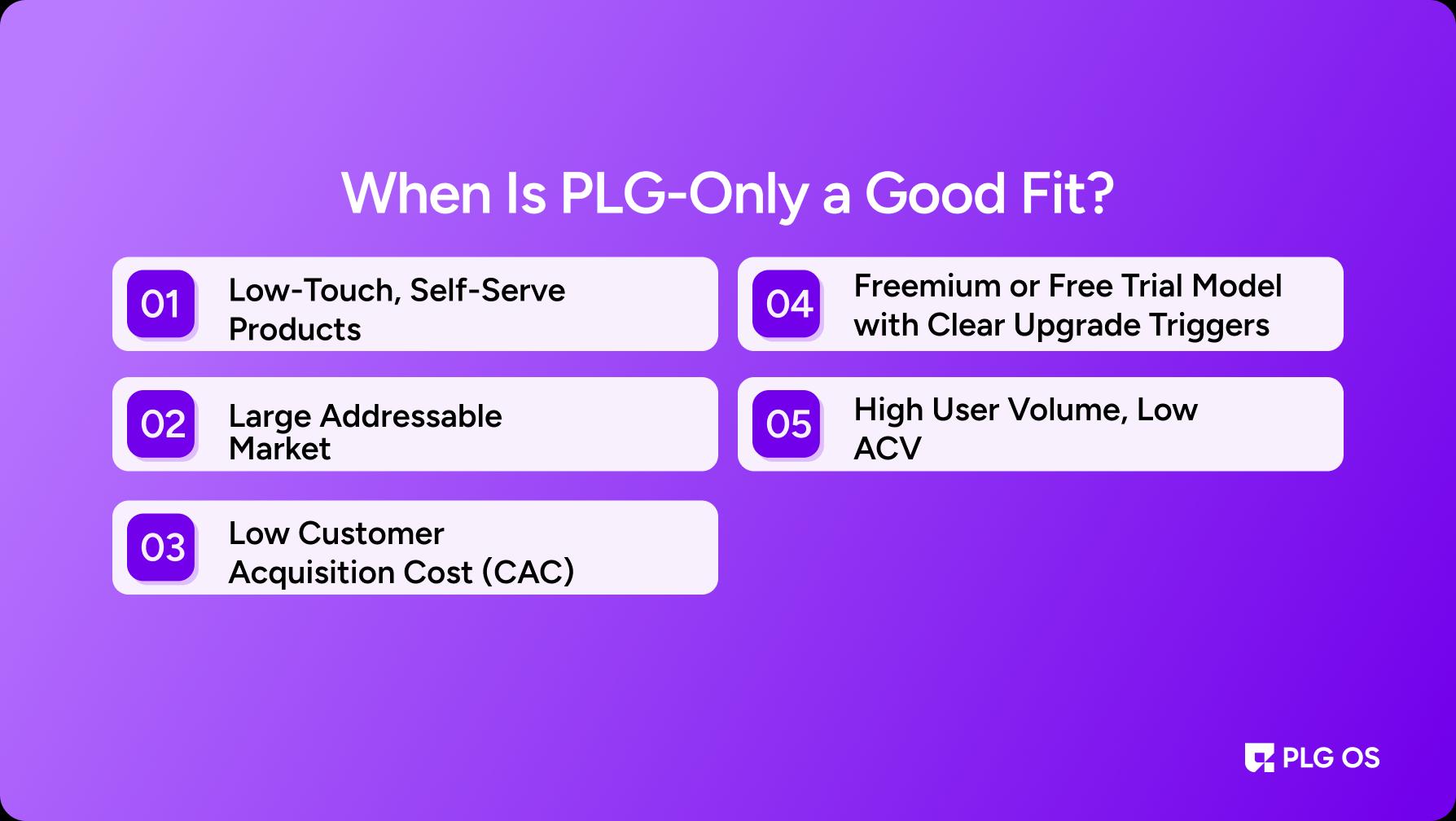
Product-led growth (PLG) isn’t a one-size-fits-all strategy. While many SaaS companies benefit from a hybrid approach (PLG + sales assist), some businesses thrive with a PLG-only model. Here’s when it works best:
1. Low-Touch, Self-Serve Products
If your product is intuitive, easy to adopt, and requires minimal onboarding, a PLG-only model makes sense. Users should be able to sign up, get immediate value, and upgrade without needing a sales call. Examples include Slack, Trello, and Notion.
2. Large Addressable Market
PLG works well when your potential user base is vast, allowing organic adoption and viral growth. Products with collaboration features (like Zoom or Dropbox) benefit from network effects, driving expansion without sales involvement.
3. Low Customer Acquisition Cost (CAC)
If your product spreads through word-of-mouth, virality, or user referrals, PLG keeps acquisition costs low. Instead of spending heavily on ads or outbound sales, you rely on users bringing in more users.
4. Freemium or Free Trial Model with Clear Upgrade Triggers
A PLG-only model thrives when users naturally hit limitations in the free version and are motivated to upgrade. Think limited storage (Dropbox), restricted features (Canva), or usage caps (Zapier) these create seamless conversion opportunities.
5. High User Volume, Low ACV
For businesses with low average contract value (ACV), a sales team isn’t cost-effective. PLG works well when you need many users to drive revenue rather than a few high-ticket deals.
When Is PLG-Only a Bad Fit?
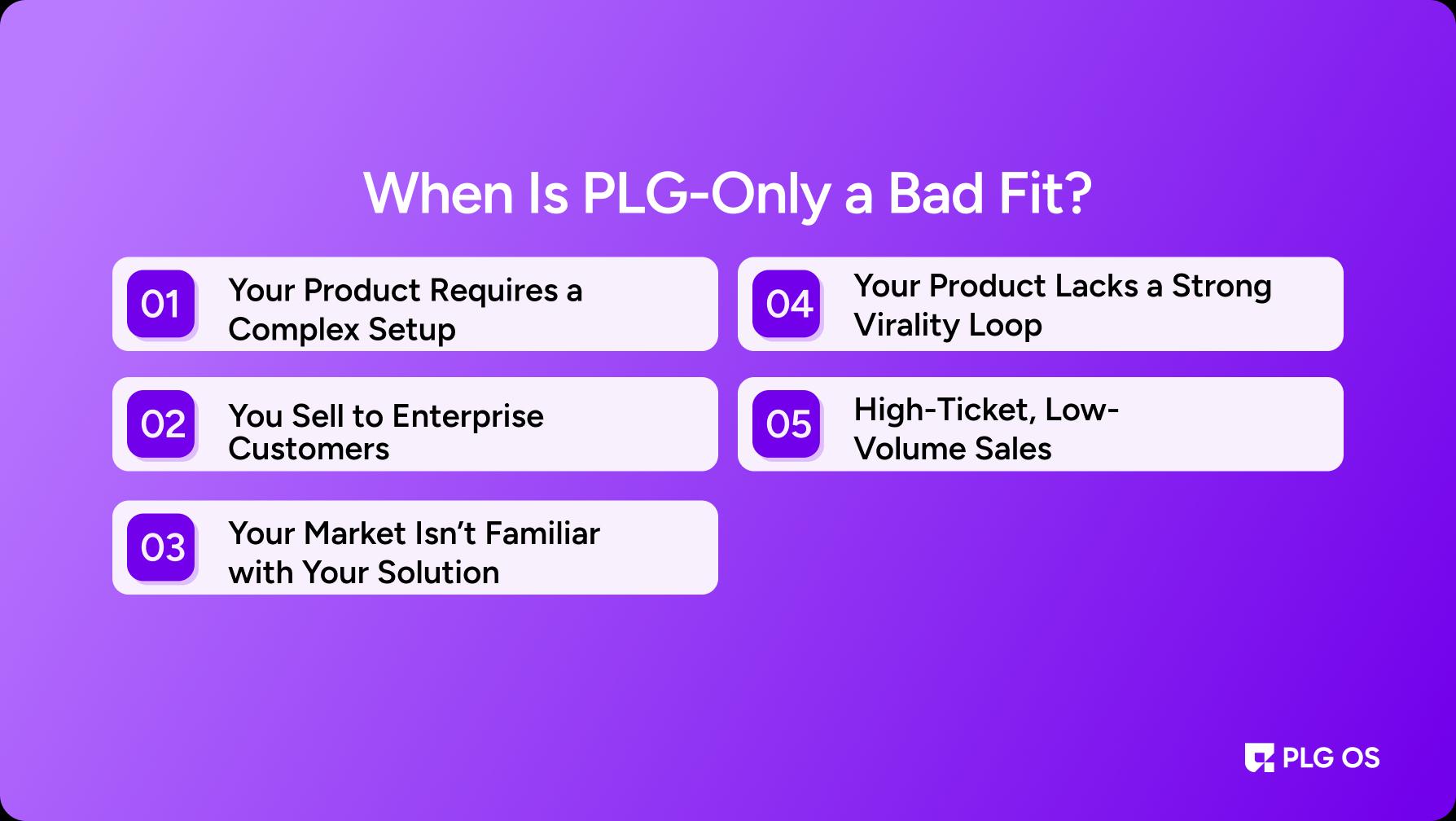
Product-led growth (PLG) is a powerful strategy, but it’s not a one-size-fits-all solution. In some cases, relying solely on PLG can limit growth or fail entirely. Here’s when PLG-only might be a bad fit:
1. Your Product Requires a Complex Setup
If your product needs deep customization, integrations, or onboarding assistance, a self-serve model might not be enough. Enterprise solutions like ERPs, cybersecurity platforms, or AI-driven analytics tools often require sales and customer success teams to guide customers through implementation.
2. You Sell to Enterprise Customers
Large enterprises have strict procurement processes, security requirements, and multiple decision-makers involved. A fully self-serve model won’t cut it. Even if your product has a PLG motion, layering in a sales-assisted approach (sales-led growth or SLG) is often necessary to close enterprise deals.
3. Your Market Isn’t Familiar with Your Solution
If your product category is new or disruptive, customers may not immediately understand its value. In such cases, an education-heavy approach through webinars, demos, or direct sales can be more effective than expecting users to figure it out on their own.
4. Your Product Lacks a Strong Virality Loop
PLG thrives on organic adoption, referrals, and network effects. If your product isn’t inherently collaborative or doesn’t create viral loops (like Slack or Zoom), it may struggle to gain traction without outbound marketing or sales.
5. High-Ticket, Low-Volume Sales
If your pricing is in the tens or hundreds of thousands of dollars, expecting users to self-serve and make a purchase without human interaction is unrealistic. Complex B2B deals often require relationship-building, negotiations, and trust.
5 Signs You’re Doing PLG Wrong (Tips to Fix It)
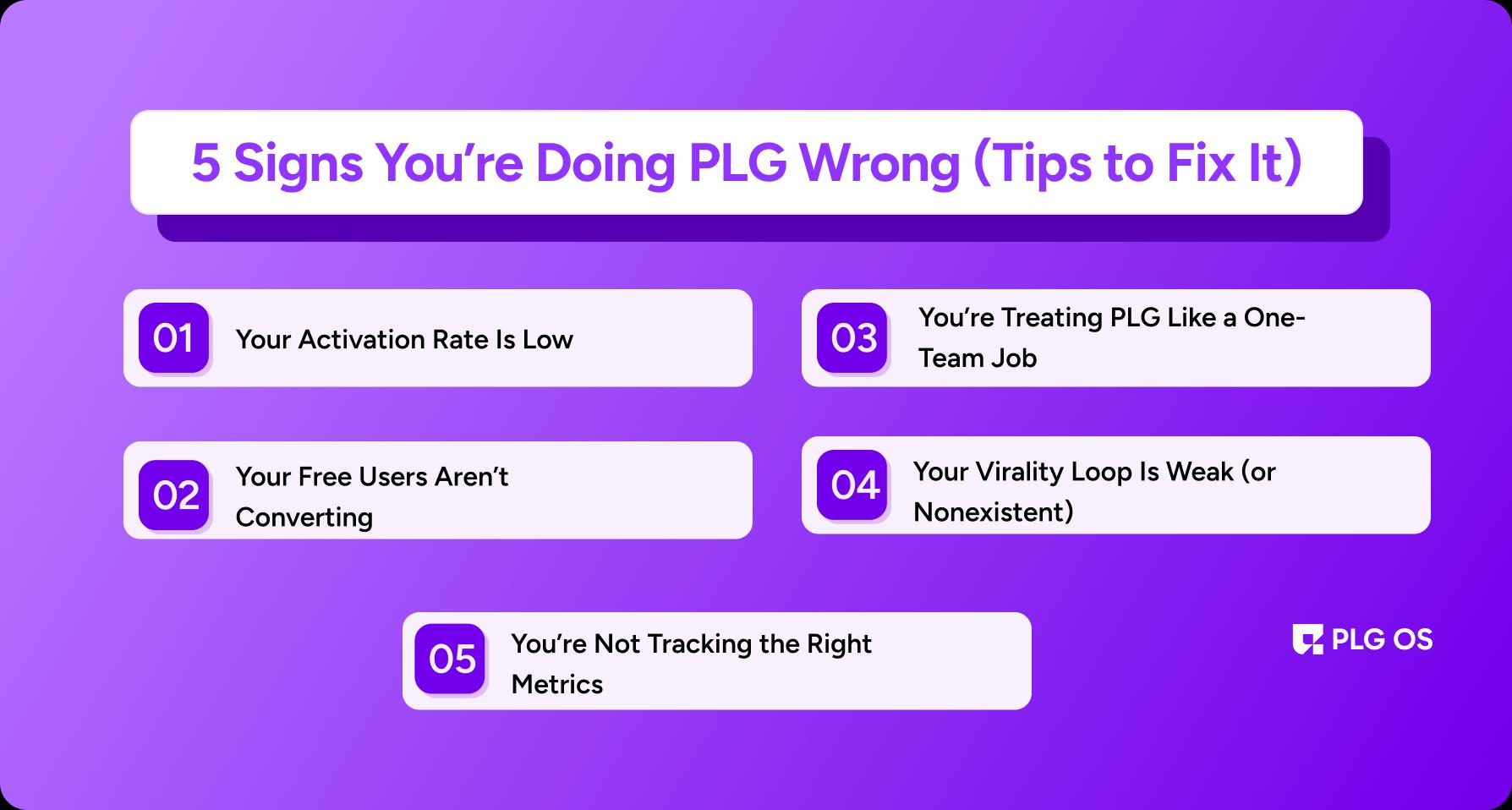
1. Your Activation Rate Is Low
The Problem:
You’re attracting users, but they aren’t sticking around. They sign up, poke around for a bit, and leave without experiencing that "aha!" moment.
This usually means one of two things:
Your onboarding is ineffective:
Users don’t understand your product’s value quickly enough.
Your activation metric is unclear:
you aren’t sure what action indicates a truly engaged user.
How to Fix It:
Define a clear activation moment:
What’s the first action a user should take to experience real value? Identify your product’s key activation point and optimize for it.
Reduce time-to-value (TTV):
Streamline onboarding with interactive walkthroughs, tooltips, or guided product tours. Make sure users get to that activation point as quickly as possible.
Personalize onboarding:
Use in-app prompts, AI-driven recommendations, or segmented onboarding based on user intent to ensure a frictionless start.
Eliminate unnecessary friction:
Don’t ask for a credit card upfront if it’s not essential. Reduce form fields. Simplify the first experience.
2. Your Free Users Aren’t Converting
The Problem:
You have plenty of free users, but they aren’t upgrading. They either remain on your freemium plan indefinitely or churn before ever considering a paid plan.
Common reasons include:
Your free plan is too generous:
Users don’t see a need to upgrade.
Your paid plans lack a compelling reason to upgrade:
They don’t feel like they’re missing out.
Your conversion paths aren’t optimized:
Users don’t know what they’re missing out on, or they aren’t nudged in the right way.
How to Fix It:
Introduce natural upgrade triggers:
If your free users are highly engaged, but conversion rates are low, identify key features that create value and make them part of the paid plan.
Use well-timed nudges:
Instead of bombarding users with generic “Upgrade Now” messages, use behavioral triggers. Example: If a free user tries to access a premium feature, show them the benefits of upgrading.
Ensure pricing aligns with value:
If users don’t see enough differentiation between free and paid tiers, consider restructuring your pricing model.
Experiment with free trial strategies:
Instead of an open-ended freemium model, offer a time-limited free trial of premium features to show their value upfront.
3. You’re Treating PLG Like a One-Team Job
The Problem:
Your PLG strategy lives in a silo. Maybe it’s just a marketing initiative, or it’s owned by product management, while sales and customer success remain out of the loop. That’s a massive mistake. PLG isn’t a one-team show; it requires alignment across the entire company. For example: Tools like PLG OS can help your team with PLG queries.
How to Fix It:
Break down silos:
PLG isn’t just a product team’s responsibility. Sales, marketing, support, and customer success all play critical roles.
Implement a hybrid sales-assisted PLG model:
Some users will always need a nudge from sales to upgrade. Don’t be afraid to add human touch points when necessary.
Align your teams around product-qualified leads (PQLs):
PQLs are users who have already engaged with your product meaningfully. Train your sales team to follow up on these leads instead of cold prospects.
Use data to create a feedback loop:
Track in-product behavior and share insights across teams to continuously improve user experience.
4. Your Virality Loop Is Weak (or Nonexistent)
The Problem:
PLG success stories (like Slack, Zoom, and Notion) all have one thing in common: virality. Their products are designed for network effects, meaning every new user brings in more users. If your product isn’t spreading organically, you’re missing out on a major growth lever.
How to Fix It:
Make sharing effortless:
If your product thrives on collaboration, ensure users can invite teammates in just a few clicks.
Incentivize referrals:
Offer users discounts, credits, or extra features in exchange for inviting others.
Turn usage into a marketing channel:
If users are interacting with your product, leverage that visibility. Think about how Notion and Figma allow users to share templates publicly, driving new signups.
Optimize for word-of-mouth:
If your product is truly delivering value, happy users will talk about it. Make it easy for them to spread the word with shareable content, badges, or branded templates.
5. You’re Not Tracking the Right Metrics
The Problem:
You might be focused on vanity metrics like total signups or website traffic, but those don’t necessarily translate to growth. PLG success is built on engagement, retention, and expansion not just acquisition.
How to Fix It:
Track the right KPIs:
Some key PLG metrics include:
⚪Activation rate (percentage of users who reach a key milestone)⚪PQL conversion rate (how many product-qualified leads become paying customers)⚪Expansion revenue (growth from upsells and cross-sells)⚪Net revenue retention (NRR)(how much revenue you retain after churn and upsells)Monitor user behavior:
Use product analytics tools like Amplitude, Mixpanel, or Heap to understand how users interact with your product.
Experiment and iterate:
PLG is an ongoing process. A/B test different onboarding flows , pricing structures, and conversion triggers to optimize your strategy continuously.
Final Thoughts
PLG isn’t just a trend, it's a strategic approach that, when executed well, turns your product into your best salesperson. But it’s not as simple as offering a free trial and waiting for users to convert.
If you’re struggling with PLG, it’s likely due to low activation rates, poor conversion from free to paid, lack of team alignment, weak virality loops, or focusing on the wrong metrics.
By addressing these five common pitfalls, you’ll build a stronger PLG motion that drives sustainable, organic growth. Start by optimizing onboarding, refining your conversion strategy, aligning your teams, boosting virality, and tracking the right metrics.
Looking to unlock the full potential of your product-led growth (PLG)? PLG OS by Questera is your all-in-one solution! It helps you seamlessly manage and scale your PLG strategy with intuitive tools to boost customer acquisition, drive engagement, and optimize conversions. Whether you're tracking user behavior, refining onboarding, or enhancing product adoption, PLG OS takes the guesswork out of growth.
Ready to supercharge your PLG journey? Book your call now and watch your growth soar!
FAQs
1. What is PLG?
Product-Led Growth (PLG) is a strategy where the product itself drives user acquisition, activation, and retention. The focus is on offering a seamless experience that encourages users to adopt, engage with, and eventually pay for the product on their own.
2. What are the main benefits of PLG?
PLG offers lower customer acquisition costs, faster growth through organic referrals, and higher product engagement. It can also reduce reliance on traditional sales teams and accelerate time-to-value for users.
3. When should I consider a PLG approach?
PLG is ideal when your product is intuitive, easy to adopt, and delivers value quickly. It works best for SaaS products with a freemium model, free trials, or self-service capabilities that can scale efficiently.
4. Can PLG work for enterprise solutions?
PLG can work for enterprise solutions, but it may require a hybrid approach. Enterprise products often need a sales team to handle complex setups, negotiations, and customization, so a combination of PLG and sales-led strategies may be necessary.
5. What metrics should I track for PLG success?
Key PLG metrics include activation rates, conversion from free to paid users, user retention, and product-qualified leads (PQLs). Monitoring these will help assess whether your product is driving growth effectively.