10 Elements of a Perfect Product-Led Onboarding Flow
In SaaS, the way you welcome and guide new users can determine whether they become loyal customers or leave before they’ve experienced the product’s true value. That’s where product-led onboarding comes in. Unlike traditional onboarding, which often relies on manuals, webinars, or customer success teams, product-led onboarding puts the product itself at the center of the experience.
Through interactive tours, contextual prompts, and tailored flows, users learn by doing and discover value on their own. The result? Faster adoption, reduced churn, and stronger customer satisfaction. A well-crafted SaaS onboarding flow doesn’t just introduce features; it guides users toward meaningful outcomes that align with their goals. Let us find out the 10 essential elements of a perfect product-led onboarding flow, to transform your onboarding into a growth engine.
What is Product-Led Onboarding Flow?
A Product-Led Onboarding Flow is the structured, step-by-step experience a user goes through when first interacting with a product designed specifically to help them experience the product’s value as quickly and intuitively as possible. Unlike traditional onboarding, which may rely heavily on sales reps or external tutorials, product-led onboarding is built into the product itself and aims to drive adoption through the user’s actual experience. Product-led companies are growing 2x faster than their sales-led counterparts.
Let’s break it down:
Key Characteristics of a Product-Led Onboarding Flow
- User-Centri: The flow is designed around the user’s goals and needs, not just the product’s features.
- Experience-Based Learning: Users learn by doing, not by reading manuals or watching videos. Interactive guides, tooltips, and first-use actions teach the product in context.
- Quick Time-to-Value (TTV): The onboarding guides the user to their “aha moment,” the first meaningful success with the product, usually within the first session.
- Segmentation and Personalization: Different users may have different goals. Product-led onboarding often includes branching flows to tailor the experience to specific user types or roles.
- Data-Driven Iteration: Metrics such as feature adoption, task completion, and churn are tracked to continuously optimize the flow.
Benefits of Product-Led Onboarding
- Faster Time-to-Value (TTV): Guides users to their “aha moment” quickly, boosting retention and conversions.
- Higher User Engagement: Interactive tutorials and in-app prompts encourage hands-on learning and feature adoption.
- Personalized Experiences: Segmented onboarding flows tailored to roles or goals reduce friction and improve adoption.
- Scalable Growth: The product itself drives adoption, reducing dependency on sales or manual onboarding.
- Better Adoption Metrics: Analytics track feature usage and onboarding progression, enabling data-driven improvements.
- Supports Product-Led Growth (PLG): Users experience value independently, naturally expanding usage and referrals.
- Continuous Iteration: Feedback and analytics allow constant optimization of the onboarding flow.
10 Elements of a Good Product-Led Growth Onboarding Flow
1. Crystal-Clear Value Proposition
A strong value proposition is the foundation of any product-led growth onboarding strategy. Users need to immediately grasp why your product matters and what problem it solves. 80% of users say they’ve deleted an app because they didn’t know how to use it.
- Key Elements of a Value Proposition:
- Clear explanation of benefits
- Differentiation from competitors
- Simple language with no jargon
Why It Matters: Users often decide whether to continue onboarding within the first few minutes. If your value isn’t clear, adoption drops.
Practical Tip: Use a compelling headline and subheadline that addresses the user’s pain point. For example, “Simplify your team collaboration, no manual tracking required.”
2. Segmented User Onboarding
Not every user comes to your SaaS product with the same background or needs. Segmentation is key for a user onboarding process for SaaS that feels tailored and relevant. 63% of customers consider onboardingas a key factor in deciding whether to purchase a product.
- Methods of Segmentation:
- Role-based: Admin, marketer, developer
- Goal-based: Short-term vs. long-term use cases
- Experience level: Beginner vs. advanced
Why Segmentation Matters: Personalized onboarding increases activation rates by presenting relevant features and skipping unnecessary steps.
PLG OS Integration: With PLG OS, you can design multiple onboarding paths for each segment. For example, a marketer might see automation features first, while a developer sees integrations. This targeted approach drives faster adoption.
3. Interactive Product Tours
Traditional tutorials are often ignored. Product-led onboarding best practices emphasize interactivity. Users learn better when they perform actions themselves rather than passively reading instructions.
- How to Implement Interactive Tours:
- Highlight core features with step-by-step walkthroughs
- Encourage users to complete small actions immediately
- Provide tooltips or contextual hints without overwhelming the screen
Example: A CRM SaaS could guide users to create their first contact and send a test email, demonstrating immediate value.
PLG OS Advantage: PLG OS enables dynamic in-app guidance that adapts based on user behavior. Users see only relevant steps, reducing friction and increasing completion rates.
4. Quick “Time-to-Value”
Time-to-value (TTV) is the single most important metric in onboarding. It measures how quickly users achieve their first meaningful success.
- Steps to Reduce TTV:
- Identify the “aha moment” in your product
- Guide users to this outcome in the first 5–10 minutes
- Remove unnecessary steps or friction points
Why It Works: Users who experience immediate value are more likely to stay engaged and convert into paying customers
PLG OS Application: Track user progress toward the first win and send real-time nudges or reminders when they stall. For example, if a user hasn’t added a necessary data source, trigger a tooltip with guidance.
5. Contextual In-App Messaging
Emails and notifications are useful, but nothing beats timely in-app messaging. Contextual guidance helps users when they need it, rather than bombarding them with generic emails.
- Best Practices for In-App Messaging:
- Trigger messages based on user actions or inactivity
- Avoid interrupting the user flow
- Provide clear, actionable instructions
Example: If a user opens a dashboard for the first time but hasn’t created a report, a subtle prompt could guide them through it.
PLG OS Advantage: PLG OS automates in-app messages based on behavior, ensuring users receive the right information at the right time, boosting completion and adoption.
6. Gamification and Progress Tracking
Gamification isn’t just fun it’s a powerful motivator. Visual progress tracking, badges, and milestone celebrations enhance engagement in a SaaS product onboarding flow.
- Gamification Strategies:
- Completion bars for onboarding steps
- Reward badges for achieving tasks
- Celebrations for reaching milestones
Why It Works: Psychological motivation plays a significant role in adoption. Seeing progress makes users more likely to complete the onboarding journey.
7. Social Proof and Validation
Social proof builds trust. Highlighting testimonials, case studies, or adoption statistics reassures users and reduces hesitation during onboarding.
- Implementation Examples:
- Display quotes from satisfied users
- Show real-time usage statistics
- Highlight company logos of well-known customers
PLG OS Advantage: Test the placement, timing, and format of social proof to determine what resonates most during onboarding. For instance, a testimonial can be triggered after a user completes a key task to reinforce value.
8. Feedback Loops and Surveys
A user onboarding process for SaaS should be iterative. Collecting feedback early helps identify friction points, confusion, or unmet needs.
- Feedback Methods:
- Micro-surveys within the app
- One-click rating prompts
- In-app feedback buttons
Why It Matters: Immediate feedback enables rapid iteration, reducing churn and improving the user experience.
PLG OS Integration: Embed surveys and feedback forms into your flow, triggering them based on specific actions or inactivity, and use the data to adjust onboarding dynamically.
9. Proactive Support and Resources
Even in a product-led model, users may need help. Integrating proactive support ensures users don’t abandon onboarding due to confusion or frustration.
- Support Options:
- In-app help buttons
- Embedded tutorials or videos
- Live chat or AI-driven support
10. Iteration and Optimization
Onboarding is not a one-time effort. Continuous testing and optimization are crucial to maintain engagement and retention in a SaaS onboarding flow.
- Key Metrics to Track:
- Feature adoption rate
- Task completion rate
- Churn rate during onboarding
- Time-to-value
PLG OS Advantage: Run experiments on every onboarding touchpoint, analyze results, and iterate quickly. For example, if a tooltip is ignored, test a different placement or wording to improve engagement.
Advanced Strategies to Enhance Product-Led Onboarding
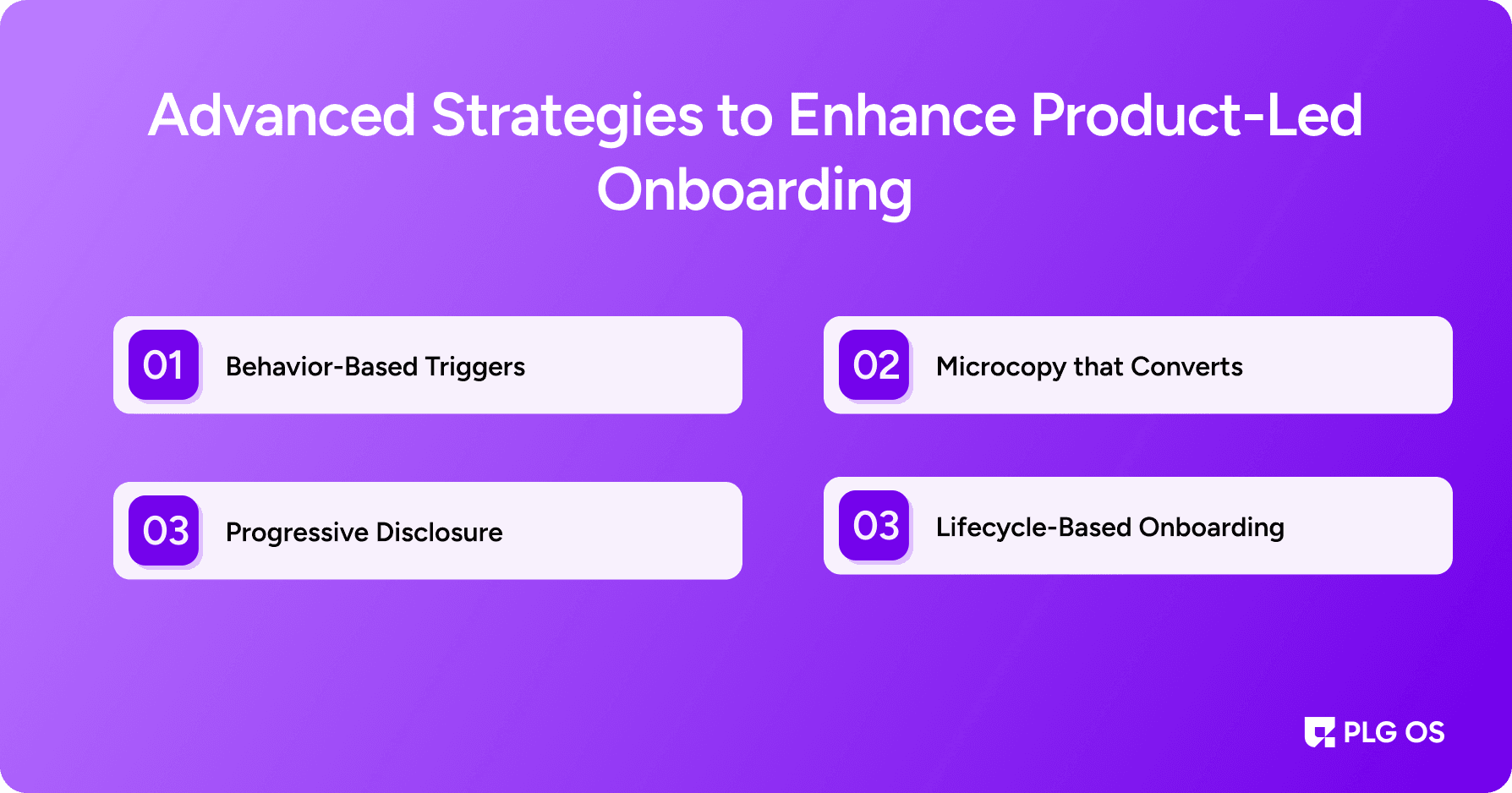
1. Behavior-Based Triggers: Deliver content and guidance based on specific user actions.
2. Progressive Disclosure: Introduce features gradually to prevent overwhelm.
3. Microcopy that Converts: Small bits of instructional text can significantly improve user understanding and confidence.
4. Lifecycle-Based Onboarding: Extend onboarding beyond first login guide users to new features as they become relevant.
How PLG OS Transforms Product-Led Onboarding
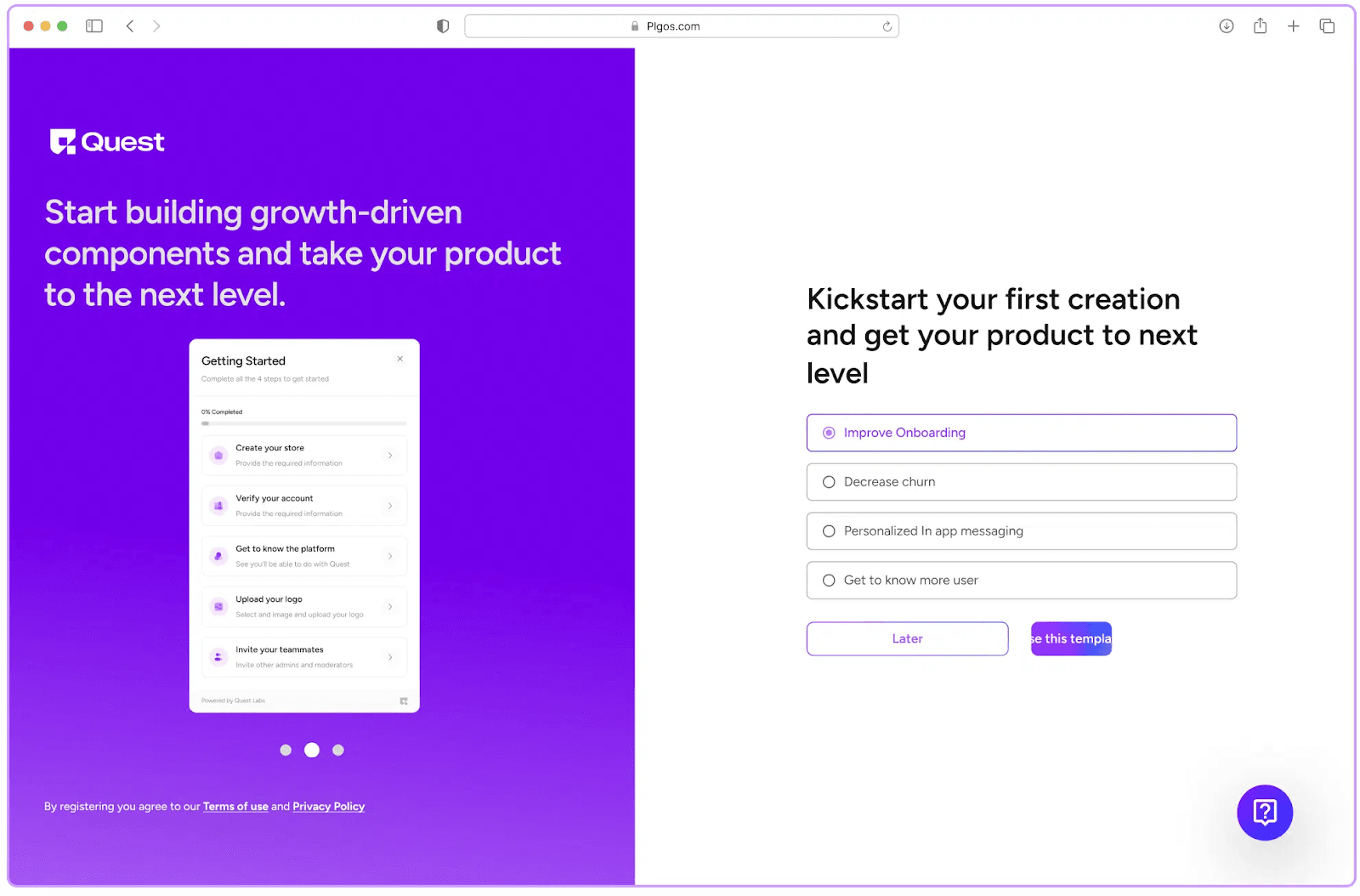
PLG OS isn’t just a tool it’s a complete framework for creating, analyzing, and optimizing product-led growth onboarding strategies. It allows you to:
- Segment users and personalize onboarding paths
- Create interactive tours and in-app guidance
- Automate messaging based on behavior
- Collect feedback and iterate rapidly
- Track metrics and optimize flows dynamically
By integrating PLG OS into your onboarding workflow, you can reduce churn, increase activation, and accelerate user adoption.
Key Takeaways
The perfect user onboarding process for SaaS isn’t about flashy gimmicks. It’s about delivering value, personalizing experiences, guiding users interactively, and continuously iterating.
- Start with a crystal-clear value proposition
- Segment users for tailored onboarding
- Enable interactive learning and rapid time-to-value
- Use contextual guidance, gamification, and social proof
- Collect feedback and provide proactive support
- Iterate constantly for maximum impact
With PLG OS, you can build a SaaS product onboarding flow that drives long-term retention, increases user engagement, and fuels sustainable product-led growth.
Conclusion
A successful product-led onboarding flow isn’t about overwhelming users with tutorials or sales-driven interactions, it’s about delivering value, fast. By focusing on personalization, interactive guidance, and data-driven optimization, SaaS companies can turn first-time users into long-term advocates.
Each element, from segmentation to progress tracking, contributes to a seamless experience that keeps users engaged and reduces churn. With the right approach, onboarding becomes more than just a first step; it becomes a powerful growth lever. By leveraging tools like PLG OS, you can build onboarding experiences that scale, delight users, and fuel sustainable product-led growth.
FAQs
1. What is product-led onboarding?
Product-led onboarding is an approach where the product itself guides users through setup, education, and feature adoption, helping them experience value quickly without heavy reliance on sales or support teams.
2. Why is product-led onboarding important for SaaS?
It reduces churn, accelerates time-to-value, and increases user engagement by letting customers learn through hands-on experiences inside the product.
3. How does product-led onboarding support product-led growth (PLG)?
By delivering value directly through the product, users are more likely to convert, expand their usage, and advocate for the tool—fueling organic, scalable growth.
4. What’s the difference between product-led and traditional onboarding?
Traditional onboarding relies on external resources like demos or manuals, while product-led onboarding embeds the learning process within the product itself.
5. What tools can improve product-led onboarding flows?
Platforms like PLG OS help SaaS teams design personalized flows, add in-app guidance, collect feedback, and optimize onboarding based on user behavior.