5 Critical Reasons to Quantify Your User Engagement

If you're building digital products, services, or content, you’ve probably heard the phrase “user engagement” thrown around a lot. But here’s the real question: are you measuring it? Or are you guessing based on surface-level metrics like page views or follower counts?
Quantifying user engagement is the key to understanding what’s working, what’s not, and what’s keeping your audience hooked. It’s the difference between creating content or products that resonate and fizzle unnoticed.
Let’s dive into five solid reasons why tracking and analyzing user engagement should be at the top of your priority list.
What is user engagement?
User engagement, also known as product engagement, tracks how activelycustomers engage with a product over some time. Businesses rely heavily on user engagement as a statistic to learn about user behavior and evaluate the long-term value of a product. 86% of customers are open to paying more for a great customer experience.
It is engaging when people are actively involved with and benefit from the media they consume, such as television shows or novels. Measuring how engaged a SaaS user is follows the same logic. A customer's experience with your product should be positive from signing up until they decide to cancel. Tools like PLG OS can help you with your user engagement journey today.
Why is it critical to understand your user engagement?
A new customer will start using your service soon after they sign up. Assuming they keep using the product, they must get something out of it. But if they don't utilize the product, it's safe to assume they didn't think it was worthwhile. Customers that don't value your goods will eventually quit buying them; thus, this is bad. Your product's health can be best gauged by the frequency with which your users engage with it.
In addition to increasing revenue, actively participating users are more likely to offer suggestions for improving the service for everyone. Some more perks you may get from digging deeper into your user engagement data are:
- Organizing sales initiatives
- Boosting methods of reaching target audiences
- Making improvements to your advertising and target demographic
- Foreseeing and organizing one's future
- Raising client retention rates
5 reasons You Should be Quantifying User Engagement
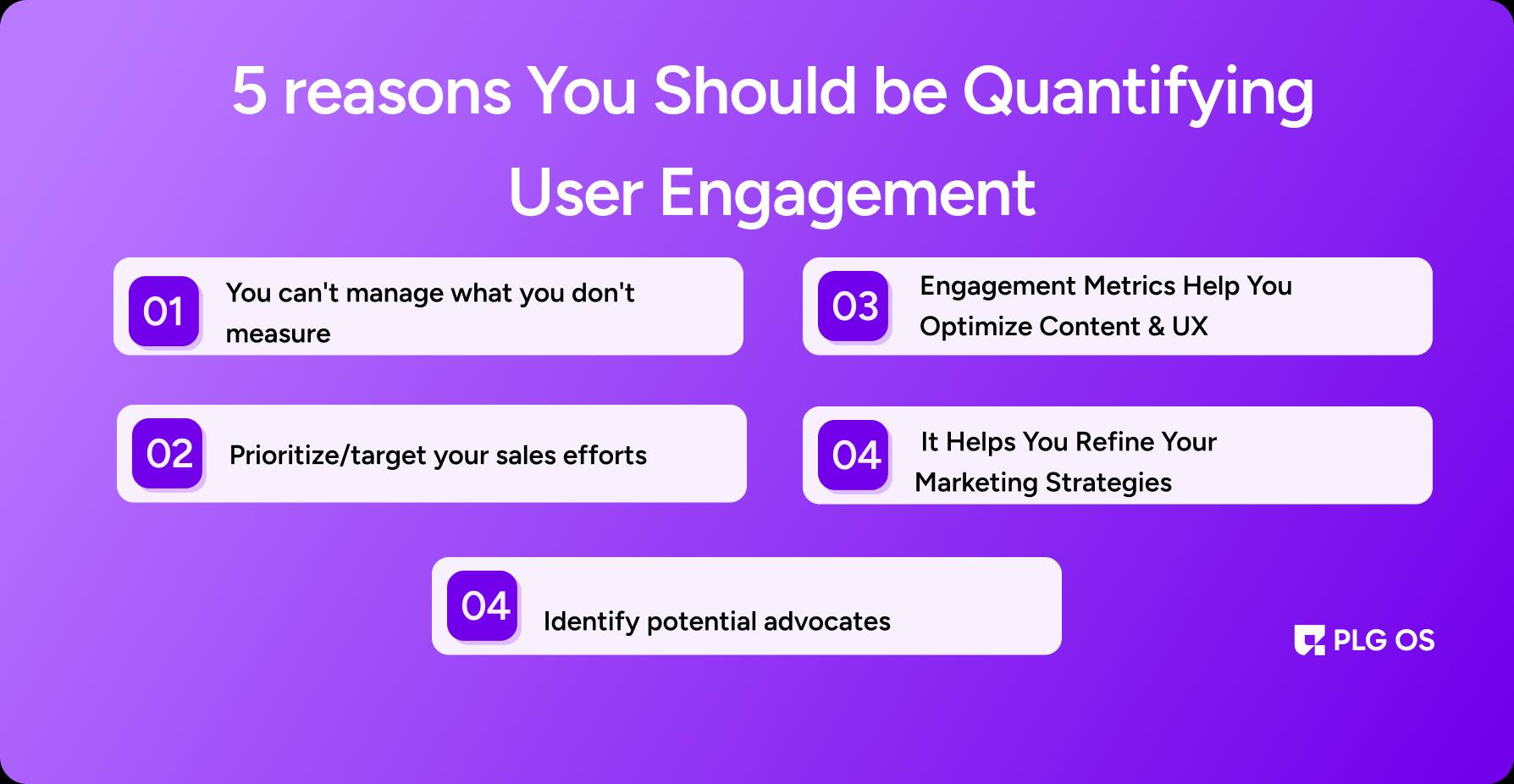
Reason 1: You can't manage what you don't measure
You should be able to handle user interaction if it's crucial to your SaaS business. 89% of businesses said they prioritize acquiring new customers as a growth strategy. You would want to see it rise. However, without measurement, how can you tell if it is increasing? Without a means of measurement, how can you tell if your efforts are paying off?
Reason 2: Prioritize/target your sales efforts
Is there a way to try out your product before you buy it? Has a sales force been assembled?
If you're a salesperson, I assume you want to target the free/trial accounts with the highest conversion rates to paid accounts. Accounts with the highest level of product engagement are the ones most likely to make a purchase.
Although it may seem apparent, a large number of SaaS businesses still randomly assign SDRs to all new clients, meaning they have an excessive demand for SDRs. In other words, they all have low conversion rates and a lot of burn. Board meetings that were unpleasant followed. Next, a large downward spiral. A "departure" from the founder and a fire sale. Interesting things.
A sales team's time and energy are best spent when they are not wasted. There is no better way to qualify potential paid conversions for a freemium or trial offering than to target the accounts actively using the product. Product Qualified Leads (PQLs) are a new approach that savvy SaaS organizations are qualifying leads for their sales staff. They are built on top of product engagement.
Reason 3: Engagement Metrics Help You Optimize Content & UX
Ever wondered why some content pieces or website pages perform better than others? The answer lies in engagement metrics.
By analyzing user behavior, scroll depth, click-through rates, heatmaps, and session duration, you can understand which aspects of your content or interface are working and which need improvement.
For example, if users consistently drop off after reading just a few sentences of your blog posts, it might mean your introductions need to be more compelling. If users abandon their shopping carts before checkout, there could be friction in the buying process.
Quantifying engagement helps you tweak and refine every detail of your user experience, ensuring that visitors stay longer, interact more, and ultimately convert.
Reason 4: It Helps You Refine Your Marketing Strategies
Ever spent money on an ad campaign only to get underwhelming results? Without engagement data, you might not even know why it failed. On average, the bounce rate for most websites can range between 25% to 70%.
Measuring user engagement gives you a clear understanding of what marketing tactics are actually working.
For example:
- Are people clicking on your ads but not converting? Your landing page might need optimization.
- Is your email campaign getting opened but no clicks? Your call-to-action might need tweaking.
- Are social media posts getting high engagement but not driving traffic to your site? You might need stronger links or better messaging.
By quantifying engagement, you can stop wasting money on strategies that don’t work and double down on the ones that do.
Reason 5: Identify potential advocates
For any SaaS company, building evangelists is crucial. Not only do advocates generate referrals, but they may also be an invaluable resource for product reviews, ideas, and case studies.
What about your most promising advocates? Users who are actively involved, of course. Finding these possible champions quickly and consistently is possible with the use of engagement metrics.
Regardless of industry, advocates are a goldmine of resources. Get a score on engagement to make finding them a breeze.
Seeking out folks who are similar to your present outstanding users is the surest approach to discover even more of them. You may feed Facebook Lookalike audiences with your most engaged users and attract fantastic users to your sales funnel. If you see that some customers are really enjoying your product, then you should definitely make more of it!
Important engagement metrics to track
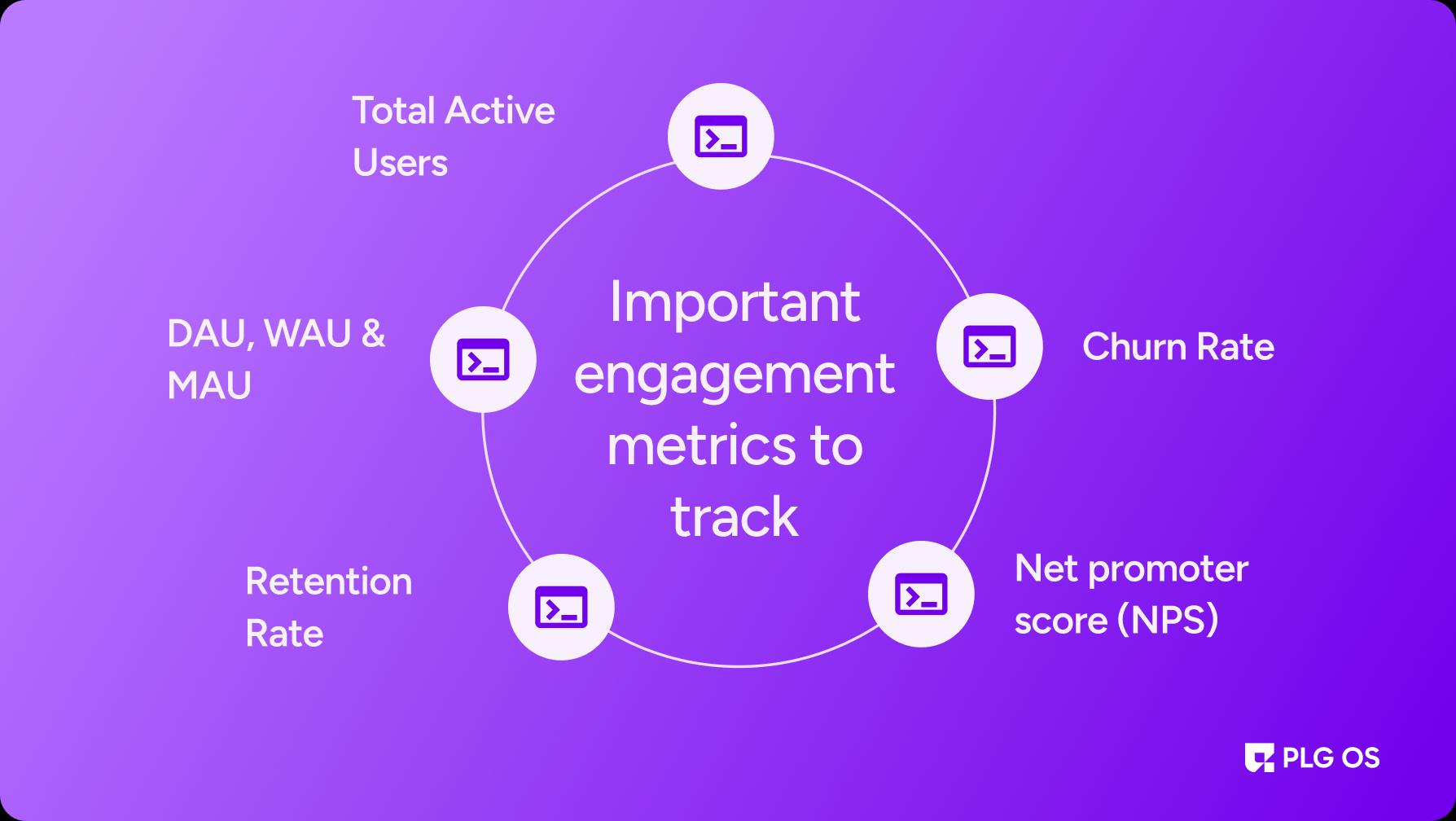
Measuring user engagement isn't possible without monitoring the other variables that go into determining it. If you want to know how engaged a cohort is during a certain time period, you should keep tabs on two metrics: the percentage of active users divided by the total number of users in that cohort. Having said that, a handful of additional measures warrant monitoring. We can examine a few of them.
Total Active Users
Determining what constitutes an active user is the first step in measuring them. Make sure the statistic you use is directly related to how engaged your users are. Each product is different, but there should be a minimum of activity to demonstrate that people engage with your offering.
DAU, WAU & MAU
User engagement is measured by tracking their actions over a specific timeframe. To better understand trends, it's helpful to monitor interaction throughout all three time periods: daily, weekly, and monthly.
Churn Rate
A high churn rate indicates that users aren't interested in what you have to offer. Consider comparing churn rates to engagement rates to enhance the utility of this measure. You can use this information to identify clients who are likely to churn and set an engagement goal for them.
Retention Rate
The inverse of churn, retention rate, can be applied in a similar fashion. How involved are the most loyal consumers, and how can you get the rest of your users to be as involved?
Net promoter score (NPS)
Finding out how much value your product is providing to users is the end goal of user engagement metrics. One other piece of this puzzle is thenet promoter score. Raising this indicator should also boost your engagement.
Conclusion
The digital landscape is more competitive than ever. Businesses that succeed are the ones that understand their users deeply—not just who they are, but how they interact, what they love, and what keeps them coming back.
Quantifying user engagement isn’t just a “nice-to-have.” It’s a necessity. It helps you:
✔ Make data-driven decisions
✔ Optimize content and UX
✔ Boost retention and revenue
✔ Predict and prevent churn
✔ Fine-tune marketing strategies
✔ Deliver personalized experiences
✔ Impress investors and stakeholders
If you’re not tracking engagement, start today. Because in a world where attention is the most valuable currency, the businesses that measure it are the ones that win. Book a call with us today to start your engagement journey.
FAQs
1. What are the key metrics for measuring user engagement?
Some essential engagement metrics include time spent on site, bounce rate, click-through rate (CTR), session duration, daily/weekly/monthly active users (DAU/WAU/MAU), and retention rate.
2. Why is user engagement more important than just tracking traffic?
Traffic tells you how many people are visiting, but engagement tells you if they’re actually interested. High engagement means users find value in your content or product, which leads to better retention and conversions.
3. How can I improve user engagement?
Optimizing content, improving user experience (UX), personalizing interactions, using interactive elements, and leveraging data analytics to refine strategies are some proven ways to boost engagement.
4. What tools can help measure user engagement?
Popular tools include Google Analytics, Hotjar, Mixpanel, Amplitude, HubSpot, and social media insights from platforms like Instagram, LinkedIn, and Facebook.
5. Can high engagement directly impact revenue?
Yes! Engaged users are more likely to convert, make purchases, subscribe, or become loyal customers, leading to higher revenue and business growth.