8 Customer SaaS Analytics Use Cases
Think your SaaS product is flying high because your signups look good? Think again. Customer growth is not just about bringing people in the door it’s about knowing who they are, what they do, and why they stay or leave. That’s where customer analytics for SaaS enters the room like a spotlight operator in a dark theater: it shows you exactly where to focus. Let's delve into the eight unconventional customer SaaS analytics use cases that can revolutionize your growth from a haphazard approach to a precise one.
What Is Customer Analytics for SaaS?
Customer analytics is the practice of using data to understand customer behavior, preferences, and journey, particularly within your SaaS product. Think of it as a GPS for product-led growth. You get to track, analyze, and optimize every interaction customers have with your product.
From churn prediction to feature adoption tracking, the insights extracted are no longer "nice to have." They’re mission-critical for survival in today’s hyper-competitive SaaS landscape.
From churn prediction to feature adoption tracking, the insights extracted are no longer "nice to have." They’re mission-critical for survival in today’s hyper-competitive SaaS landscape.
Why Customer Analytics Matters More Than Ever in SaaS
1. SaaS Is No Longer Sales-Led It's Product-Led
The SaaS industry has shifted from Sales-Led Growth (SLG) to Product-Led Growth (PLG), where your product is the primary driver of acquisition, activation, retention, and revenue. This shift demands a new operating model one that’s rooted in user behavior and experience. Companies that use customer behavior data outperform peers by 85% in sales growth.
In a PLG world:
- Users sign up before talking to sales.
- Onboarding happens inside the product.
- Expansion comes from usage, not negotiation.
To optimize this, you need granular customer analytics that reveal:
- Which features users love
- Where they get stuck
- What drives long-term retention
That’s not something a CRM or Google Analytics can show you. It requires purpose-built tools like PLG OS that focus on behavior-first analytics tied to growth loops.
2. Churn Is Silent, Sneaky, and Expensive
One of the biggest silent killers in SaaS is churn. Customers don’t always cancel with a bang they fade away quietly.
And here’s the brutal truth:
- If you're only analyzing churn after it happens, you're too late.
With customer churn prediction in SaaS, you can spot red flags early:
- A drop in feature usage
- Fewer team invites
- Slower session frequency
- Less time spent on high-value pages
Customer retention analytics lets you reverse-engineer what your most loyal users do and where the others fall off. You can then buildexperiments using PLG OS to re-engage, educate, or nudge those users back to value.
3. Every Click Is a Clue Use It Wisely
The beauty of SaaS products is that every interaction is measurable:
- Where users click
- What they ignore
- How they move through onboarding
- When they hit their “aha moment”
But most companies don’t use this goldmine. Or worse, they drown in dashboards without knowing what to do next.
That’s why modern customer analytics tools like PLG OS don’t just track they help you experiment:
- Which onboarding flow drives faster activation?
- What nudge converts free users to paid?
- How does usage correlate to expansion revenue?
It’s not about collecting more data. It’s about connecting it to action. SaaS businesses that improve customer retention by just 5% can increase profits by 25% to 95%.
4. Growth Is No Longer a Department; It's a Culture
In modern SaaS companies, growth is not just owned by marketing or sales. It’s cross-functional:
- Product needs to know what drives stickiness.
- Marketing needs to understand user segments.
- Success needs to track risk before it escalates.
- RevOps needs insights to forecast accurately.
Customer analytics provides a common language that unites all these teams. With tools like PLG OS, you can align on metrics, map shared user journeys, and experiment as one unified growth engine.
No more siloed insights. No more guessing. Just clarity and compounding growth.
5. Vanity Metrics Don’t Pay the Bills
Pageviews, downloads, even signups, they might look good in your investor decks, but they don’t mean your users are successful.
You need value-based metrics, like:
- Time to First Value (TTFV)
- Retention by cohort
- Feature adoption depth
- Expansion MRR per user segment
Customer analytics shifts the focus from “what looks good” to “what performs well.” With a framework like PLG OS, you’re not optimizing for applause you’re optimizing for sustainable revenue.
8 Customer SaaS Analytics Use Case
1. Identifying High-Intent Behavior Early
Why wait for a demo request when your product is already telling you who’s ready?
Forget scoring leads based on form fills. Real SaaS growth comes from identifying product-qualified leads (PQLs) based on how users behave inside the app. 80% of future revenue for a SaaS company comes from just 20% of existing customers.
With SaaS customer data analysis, you can:
- Track feature usage frequency
- Measure time-to-value
- Identify patterns in actions taken
PLG OS helps you map user behavior into activation journeys, showing you which steps lead to aha moments and conversions. Now your sales team knows who to call and when.
Key Metric: Time to First Value (TTFV)
2. Uncovering Invisible Churn Before It Happens
Most users don’t rage-quit. They quietly fade away.
Customer churn prediction in SaaS isn’t about analyzing who left. It’s about predicting who’s going to. And that requires more than basic dashboards.
Using customer retention analytics, you can monitor:
- Drop in usage over time
- Decline in key event triggers
- Decrease in login frequency
Key Metric: Drop in core feature engagement over 7-day rolling average
3. Mapping the Real Customer Journey
Funnels are for marketers. Journeys are for product growth.
Not every user goes from signup to success in a straight line. Some explore. Some bounce. Some come back after a week. With customer analytics in SaaS, you can visualize real user paths and find friction points.
PLG OS allows teams to map these journeys into Growth Loops:
- Acquisition → Activation → Retention → Referral → Revenue
- Each loop is measurable and optimizable
Unlike funnel tools, PLG OS connects user behavior to monetization signals, helping you focus on what drives compounding growth.
Key Metric: Feature Path Drop-off Rate
4. Segmenting Users Based on Outcomes, Not Just Personas
Demographics don’t tell you who’s getting value. Behavior does. 91% of companies with above-average customer analytics capabilities report higher customer satisfaction.
Instead of just segmenting by industry or job title, use SaaS customer insights to group users based on outcomes:
- Who achieved success fastest?
- Who needed the most support?
- Who invited teammates?
With PLG OS, you can run experiments and compare outcomes across segments. This helps build persona→behavior→result maps, which are far more useful than vanity personas.
Key Metric: Outcome-Based Segmentation ROI
5. Discovering Expansion Opportunities Hidden in Usage Patterns
Don’t just land users expand intelligently.
SaaS analytics can show you who’s using which features, but great customer analytics shows you how usage evolves over time.
When you track:
- Seat growth within teams
- Advanced feature adoption
- Collaboration triggers (e.g., shared dashboards)
You unlock natural expansion moments.
PLG OS turns these into Growth Experiments: Trigger upsell prompts based on usage thresholds, not just arbitrary timelines.
Key Metric: Monthly Feature Expansion Index
6. Diagnosing Why Users Aren’t Activating
You don’t have a funnel problem you have a friction problem.
Thousands sign up. A fraction stick around. Why?
Use SaaS customer data analysis to answer:
- Where are users dropping off during onboarding?
- Are they confused at a specific screen or step?
- Is documentation or UI failing?
PLG OS helps correlate friction points with activation drop-offs and lets you A/B test in-product changes, messages, and flows that reduce confusion and boost activation.
Key Metric: Step-to-Step Activation Drop Rate
7. Turning Passive Users Into Product Champions
Engagement ≠ Evangelism. Make it easy for users to talk about you.
You can have thousands of daily active users (DAUs) and still no one talks about your product.
Customer analytics helps identify:
- Users who create content inside your app
- Users who share externally (invites, exports, integrations)
- Users with high Net Promoter Score (NPS)
PLG OS lets you activate these users into referral programs, affiliate loops, or community builders. You’re not just driving usage you’re multiplying it.
Key Metric: Referral-Ready User Activation Rate
8. Powering Product-Led Revenue Forecasting
Can you forecast revenue based on product behavior? Yes, and you should.
Gone are the days of forecasting based only on sales pipelines. With modern customer analytics for SaaS, you can forecast revenue by:
- Cohort-based activation rates
- Expansion probability scores
- Churn risk multipliers
PLG OS combines these signals to help teams plan bottom-up revenue modeling, where growth is led by users, not sales quotas.
Key Metric: Behavior-Based Revenue Forecast Accuracy
PLG OS as a SaaS Analytics Tool
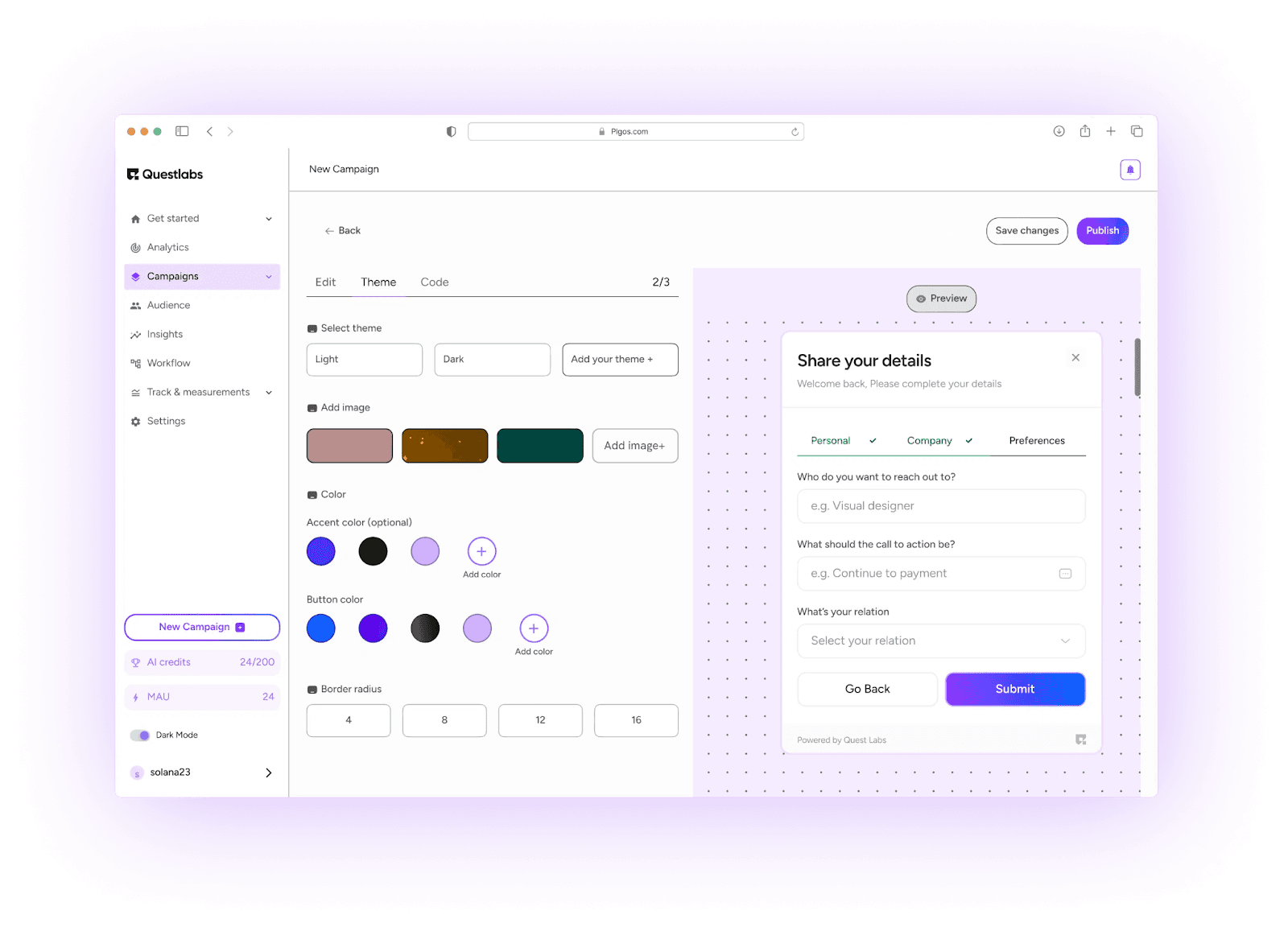
Let’s be honest. Most analytics tools drown you in charts. They show you what’s happening but not what to do about it.
PLG OS flips the model.
It’s not just a reporting tool it’s a Product-Led Growth Operating System. It connects:
- SaaS customer data analysis
- Experimentation systems
- Growth loops
- User segmentation
- Monetization pathways
With PLG OS, your team can run experiments, not guesswork. And that’s the future of SaaS customer analytics.
Must-Track KPIs for Customer Analytics in SaaS
When starting your analytics engine, please ensure you are tracking meaningful metrics. Here's a quick checklist:
| Metric | Why It Matters |
|---|---|
| Time to First Value (TTFV) | Shows how fast users realize product value |
| Activation Rate | Core indicator of user onboarding health |
| Retention Curve | Determines long-term user stickiness |
| Expansion MRR | Revenue from upsells, key for PLG |
| Net Revenue Retention (NRR) | Captures growth from existing customers |
| Churn Probability | Predictive indicator to flag at-risk users |
| Feature Adoption Depth | Reveals real product engagement |
| Referral Rate | Measures viral growth potential |
These KPIs help you move from vanity metrics (like pageviews) to value metrics that actually move the business.
Gut instinct? That worked in the early SaaS days. But today, the fastest-growing SaaS companies win because they know their users inside out. They experiment relentlessly. They optimize growth loops. They track metrics that matter.
And they don’t just use dashboards they use tools like PLG OS to operate like high-performance growth machines.
Final Thoughts
Customer analytics use cases in SaaS aren’t just academic they're your competitive edge. If your focus is solely on analyzing traffic, CTR, or signups, you're not gaining a comprehensive understanding.
From customer churn prediction to product-led revenue forecasting, modern analytics unlocks every lever of growth. And with the right system like PLG OS you’re not just analyzing data. You’re activating it.
The best SaaS companies don’t guess what customers want. They know. And they act on it.
FAQs
1. What is customer analytics in SaaS?
Customer analytics in SaaS involves tracking, analyzing, and interpreting user behavior data to improve product experience, boost retention, and drive revenue growth.
2. How does customer analytics help reduce churn in SaaS?
It helps identify early signs of disengagement—like reduced logins or feature usage—allowing teams to take proactive steps before users churn.
3. What are some key metrics for customer analytics in SaaS?
Important metrics include Time to First Value (TTFV), activation rate, feature adoption, churn rate, and Net Revenue Retention (NRR).
4. Why is PLG OS useful for SaaS analytics?
PLG OS connects customer data with product-led experiments, making it easier to identify high-impact user behaviors and scale growth loops effectively.
5. Can customer analytics improve upsell and expansion in SaaS?
Yes. By analyzing usage patterns, teams can spot expansion-ready accounts and trigger timely upsell offers or feature unlocks based on actual behavior.