UserGuiding vs PLG OS: Which Product Adoption Tool Is Right for You in 2025?
Choosing the right product adoption tool in 2025 isn’t just about guiding new users—it’s about keeping them hooked, engaged, and loyal long after that first login.
In today’s fast-paced SaaS world, where users expect to learn and love your product without ever talking to a sales rep, the tools you choose can make or break your growth. Should you stick with the tried-and-true UserGuiding, a no-code favorite for straightforward onboarding? Or is it time to embrace PLG OS, a new-age platform designed not just to onboard but to help you build a complete product-led growth engine?
This isn’t your typical feature checklist comparison. In this guide, we’ll break down how these tools stack up for onboarding, engagement, retention, and growth, and help you figure out which one will truly fuel your SaaS success in 2025.
Why Product Adoption Tools Are Essential in 2025
In today’s competitive SaaS environment, product adoption tools are more than onboarding tools they’re critical for driving growth, user engagement, and retention. With most SaaS users preferring self-service experiences, companies need platforms that offer seamless in-app guidance, engagement, and feedback collection.
- Research shows automated onboarding can cut setup time by 30–50%, and 52% of customers claim that quick onboarding is a primary factor in their decision to continue using a product.
- Companies lacking effective onboarding processes can face 47% higher support costs and a 37% drop in retention rates compared to those with robust product onboarding systems.
For teams looking to scale efficiently, selecting the best product adoption software is no longer optional—it’s a strategic necessity. Companies with seamless onboarding see 2.1x higher user retention within the first 90 days.
About UserGuiding
What is UserGuiding?
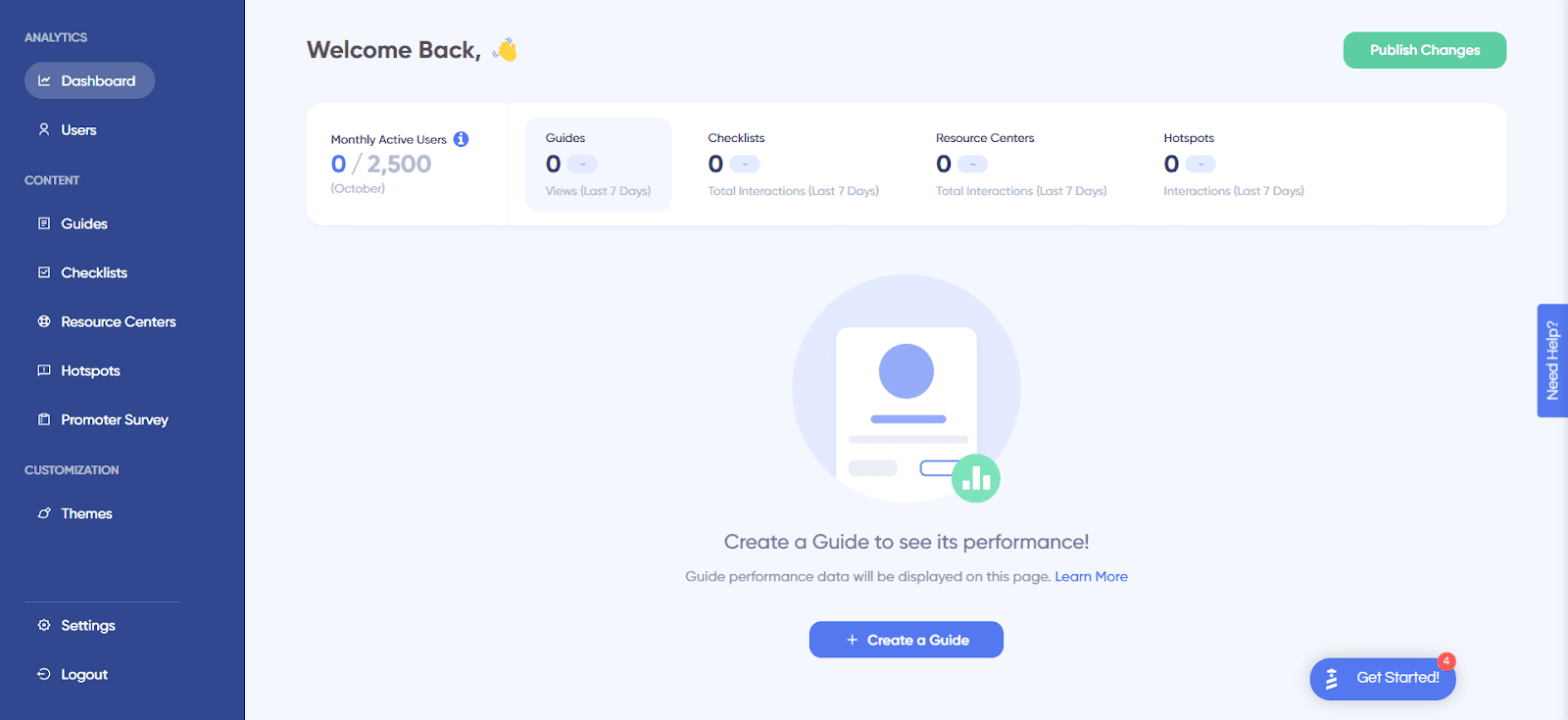
UserGuiding is a no-code product adoption platform designed to help SaaS companies build in-app experiences like onboarding flows, interactive guides, and resource centers. It’s widely favored by small and mid-sized SaaS teams for its simplicity and ease of setup.
Core Features
Onboarding and Guides
- Drag-and-drop builder for interactive walkthroughs, modals, tooltips, and banners.
- Gamified checklists with goal tracking and segmentation triggers.
Self-Service Support
- In-app knowledge base, resource center, and product updates hub for user self-help.
Feedback and Analytics
- Built-in NPS surveys and step-level analytics.
- Basic performance insights with limited event tracking.
- A/B testing only available on Growth plans and above.
Segmentation and Customization
- User targeting based on attributes and manual logic.
- Personalization options, with localization support available on higher tiers.
Integrations and Security
- Integrates with popular tools like HubSpot, Mixpanel, Segment, and Salesforce.
- Enterprise features include SSO, EU data hosting, SOC 2 compliance, and audit logs.
Strengths of UserGuiding
- Quick and easy implementation with minimal technical effort.
- Affordable entry-level pricing for smaller SaaS teams.
- Responsive support and a user-friendly interface.
- Effective for onboarding and activation through guided tours and gamified checklists.
Where UserGuiding Falls Short
- Limited beyond onboarding: lacks advanced tools for post-activation engagement and retention.
- Basic analytics: no event-based tracking or deep behavioral insights.
- Manual localization: language versions require separate setups.
- Pricing escalations: higher tiers see significant cost jumps.
Pricing:
UserGuiding’s pricing plans are based on the number of active users you have. When billed yearly:
- Starter Plan: Starting from $174/month.
- Growth Plan: Starting from $349/month.
- Enterprise Plan: Custom quote
PLG OS: The All-in-One Platform for Product-Led Growth
What is PLG OS?
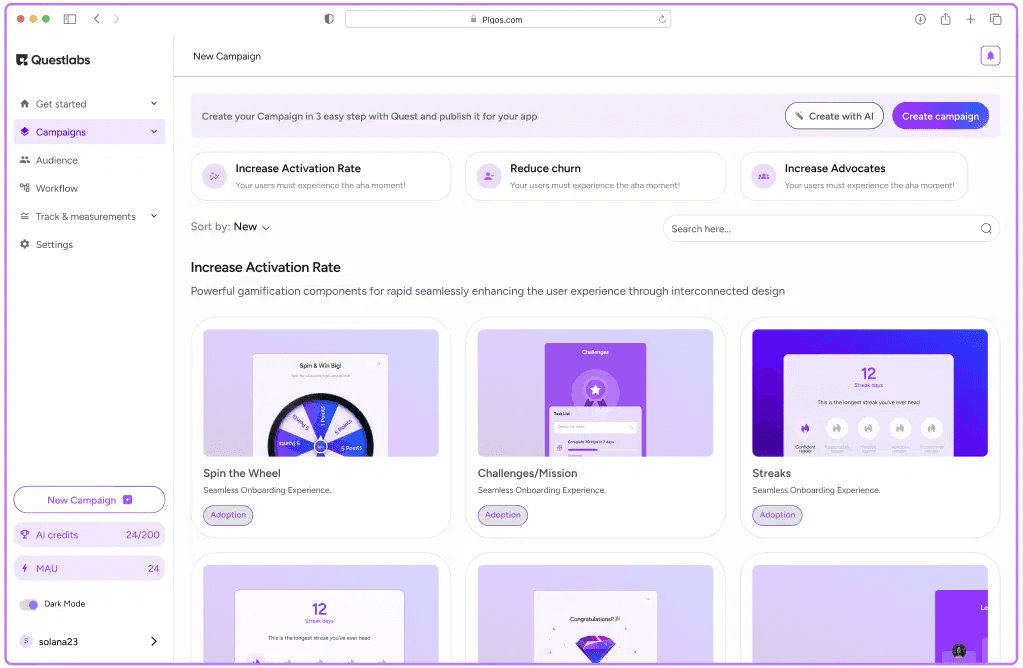
PLG OS is a next-generation product-led growth platform designed for more than just onboarding. It combines product adoption tools, AI-driven feedback, gamification, and engagement features into a single platform, helping SaaS businesses manage the entire customer lifecycle—from activation to retention and expansion. SaaS companies using product adoption tools like UserGuiding or PLG OS see a 15–25% reduction in churn.
Core Features of PLG OS
Onboarding and Activation
- Pre-built onboarding templates and customizable user journey flows.
- Funnels aligned with product activation milestones like Time-to-Value and feature adoption.
Feedback and Metrics
- AI-powered in-app surveys and real-time feedback flows.
- Dashboards tracking PLG metrics such as activation rates, Product Qualified Leads (PQLs), churn, and expansion revenue.
Retention and Gamification
- Engagement features like streak tracking, rewards, and loyalty triggers.
- Retention playbooks and loyalty systems to reduce churn.
Product-Led Growth Operations
- Frameworks for experimentation and alignment across product, marketing, and customer success teams.
- Playbooks for monetization and cross-team growth strategies.
Integrations and Deployment
- Fast SDK integration (under 30 seconds) for minimal developer involvement.
- Data and analytics integrations with tools like Mixpanel and Amplitude.
Support and Scalability
- Highly responsive support team, designed for lean SaaS teams.
- Features and roadmap actively updated based on user feedback.
What Sets PLG OS Apart
- Ultra-fast deployment with SDK integration and setup in under 30 seconds.
- AI-powered feedback tools and pre-built in-app surveys for capturing user insights instantly.
- Dynamic user flows covering onboarding, engagement, loyalty programs, and retention strategies.
- Gamification and loyalty features like streaks, badges, and rewards to drive long-term engagement.
- Deep analytics integrations for tracking user behavior and optimizing experiences.
- All-in-one PLG tool for SaaS, eliminating the need to juggle multiple platforms.
Strengths of PLG OS
- Full-lifecycle adoption capabilities, not just onboarding.
- AI-assisted features for feedback and flow creation.
- Real-time analytics and behavioral segmentation.
- Gamified engagement tools to keep users active and loyal.
- Highly praised for intuitive design and customer support.
Pricing:
- Free Plan: $0 per month
- Starter Plan: $49 per month
- Growth Plan: $149 per month
- Scale Plan: Custom pricing
UserGuiding vs PLG OS: A Side-by-Side Comparison
| Feature / Need | UserGuiding | PLG OS |
|---|---|---|
| Setup & No-Code | Simple Chrome extension | Fast SDK integration (~30 seconds) |
| Onboarding Flows & Checklists | Strong, beginner-friendly | Dynamic, AI-enhanced, and highly customizable |
| Post-Onboarding Engagement | Limited | Comprehensive journey-wide engagement tools |
| Feedback & Surveys | Basic NPS and forms | AI-powered, real-time feedback collection |
| Gamification & Loyalty | Minimal (checklists only) | Full suite: streaks, badges, rewards |
| User Segmentation | Manual segmentation | Advanced, behavior-driven segmentation |
| Analytics & Tracking | Basic built-in analytics | Rich insights with external integrations |
| Localization Support | Manual, counts per guide | AI-assisted localization (on roadmap) |
| Pricing | Affordable entry-level; steep scaling | Competitive for full-stack adoption solutions |
| Ideal Audience | Early-stage SaaS focused on onboarding | Growth-focused SaaS needing full lifecycle tools |
Which Tool Should You Choose?
When to Choose UserGuiding
- You’re a small or early-stage SaaS company with a limited budget.
- You need a simple, fast-to-implement onboarding solution.
- You don’t need advanced analytics or retention tools yet.
- Your primary goal is to guide users through initial activation.
When to Choose PLG OS
- You want a comprehensive solution covering onboarding, engagement, retention, and expansion.
- You’re a growth-oriented SaaS team focusing on product-led strategies.
- You need AI-driven feedback and gamification to boost user loyalty.
- You prefer a single platform that integrates analytics, feedback, and adoption tools.
Best Use Cases for PLG OS
1. End-to-End Product-Led Growth (PLG) Enablement
PLG OS is designed to help SaaS companies build and execute entire PLG strategies from first-touch activation to expansion. 90% of growing SaaS businesses use dedicated PLG tools by the time they hit 5,000 Monthly Active Users.
- Why it fits: Combines onboarding, engagement, feedback, and retention features in one system.
- Who benefits: SaaS companies shifting from sales-led to product-led growth models.
2. Streamlined SaaS Onboarding and Activation
While tools like UserGuiding focus on onboarding, PLG OS integrates onboarding flows with behavioral triggers, analytics, and post-onboarding engagement.
- Why it fits: Helps shorten Time-to-Value (TTV) while ensuring users don’t drop off after initial activation.
- Who benefits: B2B SaaS and freemium products aiming to increase conversion rates from free to paid.
3. Behavioral Segmentation and Targeted Experiences
PLG OS lets you segment users dynamically based on in-app behavior, events, and lifecycle stage, triggering the right flows at the right time.
- Why it fits: Improves personalization and user satisfaction while nudging upgrades.
- Who benefits: Growth teams seeking data-driven upsell and engagement strategies.
4. Gamification and Loyalty Programs
With built-in streaks, badges, rewards, and loyalty triggers, PLG OS goes beyond onboarding to keep users engaged over time.
- Why it fits: Improves retention by creating motivation loops that keep users coming back.
- Who benefits: Freemium or subscription-based SaaS platforms looking to boost engagement and reduce churn.
5. AI-Powered User Feedback and Iteration
PLG OS uses AI-assisted surveys and templates to quickly capture user feedback at key journey points.
- Why it fits: Shortens the feedback loop and allows teams to iterate product experiences faster.
- Who benefits: Product teams that want to test, learn, and optimize without heavy manual survey design.
6. Retention and Expansion Playbooks
Beyond activation, PLG OS provides retention-focused playbooks and templates for driving upsells, renewals, and expansion.
- Why it fits: Reduces churn and supports predictable revenue growth by systematically engaging users.
- Who benefits: SaaS teams with established user bases wanting to maximize lifetime value (LTV).
7. Team Alignment Across Product, Marketing, and Customer Success
As the name suggests, PLG OS isn’t just a toolset—it offers operational frameworks (playbooks, templates, and PLG metric dashboards) to keep cross-functional teams aligned.
- Why it fits: Reduces silos and helps teams collaborate on growth experiments.
- Who benefits: Startups and mid-market SaaS firms scaling up, where product, marketing, and CS teams need shared growth KPIs.
8. Early-Stage SaaS Teams Needing All-in-One Efficiency
Instead of juggling multiple tools for onboarding, feedback, analytics, and retention, PLG OS consolidates them into a single platform.
- Why it fits: Reduces tool fatigue and cuts software costs for lean teams
- Who benefits: Seed- to Series B-stage startups looking for cost-effective, scalable growth infrastructure.
Final Recommendations
- Choose UserGuiding if your priority is affordable, simple onboarding and you’re not yet focused on retention or growth.
- Choose PLG OS if you want an all-in-one PLG tool for SaaS that supports your users beyond onboarding, helping you drive engagement, retention, and expansion.
In 2025, the best choice depends on where your company is on the growth curve. For early-stage startups, UserGuiding delivers quick wins. For scaling SaaS teams, PLG OS offers the comprehensive toolkit needed to sustain growth.
FAQs
1. What are product adoption tools?
Product adoption tools help SaaS companies onboard, engage, and retain users by providing in-app guidance, interactive walkthroughs, surveys, and analytics to improve user activation and retention.
2. Is UserGuiding good for SaaS onboarding?
Yes, UserGuiding is popular among small to mid-sized SaaS businesses for creating no-code onboarding flows, checklists, and tooltips quickly. It’s ideal for teams focused mainly on user activation.
3. What makes PLG OS different from UserGuiding?
While UserGuiding focuses on onboarding, PLG OS offers a full product-led growth suite—covering onboarding, feedback, gamification, retention, and analytics in a single platform.
4. How much does UserGuiding cost?
UserGuiding’s paid plans start at around $174 per month (billed annually) for 2,000 MAUs and scale up to custom enterprise pricing for large teams and advanced features.
5. Who should use PLG OS?
PLG OS is ideal for SaaS teams seeking an all-in-one solution to manage onboarding, drive engagement, and boost retention with AI-powered feedback and gamification tools.